

ROK-U.S. Nuclear Policy after the New Russia-DPRK Alliance Treaty

Dr. Taewoo Kim,
Head of Nuclear Security Study, Korea Institute for Military Affairs (KIMA)
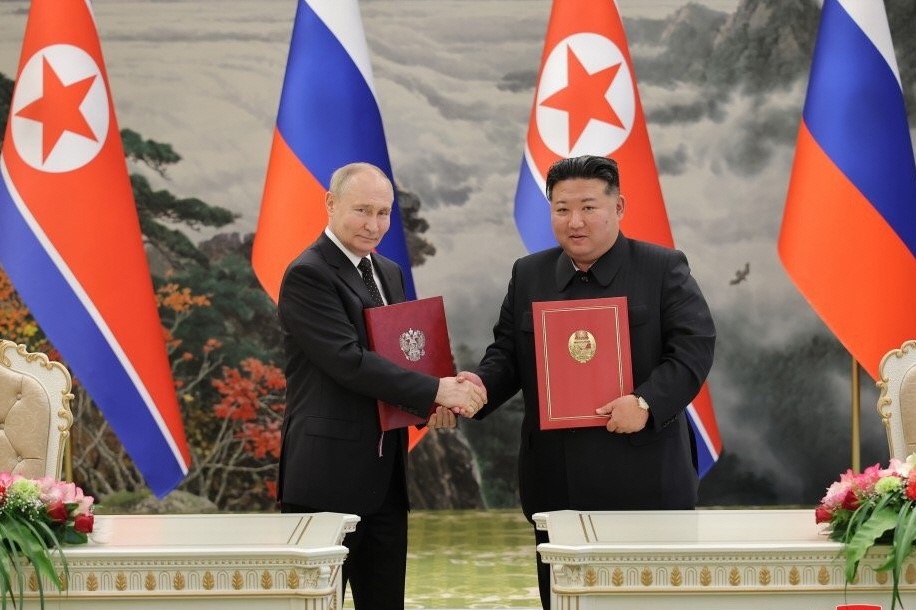
The North Korea-Russia Comprehensive Strategic Partnership Treaty signed by President Vladimir Putin and Kim Jong Un on 19 June was, as feared, a revival of an alliance. Through 23 articles, the treaty agrees on a wide range of cooperation in military, economic, technological, and other fields. The most notable part includes Article 3, which stipulates that "cooperation will be discussed without delay in the event of a threat," Article 4, which states that "if either side is in a state of war, military and other assistance will be provided without delay," Article 5, which states that "neither side will enter into agreements with third countries that violate the rights of the other side," and Articles 9, 10, and 18, which agree to cooperate in the fields of science and technology and information and communication and to jointly combat threats. In short, the North Korea-Russia treaty is a reincarnation of the 1961 DPRK-USSR Treaty which promised extensive cooperation and ‘automatic military intervention.’ Its security implications seem grave.
At the global level, Putin, who is nostalgic for the superpower Soviet Union, clarifies his intention to expand military alliances in the future. Perhaps he dreams of recreating the Warsaw Pact organization. At the Northeast Asian level, it signals a deepening strategic imbalance between the China-Russia-DPRK northern triangle and the ROK-U.S.-Japa southern triangle. While in the south, the U.S. manages the alliance by providing a nuclear umbrella while discouraging South Korea and Japan from becoming nuclear-armed, and security cooperation between South Korea and Japan is barely off the ground, the northern triangle is a nuclear alliance of the largest nuclear power and two outlaw states that are indiscriminately building up their nuclear arsenals.
At the Korean Peninsula level, the treaty signals Russia's withdrawal from the Security Council's sanctions against the DPRK’s nuclear weapons and its pledge to exchange military assistance with Pyongyang. In fact, since the 2017 resolution 2397, China and Russia have vetoed all sanction resolutions against North Korea. This is highly irresponsible behavior for permanent members of the Security Council, but that is the UN impotence brought about by the neo-Cold War. South Korea should keep in mind that Russian technological assistance will quickly strengthen the North’s nuclear prowess. The North Korea-Russia treaty is a reminder of two huge nuclear challenges for the ROK-U.S. alliance.
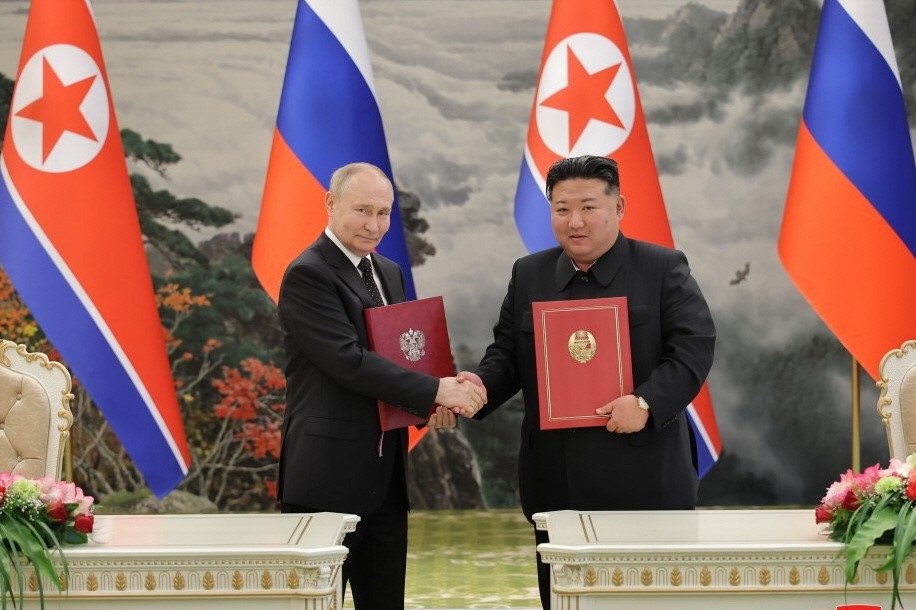
Russian President Vladimir Putin (left) and North Korean leader Kim Jong-un pose after signing a musual defense pact
in Pyongyang, North Korea, on the 19th. / Korean Central News Agency
First, the U.S. and South Korea should no longer be under the illusion that they can persuade Russia and China to take the lead in North Korea's nuclear abandonment. The treaty is an ample reaffirmation that the South Korean and US governments have been under that delusion for decades. Of course, there are some analyses both in Seoul and Washington that downplay the situation by arguing that "China is uncomfortable with DPRK-Russia military ties," or that "once the war in Ukraine is over, the North Korea-Russia honeymoon will end." But these analyses are misreading the larger trends of the New Cold War by getting mired in fringe and marginal phenomena. To be clear, the Sino-Russian-North Korean internal rivalry will hardly lead to the collapse of the Northern Triangle's common front against the United States. Nor will China and Russia roll up their sleeves to persuade North Korea to give up its nuclear weapons for the sake of ‘stability in the global nuclear order’ or ‘peace on the Korean peninsula.’ Nor will China stop using wolf warrior diplomacy and demanding vertical order from its neighbors for the sake of "stability in Northeast Asia.
Second, on the North Korean nuclear issue, the current stance of both Seoul and Washington, which has emphasized only 'strengthening extended deterrence', is unlikely to lead to a solution, while the United States should not repeat the same old phrases, such as “we oppose the nuclearization of South Korea” or “we oppose redeployment of tactical nuclear weapons,” thus disregarding the rapid changes in the security environment. It is time for the two allies to work together to bring North Korea to the negotiating table through ‘inter-Korean nuclear parity’ rather than ‘nuclear asymmetry.’ The two nations should now put all options on the table, including a dramatic expansion of extended deterrence, the redeployment of US tactical nukes to the Korean Peninsula or neighboring regions, and South Korea's own nuclear arsenal.
Moreover, the North Korea-Russia treaty presents South Korea with the additional challenge of ‘reimagining its Russia policy.’ South Korea must lead the way in ensuring that Russia, a strong state located behind the primary threat, functions as a deterrent rather than a provocateur of war on the Korean Peninsula. Unlike in Europe, in Asia the United States may feel the need to work with Russia in some areas to contain its primary threat, China, and it is in its strategic interest to deter war on the Korean Peninsula. South Korea should capitalize on this and find its own space for diplomacy toward Russia. Of course, this should be done within the framework of an "alliance-centered" foreign policy.
-
PREV [Defectors' Podium]
-
NEXT [Feature Article]