


The United Nations Command:
Its Role in the Korean Armistice and Peace Declaration
Kim Yeoul-soo
Director of Security Strategy at the Korea Institute for Military Affairs
It has been 71 years since the Korean Armistice Agreement was signed. Despite this, there is little to celebrate. We should be disappointed at our failure to achieve peaceful reunification beyond the armistice system. If North Korea had honored the agreement, reunification through peace declarations and agreements might have been possible. However, North Korea's continuous provocations and breaches have kept even minimal peace under threat. Some believe that declaring the end of the war or signing a peace agreement will bring peace to the peninsula. This article explores the relationship between the Korean Armistice Agreement, the declaration to end the war, and the peace agreement, while also reexamining the role and importance of the United Nations Command in this context.
The Korean Armistice Agreement, the Declaration of the End of the War, and the Peace Agreement
On July 27, 1953, after over two years and 159 meetings, the Korean Armistice Agreement was signed at Panmunjom. This "Agreement on the Military Armistice in Korea" was made between the United Nations Command, the Korean People's Army, and the Chinese People's Volunteers, containing five articles and 63 clauses aimed at ceasing all hostilities in Korea. The agreement established the United Nations Command Military Armistice Commission (UNCMAC) and the Neutral Nations Supervisory Commission (NNSC), which included Switzerland, Sweden, Czechoslovakia, and Poland, to ensure compliance.
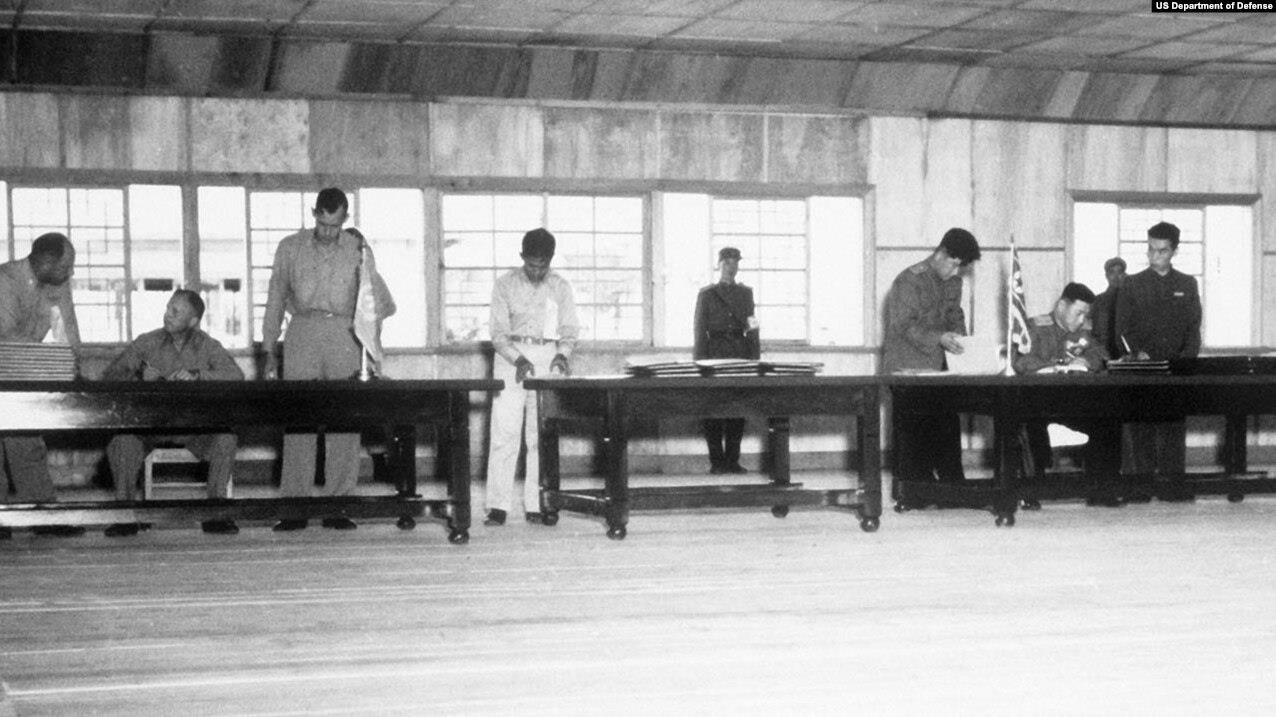
U.S. Army Lt. Gen. William Harrison (left table) and General Nam Il (right table) of the communist army
sign the Korean War Armistice Agreementat Panmunjom, July 27, 1953./VOA
Over the past 71 years, North Korea violated the Korean Armistice Agreement around 430,000 times in efforts to undermine it. In April 1993, North Korea withdrew from the UNCMAC and later withdrew the Czechoslovak representatives after the country's division. In 1994, North Korea created the "Korean People's Army Panmunjom Representative Office" in Kaesong and removed Chinese representatives from the UNCMAC, believing these steps would lead to a peace agreement with the United States.
Since 2007, North Korea has been pushing for a peace agreement involving either three parties (South Korea–North Korea–the U.S.) or four parties (South Korea–North Korea–the U.S.–China). Initially, North Korea aimed to sideline South Korea and sign a peace agreement directly with the U.S. When this didn't happen, they shifted to demanding a three-party or four-party agreement. The 2018 Panmunjom Declaration stated, "We will actively promote three-party or four-party meetings of South Korea–North Korea–the U.S., or South Korea–North Korea–the U.S.– China, to declare the end of the war and convert the Korean Armistice Agreement into a peace agreement this year." During the North Korea-U.S. summit in Singapore in 2018, a joint statement was issued declaring, "The two countries will work together to build a lasting and stable peace regime on the Korean Peninsula."
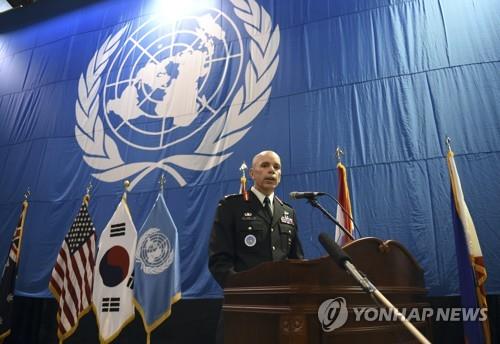
Deputy Commander of the United Nations Command Wayne Eyre speaks about the declaration of
the end of the war and the role of the United Nations Command during a seminar
at the Carnegie Endowment for International Peace in Washington, DC, U.S., Oct. 5, 2018./Yonhap News
Declaring the end of the war by multiple parties was expected to lead to a peace agreement. However, six years later, this declaration still hasn't been made. An armistice is a military act to stop hostilities, while ending the war is a political act to conclude the conflict. North Korea's military actions, like nuclear tests, continue to threaten regional peace. Simply declaring the end of the war without addressing these threats will not bring peace.
A peace agreement is more than just declaring the end of the war; it is a written commitment to mutual recognition and cooperation between the Koreas. Although these declarations and agreements are necessary for future peace, they are ineffective without adherence to the armistice. Hastily signed accords, like the Paris Peace Accords, led to adverse outcomes. South and North Korea have already signed agreements akin to a peace agreement, such as the Inter-Korean Basic Agreement and the Joint Declaration on Denuclearization.
These agreements have not brought peace to the Korean Peninsula, and North Korea is advancing towards nuclear armament. Maintaining the armistice system is essential before discussing a lasting peace regime. Without adhering to existing agreements, declarations and peace agreements are merely symbolic. North Korea's pursuit of these agreements aims to dissolve the UNC and the ROK-US Combined Forces Command, ultimately leading to the withdrawal of U.S. forces from Korea.
Establishment, Evolution, and Mission of the UNC
When North Korea invaded, the United States immediately called for an urgent United Nations Security Council (UNSC) meeting. The UNSC quickly adopted Resolution 82, demanding an end to hostilities and North Korea's withdrawal. Subsequently, Resolution 83 recommended that UN member states provide necessary assistance to repel the attack and restore peace. Resolution 84 established a unified command under the U.S., authorized the use of the UN flag, and appointed General Douglas MacArthur as the Commander-in-Chief of the United Nations Command (UNC).
General MacArthur set up the UNC in Tokyo, combining Far East Command staff with the new UNC staff. This allowed UN member states to join the Korean War effort. Sixteen countries sent combat troops, five sent medical units, and 39 provided material support. This was the first time collective security under Chapter VII, Article 42 of the UN Charter was implemented on the Korean Peninsula. By signing the Korean Armistice Agreement, the UNC became a key player in the armistice system.
In 1957, the UNC moved from Tokyo to Seoul, taking on the role of defender and armistice manager on the Korean Peninsula. However, with the establishment of the ROK-US Combined Forces Command (CFC) in 1978, the UNC transferred its defense duties to the CFC. Currently, the UNC maintains a supportive and cooperative relationship with the ROK-US CFC. It oversees seven UNC rear bases in Japan (four on the mainland and three in Okinawa), exercises operational control over the Joint Security Area (JSA) and honor guard, monitors the implementation of the Korean Armistice Agreement, and supports the ROK-US CFC by integrating and accommodating forces from UNC member states.
The UNC is made up of 17 sending states that provide military forces. This includes 14 of the 16 countries that sent combat troops and three of the five that sent medical units. With Germany joining as a sending state this year, the total number of UNC member states will increase to 18.
When the armistice was signed, representatives of 16 countries pledged to rejoin the conflict if it resumed, known as the "Joint Policy Declaration Concerning the Korean Armistice." UNC member states still uphold this commitment, affirming their readiness to support South Korea in an emergency.
To mark the 70th anniversary of the armistice in 2023, South Korea hosted a meeting of defense ministers from South Korea and UNC member states, reaffirming the "Washington Declaration" of 1953. A joint statement was adopted, pledging collective response to any threats against South Korea's security.
UNC and South Korea’s Security
Prioritizing the management of the armistice system is crucial, with the United Nations Command (UNC) at its core, over declarations or peace agreements. The UNC not only oversees the armistice but also integrates forces from member states to support the ROK-US Combined Forces Command (CFC) in emergencies. Given today's security climate, expecting a new Security Council resolution in case of renewed conflict is unrealistic. UNC rear bases act as crucial hubs for deploying forces to the Korean Peninsula, providing significant strategic value. The current UNC system must be maintained until stable peace is achieved.
Given Kim Jong-un's ambitions to unify Korea by force, the UNC's role is critical. The UNC not only ensures peace on the peninsula but also contributes to regional stability. South Korea should recognize the UNC as vital to its security and strengthen ties with member states, developing the UNC into a multilateral consultative body for both military and diplomatic efforts.
-
PREV [Issue Brief]
-
NEXT [North Korea in History]