


North Korea 30 Years After Kim Il-sung's Death: Past, Present, and Future (2)
The Korean War Justified by National Unification

Kang In-deok
Former Minister of Unification of the Republic of Korea
In February 1948, the United Nations held a general assembly with the objective of unifying Korea and ending its division. They decided to send the 'United Nations Temporary Commission on Korea' to oversee free and democratic elections in areas where it was feasible.
However, on April 28, Kim Il-sung's faction convened the Supreme People's Assembly of North Korea and decided to establish the Democratic People's Republic of Korea in response to the formation of the Republic of Korea. Kim Il-sung was appointed as the first Premier. He announced the People's Republic's eight-point program, with the first point being the "reunification of the country by breaking the 38th parallel and annexing South Korea."
In February 1949, Kim Il-sung led a significant government delegation to Moscow. On March 5, they engaged in talks with Joseph Stalin and, two days later, signed both the 'Soviet-North Korean Economic and Cultural Agreement' and a secret military agreement.

North Korea's Kim Il-sung visited Moscow from March 30 to April 25, 1950, meeting with Joseph Stalin.
On April 10, Stalin approved Kim Il-sung's invasion plan. / Public Domain
As per this agreement, the Soviet Union provided $212 million in economic aid and various military supplies, including 240 tanks, to equip the 200,000-strong North Korean People's Army. By October, diplomatic relations were established with the newly formed People's Republic of China. An agreement was also reached to transfer 29,500 Korean-Chinese soldiers from the 166th and 164th divisions, who had combat experience in China's civil war, to North Korea. These soldiers were integrated into two divisions tasked with attacking Seoul before Kim Il-sung's planned invasion.
On June 25, 1950, North Korea launched an invasion at dawn, following a strategy devised by 3,000 Soviet military advisors. This invasion led to a catastrophic war that lasted three years, resulting in the deaths of 147,000 South Korean soldiers, 34,000 American soldiers, and 14,000 other UN soldiers (including those missing). Additionally, 520,000 North Korean soldiers and 184,000 Chinese soldiers perished. The war left 2 million military personnel injured, over a million innocent civilians dead, 3.7 million people displaced, 300,000 widows, 100,000 orphans, and 10 million separated families.
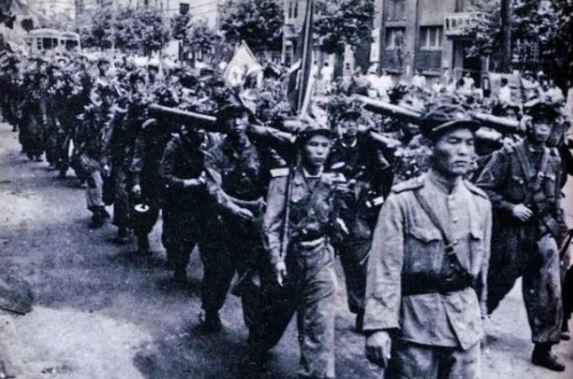
On June 28, 1950, North Korean infantry followed the 105th Armored Division into downtown Seoul. / History Net
During this national catastrophe, I must highlight Joseph Stalin's role. Despite the immense suffering of soldiers and civilians, Stalin pursued his own sinister goals. By the fall of 1951, about a year after the war began, there were signs that the Chinese and UN forces were open to negotiating an armistice.
It was evident that continuing the war offered no benefit to the involved parties. However, Stalin, who had instigated the conflict, insisted on prolonging the war until his death.
He believed that the weakening of the United States, China, and both Korean governments would benefit the Soviet Union's pursuit of global dominance. Consequently, the opportunity to end the war sooner was missed, and the armistice was finally signed on July 27, 1953, four months after Stalin's death on March 5, 1953.
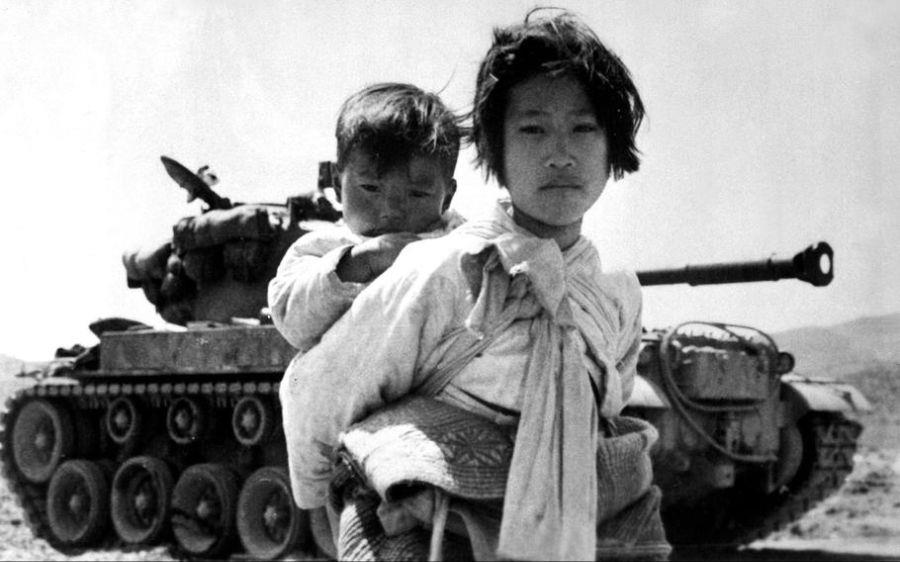
On June 9, 1951, a tired girl carrying her sibling passes in front of an M-26 tank near Haengju in Goyang.
/ National Archives and Records Administration (NARA)
We should recognize how Joseph Stalin's imperialist ambitions and Russia's longstanding desire for territorial expansion, especially towards the Pacific, have persisted since the “Tsarist” era and continue to influence their actions today.
-
PREV [Feature Article]
-
NEXT [Feature Article Series]