

Marketing In North Korea (5)
- Dental care as clean as a white crane

Jeon Byung-kil
Senior Consultant of YESInnovation
former of Secretary General of UniKorea Foundation
Dental Care for North Koreans
Dental health has a lot to do with our body. In order to be healthy, it need to eat well and well balanced. If teeth or gums hurt, it's hard to eat well. A malnourished body is more susceptible to illness, and passing food without chewing it properly can lead to indigestion. That's why most countries teach oral health education from a young age.
According to a 2016 survey by the Korea Institute of Health and Social Affairs, the percentage of North Korean refugees entering South Korea with missing teeth is 35.1%. That's 1 in 3. More than 70% of North Korean defectors were younger than 40 years old when they entered South Korea. Given this, the dental health of North Koreans, especially the elderly, is likely to be worse.
The percentage of South Koreans under 40 who have lost some teeth and have prosthetics is 8.4%. North Korean refugees often lack access to proper dental care due to poor healthcare, and when pain becomes too much, they often resort to tooth extraction. In addition, when staying in a third country such as China, they did not take proper oral care such as brushing teeth.
It wasn't until around 2017 that North Korean authorities began to improve the quality of dental supplies and talk about the importance of oral care through media outlets. The August 20, 2017, edition of North Korea's Rodong Sinmun also featured oral hygiene tips, including brushing teeth, cleaning between teeth, and gargling.
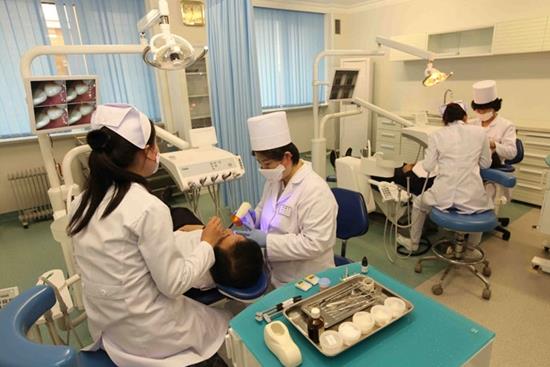
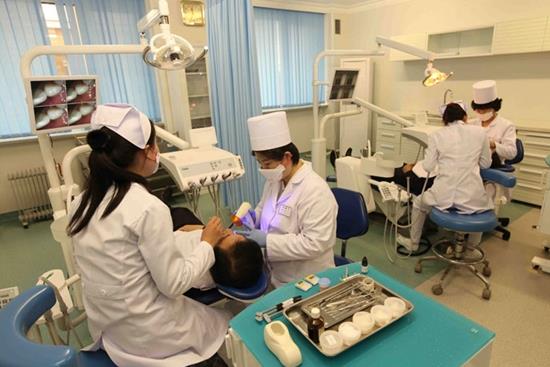
North Korea's Ryugyong Dental Hospital succeeded in localizing the implant in February 2016,
according to North Korea's propaganda media. Pictured is the treatment room at Ryugyong Dental Hospital./Chosun's Today
In February 2021, researchers from Pyongyang Dental Hygiene Supplies Factory appeared on North Korea's KC TV to talk about the importance of dental health care, introducing toothpaste, toothbrushes, mouthwash, and more. Previously, North Korean media rarely reported on dental care.
Baikhak, Dental health brand
Founded in 2017, Pyongyang Dental Hygiene Supplies Factory began producing toothpaste and other dental hygiene products. It is the first factory in North Korea to produce various dental hygiene products. Products produced by the Pyongyang Dental Hygiene Supplies Factory are branded Baikhak, which means white crane. The brand Baikhak is also the trademarked name of a toothpaste produced by Sinuiju Cosmetics Factory. Baikhak became a household name in North Korea as a toothpaste brand, and the toothpaste soon gained credibility as a Baikhak product.
North Korean authorities also gave the name Baikhak to products produced by the Pyongyang Dental Hygiene Supplies Factory. The brand image of 'Baikhak' in the minds of North Koreans has been carried over to the new products produced in the new factory. The Baikhak brand was also registered as a trademark with the World Intellectual Property Organization (WIPO) in October 2017.
It is not known if there was any consultation with Sinuiju Cosmetics Factory, the original producer of Baikhak toothpaste, in this process. Baikhak toothpaste was a well-known brand throughout North Korea, but it was overshadowed by Sinuiju Cosmetics Factory's flagship product, Pomhyanggi cosmetics. The quality of the product wasn't bad, but it wasn't as good as toothpaste made in South Korea or China.
Pyongyang Dental Hygiene Supplies Factory has formed a wide range of dental hygiene products under the Baikhak brand. The dental hygiene supplies are categorized into chemical dental hygiene supplies and mechanical dental hygiene supplies. Chemical dental hygiene products include products like toothpaste and mouthwash. Toothpastes are categorized into functional toothpastes (removes plaque, whitens, prevents tartar, protects the mouth, etc.) and therapeutic toothpastes (treats inflammation, eliminates bad breath, etc.).
In 2020, 12 toothpastes under the Baikhak brand, including fluoride toothpaste, salt toothpaste, ginseng toothpaste, yellow pine toothpaste, and children's toothpaste (strawberry flavor and mint flavor), were registered as "February 2 products" (North Korea's excellent product certification). North Korean media have also reported that Baikhak brand products have improved their quality by innovating in the refining of peppermint oil, one of the key technologies for making toothpaste.
In 2017, it began marketing its mouthwash under the Baikhak brand. 'Mechanical dental hygiene products' are categorized as toothbrushes, dental hygiene instruments (interdental floss, tongue depilatories, etc.).
Pyongyang Dental Hygiene Supplies Factory does not produce toothbrushes, the main dental hygiene tool. For toothbrushes, the Soriggot toothbrush, produced by the Pyongyang Daily Necessities Factory, is already a widely recognized brand in North Korea. It's a puzzling strategy for North Korea's leading dental hygiene brand, Baikhak, not to produce its signature dental hygiene product, toothbrushes.
In 2002, Kim Jong Il, then North Korea's supreme leader, took a field guide to the Pyongyang Daily Necessities Factory, which produces Soriggot toothbrushes. Soriggot is a flower-like phenomenon in which the frost has various shapes, such as needles, fans, and scales. The name was reportedly given by Kim Jong Il himself. The meaning of 'Soriggot' is related to 'Soriggot of Paekdu', a metaphorical expression praising the achievements of Kim Jong Il at the time.
The market makes sense to produce a quality, competitive toothbrush that is the consumer's choice. However, emphasizing the three generations of Kim Il Sung's family's orthodoxy is a taboo in North Korea, as it requires the brand to compete with the legacy of its ancestors.
So it looks like Baikhak is producing other dental hygiene products besides toothbrushes. They even produce denture cleaning brushes, tongue plaque removal brushes, and more under the Baikhak brand, but not the most popular toothbrush.
Diversity of consumer choice and product innovation
In addition to Baikhak, there are several other toothpaste brands in North Korea. One of the most popular is the Malgnachim brand of toothpaste. Malgnachim sells a number of functional toothpastes, including nano toothpaste. 'Malgnachim' means Crystal-claer morning.
The 'Malgnachim' brand was launched by Taeyang Technology Joint Venture Company. The company is a trading company established for the purpose of exporting overseas. The "Malgnachim" toothpaste doesn't describe the factory where it was produced. However, the brand has appeared consistently in North Korean media since 2015. In 2024, Malgnachim was registered as a trademark with the World Intellectual Property Organization (WIPO).
However, there are no media reports of Kim Jong-un's field guides to the factories that produce these brands, or of the expansion of research and production facilities. It is mainly a product introduction to the Malgnachim brand products. This is a departure from previous North Korean media reports, which often politicize products at the production site.
'Malgnachim' does not have its own research and production facilities and appears to be using North Korea's existing cosmetics factories, chemical plants, and laboratories to produce its products on an Original Equipment Manufacturer (OEM) basis.
In addition, several trading companies produce and sell toothpaste, such as the Malgnachim brand, for export and domestic self-reliance.
But what about the quality of toothpaste made in North Korea? North Korean media reports that the quality of the products has improved due to state-of-the-art facilities and technological innovation. However, those who have tried North Korean toothpaste say it is better than in the past, but still not as good as products from South Korea and other industrialized countries. There are videos on YouTube of people using North Korean toothpaste and giving their honest impressions of it.
In addition to a wider variety of toothpastes being produced in North Korea than ever before, the number of people who have tried South Korean and Chinese toothpastes through the market has increased. In other words, North Korean consumers have more experience with toothpaste and more options for purchase. Toothpaste is one of the hottest deals on the market.
Improved quality and widespread availability of toothpaste, toothbrushes, and other dental hygiene products means better dental health for the population. South Korea developed domestic toothbrushes and toothpaste in the 1950s and campaigned for dental health care in the 1960s and beyond as the economy grew.
Government and business have come together to raise awareness about dental health. This shift in consciousness has led to the active production and consumption of dental hygiene products. Currently, the quality of dental hygiene products in South Korea and the level of dental care among Koreans is on par with developed countries. This is a good example for North Korean authorities to benchmark. It's also the way forward for North Korea's dental health brand Baikhak.
-
PREV [North Korea in History]
-
NEXT [Feature Article]