

ROK-US-Japan Trilateral Camp David, One Year After:
Milestones and Prospects

Bee Yun JO
Associate Research Fellow, Korea Institute for Defense Analyses
Milestones since the Camp David Summit
With first-ever stand-alone trilateral summit at Camp David last year in August 2023, the leaders of the Republic of Korea(ROK), US, and Japan agreed to embark on a new era of trilateral partnership. Coming down to three set of documents – a comprehensive joint statement(“The Spirit of Camp David,), Camp David Principles, and Commitment to Consult – the three countries committed to increase and regularize their consultations between their leaders and high-level diplomatic, economic, and security officials; resume and expand their joint military exercises; and also venture into new areas such as real-time information-sharing of missile warning data on North Korea; and collaborating in areas of economic security, emerging technologies, and global supply chains.
As we reach a year-end since Camp David, key accomplishments and progress are visible on multiple fronts. In the areas of consultation, to name few, a first-ever permanent secretariat is in the making. Holding trilateral defense ministerial meeting in Japan for the first time in history on July 28, 2024, the three defense leaders came down to signing the Memorandum of Cooperation on the Trilateral Security Cooperation Framework(TSCF). As stated, TSCF will institutionalize trilateral security cooperation among defense authorities, including senior-level policy consultations, information sharing, trilateral exercises, and defense exchange cooperation. US Deputy Secretary of State Kurt Campbell stated previously during press meeting on May 31, 2024, that the three countries have committed “to forming some sort of coordinating body, a secretariat of some kind." TCSF is a milestone to a permanent consultation and coordinating mechanism of the three countries.
Trilateral defense exercises are another area with tangible developments. As agreed by three leaders at Camp David to hold multi-domain trilateral defense exercises on a regular basis, the three countries successfully launched Freedom Edge, this summer, as well as a trilateral tabletop exercise. Most notable development is that the three-day Freedom Edge brought together air, maritime, underwater, and cyber exercises for the first time. While the three countries have had exercises combining maritime and air, this was the first trilateral multi-domain exercise. It was also the first trilateral cyber exercise. Another visible progress is the location of the exercise. Convened in international waters south of ROK’s island of Jeju, three countries were able to hold exercise in real-time environment. While culminating historical and territorial disputes between ROK and Japan during previous administration have prevented military exercises adjacent to the waters of ROK and Japan, Freedom Edge symbolizes the depth of ROK-Japan rapprochement.

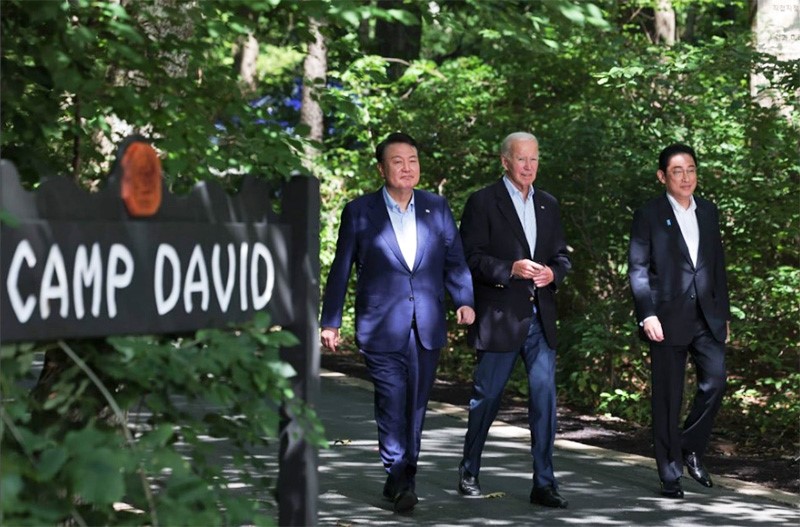
Presidents Yoon, Biden, and Prime Minister Kishida meet for a photo before the trilateral summit at Camp David,
Maryland, on August 18 last year (Photo by Newsis).
In the areas of real-time information sharing, the three countries walked through several tests to coordinate and verify DPRK warning data sharing mechanism since the Camp David summit. And on December 19, 2023, the three countries finally announced that they have now fully activated the system to share real-time information on North Korea’s missile launches. They also agreed to jointly establish multi-year trilateral exercise plan on this front. As North Korea and Russia’s closer military ties further spur momentum to trilateral security cooperation, the three countries are also looking into how the three countries can more effectively, promptly, and coherently respond to North Korea’s nuclear and missile threats based on the real-time data sharing.
Ways Forward
Given the prospects of leadership changes in Washington and Tokyo, institutionalization appears to be one of the most pressing matter for trilateral security cooperation at this moment. While value of permanent body or secretariat may be questioned given how the presence of Trilateral Cooperation Secretariat(TCS) was not able to sustain regular talks and meetings of ROK, Japan, and China when relations turned rough, we have to distinguish how ROK-US-Japan have robust history of cooperation and clearer alignment on threats from North Korea. We have to also note the developments between Russia and North Korea since their signing of Comprehensive Strategic Parternership Agreement in June 2024. ROK-US-Japan trilateral body comes as the time is ripe. Once established, it will faciliate trilateral cooperation on multiple fronts and help to endure future period of difficulties. We can also anticipate the trilateral body to become interconnecting hub of other minilateral and multilateral frameworks in the region.
In the areas of real-time information sharing, the three countries should also seek to expand their intelligence sharing to multiple domains such as maritime. By strengthening cooperation on maritime intelligence, surveillance, and reconnaissance for instance, the three countries will be able to enhance collective maritime domain awareness and intelligence sharing. Moreover, with trilateral exercises convening in adjacent waters, the three countries should focus on enhancing trilateral contingency planning including evacuation of civilians. Against possible scenarios of regional contingency, the three countries should use the momentum to enhance trilateral contingency planning, logistics, and interoperability.
Another prospective area of cooperation is extended deterrence. In the backdrop of North Korea and Russia's increasing military ties, ROK-US-Japan trilateral discussions on extended deterrence may induce new measures that can prepare and enhance clarity and credibility of US's security commitments in the region. For ROK and Japan, it will be also strategic means to prepare for any uncertainties that may arise from leadership change in Washington.
Last but not least, continued efforts on ROK-Japan relations are also important. Behind trilateral efforts since Camp David, bilateral rapprochement between ROK and Japan have been critical. With upcoming leadership change in the US and Japan, President Yoon has to play key role in maintaining and transposing Camp David Spirit and Principles with new leaders of the two countries. ROK and Japan will reach their 60th anniversary in 2025 since two countries’ normalization of diplomatic relations. As the Yoon administration explores new joint statement with Japan, 2025 will be imperative for both ROK-Japan and ROK-US-Japan relations.
-
PREV [Feature Article Series]
-
NEXT [Issue Brief]