


Sado Gold Mine Listed as a World Heritage Site: Issues and Challenges

Suk Ju-hee
Northeast Asian History Foundation
On July 27, 2024, the 46th UNESCO World Heritage Committee (WHC) officially designated Japan's Sado Gold Mine as a World Cultural Heritage site. Located on Sado Island, 45 kilometers west of Niigata City, the Sado Gold Mine has been a site of gold extraction since the 12th century, yielding a total of 78 tons of gold and over 2,330 tons of silver. Mining activities at the Sado Gold Mine began in 1601 and continued for nearly 400 years until operations ceased in 1989.
The Aikawa gold and silver mining area, which includes the Sado Gold Mine, spans a total of 400 kilometers. Some portions of this area have been opened to the public as historical sites and tourist attractions. Visitors can explore two types of tunnels: the Sodayu Tunnel, which shows mining techniques from the Edo period (1603–1867), and the Doyu Tunnel, which reflects the methods used during the Meiji era (1868–1912). The contrasting tunnel designs visually demonstrate the evolution of mining technology and practices at the Sado Mine, including vertical shafts and ore dressing facilities. However, the presence of Korean laborers is not easily noticeable unless one looks carefully.
Three Issues Surrounding Sado Gold Mine as a World Heritage Site
The designation of the Sado Gold Mine as a World Heritage site has sparked three major issues related to Korean laborers: the question of "coercion," the role of the Aikawa History Museum, and the organization of memorial services. The most controversial of these issues is "coercion." Although some exhibits and facilities acknowledge the harsh conditions that Korean laborers faced, they do not explicitly mention the forced nature of their work. The Aikawa History Museum's displays note that Korean laborers were often assigned to more dangerous tasks than their Japanese counterparts, but the specific term "coercion" is not used. Korean media has widely criticized the omission of terms like "forced mobilization" at the Sado Gold Mine heritage site and related facilities.
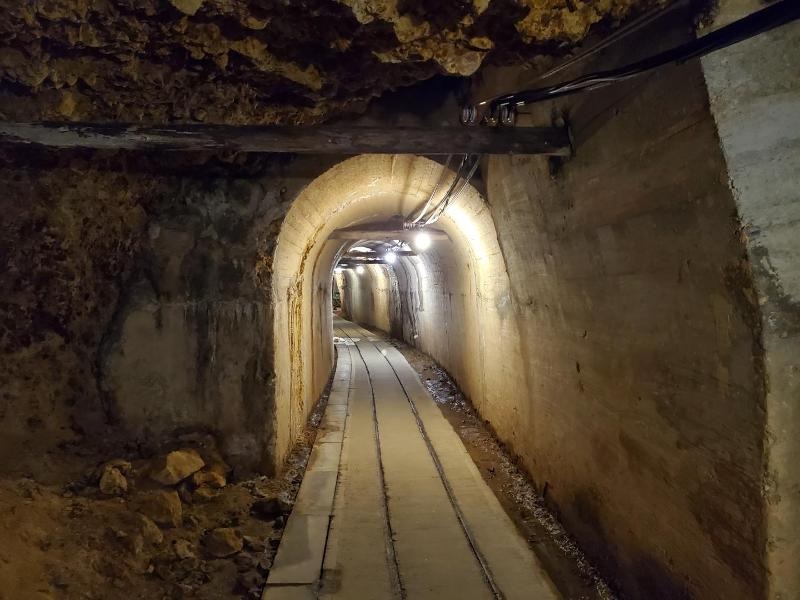
The International Council on Monuments and Sites, one of three advisory bodies to the UNESCO World Heritage Committee, has recommended that Japan reflect the full history of the mining complex on Sado, an island that once had forced laborers from Korea and other countries, and build facilities there to promote global awareness of the site's full history. Shown is an underground shaft built after the Meiji era at the Aikawa Gold and Silver Mine on the island. (Yonhap News)
In contrast, when Hashima Island (Gunkanjima) was listed as a World Heritage site in July 2015, the Japanese government admitted that Korean laborers were "mobilized against their will and forced to work under harsh conditions," committing to preserve this acknowledgment. The absence of a clear reference to "forced labor" in the context of the Sado Gold Mine keeps the debate alive.
The second issue revolves around the exhibits at the Aikawa History Museum. Alongside the World Heritage listing of the Sado Gold Mine, the Japanese government mandated the installation of facilities on-site that reflect the comprehensive history of the mine. Consequently, the third floor of the Aikawa History Museum features an exhibition dedicated to Korean laborers. Although the museum is some distance from the Sado Gold Mine, it is accessible on foot via a route that passes the sites of the third and first dormitories, former residences for Korean laborers. For those interested in tracing the history of Korean laborers, walking is the recommended approach.
This exhibition was part of a promise to depict the working conditions of Korean laborers at the Sado Gold Mine. Titled "The Life of Mine Workers Including Those from Korea," the exhibition displays documents detailing the workers' origins, their living conditions, and the harsh environments they endured. It states that Koreans were systematically mobilized by Japanese government policies and faced severe working conditions during the war. However, there is no direct mention of "coercion" or forced labor.
Third, South Korea and Japan have agreed to hold an annual memorial service for the laborers who worked at the Sado Gold Mine, with the first ceremony potentially happening as early as September. However, the "Peninsula Laborer List," which details the Korean laborers mobilized to work at the Sado Gold Mine during Japan's colonial period, has yet to be made public. This register, labeled as "Document No. 1414" in the Niigata Prefectural Archives, is vital for understanding the experiences of Korean laborers at the mine. The decision on whether to release this document is likely to become a significant point of contention between South Korea and Japan before the memorial service takes place.
Sado Gold Mine as a " Full History"
Many experts, both domestic and international, agree on the importance of presenting a "Full history" of the Sado Gold Mine. In Japan, there are efforts to develop interpretive materials, exhibits, and facilities that comprehensively reflect the entire history of the site. Takeuchi Yasuto, who recently published a collection of documents about the Sado Gold Mine and the forced labor of Koreans, stressed the significance of displaying the full historical context.
On June 6, International Council on Monuments and Sites (ICOMOS) called for a comprehensive strategy to explain and exhibit the entire history of the site, accompanied by appropriate facilities and installations. The Sado Gold Mine and its surroundings vividly reveal the site's historical evolution.
Key facilities, such as the ore concentration plant, the Kitazawa flotation plant, and the Takato warehouse, all constructed during the modern era, remain under the mine area. These structures are widely recognized within Japan as significant examples of modern heritage. The severed peak of Doyu no Warito, a prominent feature of the Sado Mine, serves as a powerful symbol of the passage of time.
Remaining Challenges after World Heritage Listing
Following its recognition as a UNESCO World Heritage site, the Sado Gold Mine now stands as a symbol representing the universal values of humanity. Cultural heritage, like a river that flows continuously, cannot be severed from history; it must preserve every moment in time. Through the remnants left by people, we can piece together the broader history of humanity. The dark and extensive tunnels of the Sado Mine, developed since the Edo period, will continue to bear witness as a World Heritage site. Along with recognizing the cultural value and historical significance of the Sado Gold Mine, it is crucial to remember the Korean laborers who endured harsh conditions as part of its legacy.
References
- Japan Tourism Agency Official Website: https://www.japan.travel/ko/spot/1426/
- Dong-A Ilbo: "Japan Should Also Acknowledge the Negative Aspects of Sado Gold Mine" (31 July, 2024)
- Dong-A Ilbo: "Memorial Service for Korean Forced Laborers at Sado Gold Mine Scheduled After August" (30 July, 2024)
- Yonhap News Agency: "Japanese Researchers Release 'Sado Gold Mine Korean Data Collection'... 'The Full History Needs to Be Revealed'" (17 July, 2024)
- KBS News, [Correspondent Report]: "Sado Gold Mine - Japan Digging Its Own Trap" (13 January, 2022)
- The Hankyoreh: "Actions South Korea Needed to Take in Response to the Sado Gold Mine Listing" (13 August, 2024)
- Asahi Shimbun: "A Heritage That Conveys Both Light and Shadow"