

Why Nuclear Armament of South Korea and Japan is Necessary
for Peace in Northeast Asia

Cheong Seong-chang,Ph.D.
Director, Center for Korean Peninsula Strategy, The Sejong Institute
On September 13, North Korea's state media revealed a high-enriched uranium (HEU) production facility during Kim Jong-un's on-site inspection, a significant escalation. While North Korea had previously shown U.S. nuclear physicist Dr. Siegfried Hecker its uranium enrichment facility in 2010, this is the first time the regime has publicly released photos of the facility.
During this visit, Kim Jong-un ordered the expansion of centrifuges and the introduction of new ones to increase the nuclear arsenal exponentially. This reflects Kim’s commitment to developing enough nuclear weapons to threaten South Korea, Japan, and even the U.S., irrespective of external developments like the U.S. presidential election.
South Korean military officials estimate that the newly revealed facility contains over 4,000 centrifuges, capable of producing 80kg of HEU annually—enough for three nuclear warheads. Additionally, North Korea could potentially produce up to 10 nuclear warheads a year using its known facilities in Yongbyon and Kangson, if they operate at full capacity.
A report titled “Enhancing Nuclear Assurance for South Korea”, released by RAND Corporation and South Korea’s Asan Institute for Policy Studies in August 2023, concluded that North Korea already has nuclear forces capable of posing a serious threat to South Korea and is close to threatening the U.S. as well. North Korea aims to use its nuclear weapons to weaken the U.S.-ROK alliance and dominate South Korea without military invasion. The report estimated that North Korea has at least 180 nuclear weapons, potentially reaching 300 by 2030. The recent revelation of North Korea’s uranium enrichment facility and Kim Jong-un's comments further support this analysis.

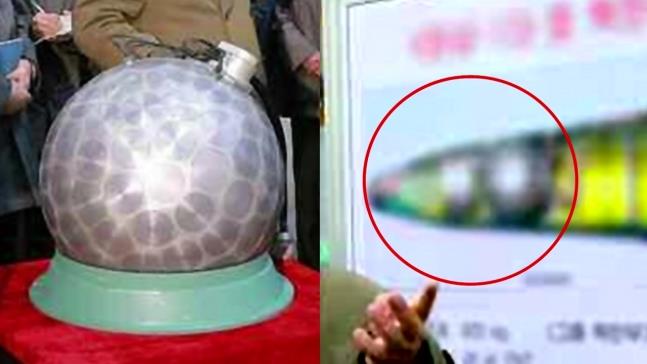
In March 2016, North Korean leader Kim Jong-un claimed that North Korea had successfully miniaturized a nuclear
warhead to fit on a ballistic missile. Pictured here is the nuclear warhead. / Korean Central News Agency
North Korea’s nuclear arsenal is not just a threat to South Korea. If war breaks out, U.S. forces stationed in Japan would inevitably be deployed to the Korean Peninsula, drawing Japan into the conflict. Without nuclear weapons, Japan could become an easy target for North Korea. However, if Japan were to possess nuclear weapons, it would make a North Korean strike much more difficult, even with Japan’s support of U.S. forces.
The possibility of China invading Taiwan cannot be dismissed. At an international conference in China in September 2023, I observed a strong desire among Chinese officials and experts to achieve unification with Taiwan. Given Xi Jinping’s aim to accomplish what Mao Zedong couldn’t—Chinese unification—there is a considerable chance he may resort to military force to secure his long-term rule. U.S. Indo-Pacific Commander John Aquilino, in a March 2024 testimony, predicted that China could gain the capability to invade Taiwan by 2027.
If Donald Trump is re-elected in the upcoming U.S. presidential election, his administration is likely to prioritize American interests over alliances. Trump has expressed skepticism about the need for the U.S. to engage in conflict with nuclear-armed China over Taiwan. His stance raises the possibility of a deal with Xi Jinping that could leave Taiwan vulnerable.
In January 2024, when questioned by Fox News about whether he would back Taiwan in the event of a Chinese military provocation, which could potentially escalate into a U.S.-China conflict, Trump made it clear that he didn’t see a need for the U.S. to intervene on Taiwan’s behalf. He also pointed out that Taiwan had taken control of 90% of the global semiconductor market, a sector once led by the U.S., further casting doubt on the necessity of defending Taiwan.
In November 2020, just two months before leaving office, Trump ordered a partial withdrawal of U.S. troops from Afghanistan and Iraq. At that time, there were 4,500 U.S. troops stationed in Afghanistan and 3,000 in Iraq. By January 15, 2021, just days before Biden’s inauguration, Trump had already pulled out 2,000 troops from Afghanistan and 500 from Iraq, resulting in the withdrawal of 44% of U.S. forces in Afghanistan and 17% in Iraq in a very short span. Despite opposition from both parties and international allies, Trump pressed ahead with these significant foreign and defense decisions right before leaving office.
The U.S. abandoned its post-Cold War strategy of fighting two simultaneous wars in 2012, replacing it with a "win-and-deter" strategy, which focuses on winning one conflict while deterring another. However, following Russia’s invasion of Ukraine in February 2022, four major global fronts have emerged: Europe, the Middle East, the Taiwan Strait, and the Korean Peninsula. The challenge is that the U.S. cannot effectively manage all four fronts at once. If a U.S.-China military clash occurs in the Taiwan Strait, and North Korea simultaneously escalates tensions with nuclear provocations on the Korean Peninsula, the U.S.'s ability to respond would be even more constrained.
As North Korea’s nuclear threat grows, South Korean public support for nuclear armament is increasing. In a May 2024 survey by the Asan Institute for Policy Studies, 70.9% of South Koreans supported independent nuclear armament, the highest level since 2011.
If Trump’s re-election leads to a reduction in U.S. forces in Korea or a cutback in joint military exercises, support for nuclear armament in South Korea will likely increase further, putting pressure on the Yoon Suk-yeol administration to seriously consider nuclear weapons. If a pro-nuclear candidate wins the 2027 or 2032 presidential election, South Korea could quickly move towards nuclear armament, possibly within the next decade.
Japan, meanwhile, has long relied on the U.S. for its defense, trusting that the U.S. would protect it in any scenario. But if an isolationist U.S. government emerges, and South Korea pursues nuclear weapons to counter North Korea, Japan may be left as the only non-nuclear state in Northeast Asia. In such a situation, Japan might have no choice but to follow suit and pursue nuclear weapons.
The most viable path for South Korea and Japan to avoid heavy international sanctions is for both countries to move towards nuclear armament simultaneously. A secondary option is for South Korea to go first, with Japan following closely behind. Either way, the U.S. and Western nations would likely avoid imposing harsh sanctions, given the economic consequences.
If both South Korea and Japan become nuclear-armed, the security landscape in Northeast Asia would change dramatically, leading to a more stable peace. A balance of power would emerge, making it difficult for any of the six regional powers—North Korea, South Korea, Japan, China, Russia, and the U.S.—to threaten one another with nuclear weapons.
Non-proliferation advocates fear that nuclear armament by South Korea and Japan would diminish U.S. influence in the region. However, failing to stop North Korea and China from expanding their nuclear capabilities while preventing U.S. allies from defending themselves would put South Korea and Japan at greater risk.
Nuclear armament by South Korea and Japan would not only weaken the ambitions of authoritarian regimes like North Korea and China but also strengthen the U.S.-ROK and U.S.-Japan alliances as nuclear partners. This would provide the U.S. with stronger allies in Northeast Asia, allowing it to focus more effectively on containing China.
-
PREV [Interview]
-
NEXT [North Korea in History]