

Trilateral security cooperation among South Korea, the US, and Japan
is a cornerstone of East Asian stability

Shin Chi-bum
Professor, Department of Military Science and Art, Konyang University
The trilateral security cooperation among South Korea, the US, and Japan serves as a cornerstone of East Asian security. Its importance continues to grow as North Korea's nuclear and missile programs advance and strategic competition between the US and China escalates.
This system, a crucial element of South Korea’s security mechanism, was established in the early 1990s during efforts to address the first North Korean nuclear crisis. Over the years, it has developed into a multilayered structure that counters North Korean threats and strengthens security on the Korean Peninsula and in East Asia, ultimately leading to the Camp David Declaration.
In the post-Cold War era, North Korea's nuclear ambitions and ballistic missile development introduced new security challenges. To address these, South Korea, the U.S., and Japan aligned their perceptions of the threats and established institutions like the Korean Peninsula Energy Development Organization (KEDO) and the Trilateral Coordination and Oversight Group (TCOG).
These initiatives transformed the U.S.-South Korea and U.S.-Japan alliances into a multilayered mechanism. While the alliances focused on containing North Korea externally, the mechanism addressed internal threats through economic engagement. Originating from efforts to resolve the first North Korean nuclear crisis, it has significantly evolved, culminating in milestones like the 2023 Camp David Declaration.
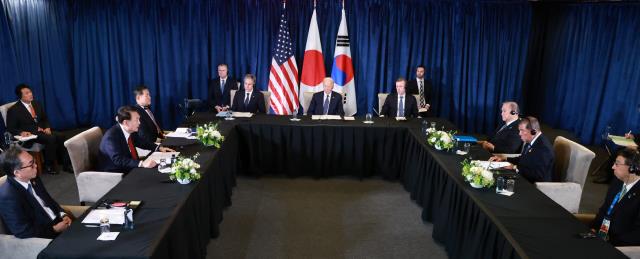
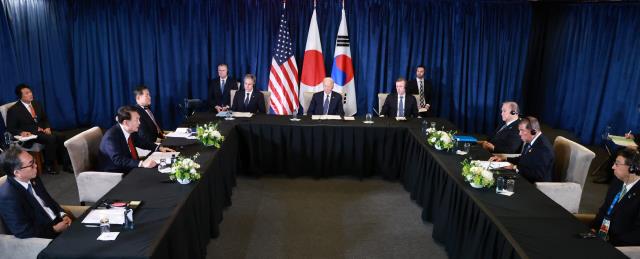
President Yoon Suk Yeol, who is visiting Peru to attend the Asia-Pacific Economic Cooperation (APEC) summit, holds a Korea-U.S.-Japan summit
with U.S. President Joe Biden and Japanese Prime Minister Shigeru Ishiba at the Lima Convention Center on the 15th (local time). Lima (Peru)
= Yonhap News
The genesis of this mechanism can be traced to the Geneva Agreed Framework of 1993, prompted by North Korea’s withdrawal from the Non-Proliferation Treaty (NPT). The creation of KEDO, jointly spearheaded by the three nations, not only strengthened security cooperation but also curtailed North Korea's nuclear ambitions by providing economic incentives such as light-water reactors and heavy fuel oil.
KEDO's establishment marked the start of a multilayered trilateral security mechanism, blending external deterrence and containment through military alliances with economic strategies to address internal threats from North Korea. This initiative significantly strengthened security ties among the three nations. In 1998, North Korea’s launch of the Taepodong-1 ballistic missile highlighted the escalating missile threat. In response, the three countries formed TCOG, based on the Perry Process, to tackle ballistic missile challenges comprehensively. This advancement further reinforced the multilayered mechanism, broadening its focus to address North Korean issues across military, economic, and political dimensions.
Despite these efforts, conflicts within the trilateral security cooperation among South Korea, the US, and Japan have provided valuable lessons for its future development. Differences in threat perceptions and interests over North Korea’s evolving threats sometimes led to unilateral actions, causing friction within the multilayered mechanism.
Nonetheless, the 2023 Camp David Declaration marked a major step in advancing and institutionalizing the mechanism. Today, trilateral cooperation is crucial not only for South Korea's security but also for the stability of Northeast Asia, East Asia, and the global order. It goes beyond military strategies, incorporating political and economic approaches to tackle diverse challenges.
Against the backdrop of intensifying U.S.-China strategic competition, this cooperation has become critical in maintaining regional and global stability. For South Korea, it serves as a foundation for national security and peace on the Korean Peninsula.
The evolution of the trilateral mechanism—its formation, development, and periods of strain—illustrates the complex dynamics among the three nations. These must be carefully considered as the mechanism continues to advance and solidify as an integral part of regional security.