

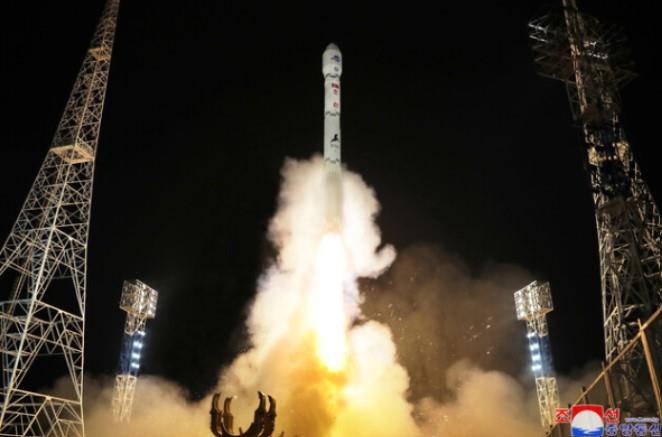
The Truth Behind North Korea's New Satellite Launch Vehicles
and Delayed Reconnaissance Missions

Chang Young-keun
Head of the Missile Center at the Korea Research Institute for National Strategy,
Former Professor at Korea Aerospace University
After two failed attempts to launch the Chollima-1 satellite launch vehicle in 2023, North Korea successfully placed the Malligyong-1 reconnaissance satellite into a sun-synchronous orbit at 502 km altitude on November 21. North Korea then announced plans to launch three additional reconnaissance satellites by the end of 2024, aiming to operate a cluster of four satellites. This cluster would shorten the revisit time, allowing for more frequent surveillance of the South Korean military, U.S. forces stationed in South Korea, and U.S. military bases in Guam and Japan.
However, despite its success, North Korea did not conduct any satellite launches for six months. On May 26, 2024, it informed the Japan Coast Guard of plans to launch another reconnaissance satellite and shared the anticipated drop zones. The next day, North Korean media reported the launch of a new space launch vehicle, which used a combination of cryogenic liquid oxygen and kerosene fuel instead of the storable propellant 'unsymmetrical dimethylhydrazine (UDMH)' and oxidizer 'dinitrogen tetroxide' typically used in the Baekdu engine. Unfortunately, the new launch failed due to a lack of operational reliability. As of now, a year after the successful launch in November 2023, North Korea has yet to place additional reconnaissance satellites into orbit.
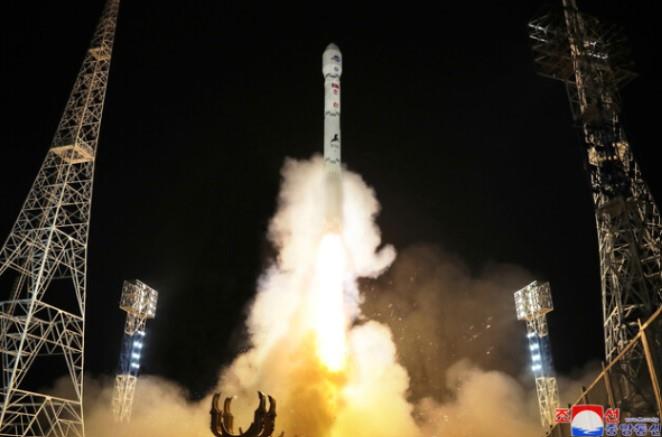
Reconnaissance Satellite Launched by North Korea in November 2023 'Manly Kyung 1'/Korean Central News Agency
Why Did North Korea Switch from the Successful Chollima-1?
It would have been logical for North Korea to continue using the Chollima-1 launch vehicle, which successfully launched last year, to deploy the three additional reconnaissance satellites as planned. So why did North Korea abruptly opt for a new space launch vehicle powered by kerosene fuel and a cryogenic liquid oxygen oxidizer, despite the Baekdu mountain engine’s proven lower thrust performance in the Hwasong-17 ICBM?
With the recent advancements in solid-fueled missile technology, such as the Hwasong-18 and Hwasong-19 ICBMs, North Korea appears to be prioritizing a transition away from liquid-fueled systems. While liquid-propellant ICBMs may still be used for their capacity to carry heavier payloads, the focus on enhancing reliability through storable propellant launch vehicles has diminished. Instead, North Korea seems to be emphasizing the development of propulsion systems using cryogenic oxidizers to achieve greater efficiency and performance.
Second, while the Chollima-1 successfully launched the Malligyong-1 into orbit in November 2023, technical limitations may have hindered its continued use, prompting North Korea to develop and switch to a new launch vehicle.
Third, redesigning the follow-up Malligyong-1-1 satellite to enhance its performance may have significantly increased its weight. The Chollima-1 might have lacked sufficient thrust to place the heavier satellite into its desired orbit, necessitating the development of an upgraded space launch vehicle.
How Did North Korea Acquire the New Space Launch Vehicle?
So, how did North Korea manage to develop or obtain the engine for its new space launch vehicle, which operates on kerosene fuel and cryogenic liquid oxygen? There are two possible scenarios: independent development by North Korea or assistance from Russia.
The first scenario suggests that North Korea developed the engine independently. The country has previously focused on the Baekdu mountain engine, a storable propellant-based liquid engine used in its ICBMs, leaving unclear when work began on a kerosene fuel and liquid oxygen oxidizer engine. Even if North Korea adapted its existing storable propellant engine, integrating it with a cryogenic oxidizer would have required extensive upgrades to the engine hardware, likely taking a significant amount of time.
Key components for cryogenic oxidizers, such as combustion chambers, turbo pumps, and oxidizer tanks, need specialized materials that can endure extreme temperatures below -183°C. Using the Baekdu mountain engine and propellant tank from the Chollima-1 without changes would be impossible. Even modifying the Chollima-1 would demand redesigning at least 50% of its structure and materials, requiring a substantial period. Additionally, software for operating the space launch vehicle would need major updates, raising questions about whether North Korea could achieve these modifications in a short timeframe without external support.
The second scenario suggests that North Korea acquired engines from Russia. During a September 2023 summit at the Vostochny Cosmodrome, Kim Jong-un was briefed on the Angara and Soyuz-2 launch vehicles, with Vladimir Putin expressing support for North Korea's space and satellite programs. It is believed that, similar to South Korea's Naro-1 development, North Korea may have sourced the first-stage propulsion system from Russia while integrating a North Korean small rocket for the second stage.
The upper-stage (third-stage) rocket could be added based on payload needs but might be unnecessary if Russia supplied a high-thrust first-stage propulsion system. As part of the debated North Korea-Russia space cooperation, Russia may have provided the RD-191 engine for the first stage.
The RD-151 engine, supplied to South Korea for the Naro-1 launch vehicle, is a modified version of Russia's RD-191 engine used in the Angara rocket, offering similar performance with adjusted thrust. Given its prior provision to South Korea, Russia could justify supplying it to North Korea without significant controversy.
Why Has North Korea Not Resumed Satellite Launches?
It remains unclear why North Korea has not attempted a relaunch more than six months after the failure of its new space launch vehicle in late May. In the West, addressing a launch failure typically involves a lengthy process of failure analysis, corrections, and preparations, often taking over a year. However, North Korea has historically resumed launches much faster, as seen with the two Chollima-1 failures last year, where relaunches occurred within weeks.
One possibility is that North Korea, if developing the new space launch vehicle independently, has yet to identify the cause of the first-stage engine explosion or find a solution. Alternatively, if they used a first-stage propulsion system acquired from Russia alongside their own second- and third-stage engines—or if Russia supplied the entire launch vehicle—the delay could stem from development setbacks on the Russian side. Since the vehicle is Russian-designed, it’s likely that unresolved technical issues remain, requiring extensive design changes or re-manufacturing, which would take considerable time.
If North Korea used Russia's Angara launch vehicle engine, it is puzzling that it notified the Japan Coast Guard of expected drop zones for the first- and second-stage propulsion systems that matched those of the Chollima-1 from the previous year. Even if targeting the same orbit, differences in engine performance and characteristics should result in distinct drop zones, making this notification inconsistent.
Ultimately, North Korea's secrecy and the lack of information about additional reconnaissance satellite launch failures make it difficult to pinpoint the cause. If a Russian space launch vehicle was used as part of Russia-North Korea cooperation, the timeline for resuming follow-up launches is unlikely to align with North Korea's plans.
Performance and Operational Status of the Malligyong-1 Reconnaissance Satellite
Based on the limited public information available, assessing the performance of North Korea’s Malligyong-1 satellite is challenging. External shape diagrams indicate the satellite is equipped with four deployable solar panels, two star-tracker sensors commonly used for precise attitude control in high-performance observation satellites, and thrusters for periodic orbit and attitude adjustments. These features suggest it was designed to achieve a target resolution of at least 2–3 meters.
Since its launch in November 2023, the satellite’s altitude has been adjusted every three months. Its subtle movements over five-day periods suggest the use of very low-thrust electric thrusters. The electro-optical camera seems to feature a dual-telescope design, with each telescope having a diameter of less than 20cm.
Internally, the satellite is likely equipped with four reaction wheels, each approximately 15cm in diameter, providing a torque output of 0.2–0.3 Nm. This configuration offers sufficient maneuverability for high-resolution imaging. The satellite’s weight is estimated at around 300 kg. However, due to the lack of verifiable information on electronic systems and flight software, its image storage and transmission capabilities remain uncertain. Without released imagery, estimating the image quality, such as modulation transfer function (MTF), is also impossible.