

Land Reforms of Rhee Syng-man and Kim Il-sung:
Shaping the Two Koreas' Development
Park Sang-bong
Director of the German Unification Information Center,
Former President of the National Institute for Unification Education
A defining theme of modern Korean history is division, reflected in ongoing conflicts over values, political systems, and ideologies that persisted throughout history. The post-liberation period following Japan’s defeat marked the beginning of this struggle, leading to social chaos and an intensified ideological rivalry between the U.S. and the Soviet Union."
While the U.S. military government promoted anti-communist democracy in the South, Soviet forces established a socialist regime in the North to spread communism across the Korean Peninsula. Having just gained independence from Japan, many Koreans were drawn to socialist ideals and admired North Korea. Some intellectuals, like Song Yu-kyong—the father of Song Hye-rim, Kim Jong-nam’s mother—migrated north. However, others, horrified by North Korea’s brutality, fled to the South.
As ideological conflict deepened, both Koreas sought public support, with land reform becoming the first battleground. North Korea saw redistribution as revolutionary, seizing land from landlords and pro-Japanese figures to give to farmers for free. Those labeled as collaborators were punished and expelled by party-controlled authorities.
South Korea introduced agrarian reform to counter North Korea’s policies, opting to buy land from landlords and sell it to farmers through a payment plan. Beyond redistribution, these reforms reflected a choice between competing political and economic systems, marking Korea’s true division.
On June 25, 1950, North Korea invaded South Korea to impose communist unification but was stopped by U.S. and allied intervention. The war further entrenched division, pulling the peninsula into Cold War turmoil.
By 2025, 75 years after the division, South Korea has achieved remarkable growth, known as the "Miracle on the Han River," while North Korea remains a hereditary dictatorship plagued by poverty. But still, they seek reunification under communism and engages in hybrid warfare.
North Korea’s Land Reform: Confiscation Without Compensation, Redistribution Without Cost
With Soviet backing, Kim Il-sung established the North Korea People's Committee in February 1946, effectively acting as the government. This committee launched radical land reform while purging so-called "national traitors." On March 5, it announced the Land Reform Act, with rural committees mobilizing villagers to implement the policy. These committees branded landlords as traitors, confiscated their land and assets, and redistributed them to farmers at no cost.
Landowners lost everything overnight, including livestock and homes, and many fled to South Korea or were forcibly relocated to other cities in North. Meanwhile, grateful farmers received land without payment, some even praising Kim Il-sung.
However, the reform was largely a Communist Party propaganda tool. Article 5 of the Land Reform Act promised permanent land grants to farmers, yet Article 10 banned them from selling, leasing, or mortgaging their land.
In reality, farmers received only cultivation rights, not true ownership, and had to pay 25% of their harvest as an agricultural tax. This effectively replaced landlords with state control, as farmland was nationalized and the Communist Party became the new "landlord," collecting rent through taxation.
North Korea’s land reform was a socialist revolution rooted in class struggle. It eliminated landlords, redistributed land to farmers, and reinforced the socialist economic system.
South Korea’s Agrarian Reform: Compensated Land Purchase, Distributed with Payment
In response to North Korea’s land policies, South Korea saw an urgent need for agrarian reform. By late 1945, 2.06 million farm households existed, with 1.01 million (48.9%) as tenant farmers. Including small landowners who also rented land, tenant farmers made up 83.5% of all households.
<Table 1> Status of Owner-Farmers and Tenant Farmers in South Korea
(Unit: Households, %)
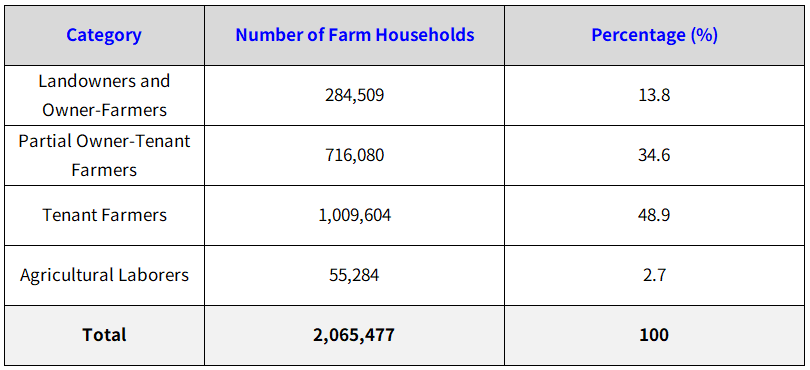
Source: National Institute of Korean History, Korean History,
Vol. 52: The Establishment of the Republic of Korea, 2002, p. 243.
After liberation, the U.S. military government capped tenant rent at one-third of the harvest, down from 50–80%. It also confiscated Japanese-owned land, selling it to Korean tenant farmers at a fair price. Farmland was valued at three times the annual harvest, with farmers gaining ownership by paying 20% of their yield annually over 15 years.
After the establishment of the South Korean government in 1948, President Rhee Syng-man pushed agrarian reform but faced resistance from the landlord-backed Korean Democratic Party. Despite this, the 1950 Land Reform Act enabled the government to buy and redistribute land at a set price.
The new system involved the government purchasing land from landlords and reselling it. Land was priced at 1.5 times the annual harvest, with farmers repaying in installments over five years to gain full ownership. Unlike North Korea’s state-controlled system, South Korea’s reform created independent landowners, supporting a free-market economy.
President Rhee Syng-man firmly ordered, "Overcome all obstacles and carry out the agrarian reform." His decisive leadership ensured its completion before the Korean War. This reform laid the foundation for industrial growth, eliminating the feudal landlord class and creating a new class of equal citizens.
The Miracle on the Han River vs. A Totalitarian Impoverished State
Following the Korean War, the ideological and economic divide between South and North Korea intensified. Today, 75 years later, South Korea stands as a model of industrialization and democratization, while North Korea remains mired in extreme poverty under its hereditary dictatorship.
The world recognizes South Korea for achieving the "Miracle on the Han River," while North Korea is seen as one of the most impoverished states, with Kim Jong-un prioritizing nuclear missile development over the well-being of his people.
European media outlets have openly criticized Kim Jong-un. The Swiss newspaper Neue Zürcher Zeitung referred to him as a "criminal against humanity," while Germany’s progressive daily Taz described him as "a hostage-taker holding his people captive." Recent reports highlight North Korea's involvement in cybercrime, stealing funds from international institutions and cryptocurrency exchanges to finance its weapons programs.
The sharp contrast between North and South Korea stems directly from their post-liberation land policies—Kim Il-sung’s socialist reform and Rhee Syng-man’s agrarian reform. This is further supported by a report from the German Economic Institute (IW).
<Table 2> Comparison of Economic and Social Indicators Between South and North Korea
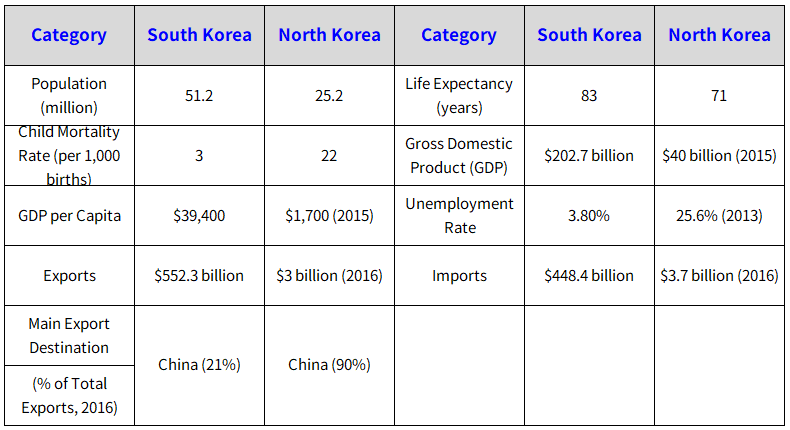
Source: Südkorea: Der Entwicklungsstar, in: iwd der Informationsdienst des Institutes der deutschen Wirtschaft,
February 9, 2018.
-
PREV [Feature Article Series]
-
NEXT [Opinion]