

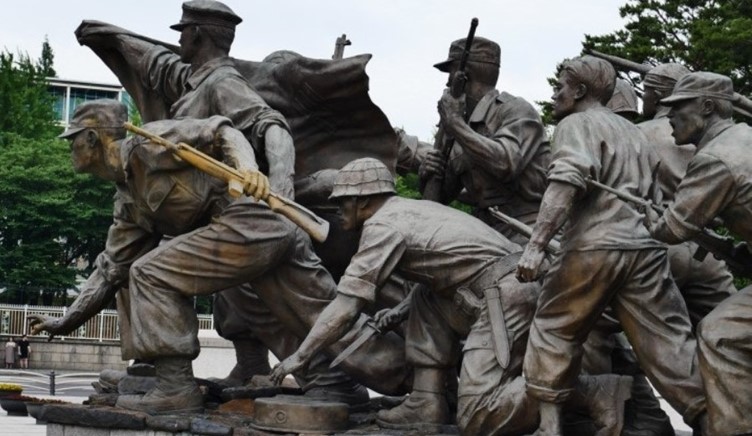
Reflection of the Korean War and Peace Regime Building

Professor Chung Kyung-young
Graduate School of International Studies
Hanyang University
The study aims to reflect the Korean War and build a peace regime on the Korean Peninsular. The year 2025 was the 75th
anniversary of the Korean War. The Korean War constituted a turning point in the history of the Cold War.
North Korea launched largescale attack along the 38th parallel on June 25, 1950 after the close coordination
among North Korea, the Soviet Union, and the People’s Republic of China.
The Republic of Korea (ROK) forces lost Seoul within three days after the invasion and conducted the delaying operations.
67 countries of 91 member states of United Nations supported the ROK to save it from the communist attack.
16 countries including the U.S. sent combat forces, along with 5 medical supporting countries and 46 material
and post-reconstruction supporting countries. The ROK forces conducted the counter-offensive operations with UN forces
advancing toward the Yalu River along the international border. Chinese Communist Forces (CCF) massively intervened
in the Korean War to protest the U.S. and to support North Korea. We lost again Seoul on January 4, 1951.
It took more than two years to sign the Korean Armistice Agreement as of the result of two fronts war of trench combat
and armistice negotiations. The Armistice Agreement was signed between the Commander-in-Chief,
United Nations Command, on the one hand, and the Supreme Commander of the Korean People's Army
and the Commander of the Chinese People's volunteers, on the other hand on July 27, 1953.
The study addresses the meaning of world history of the Korean War, along with casualties from the war
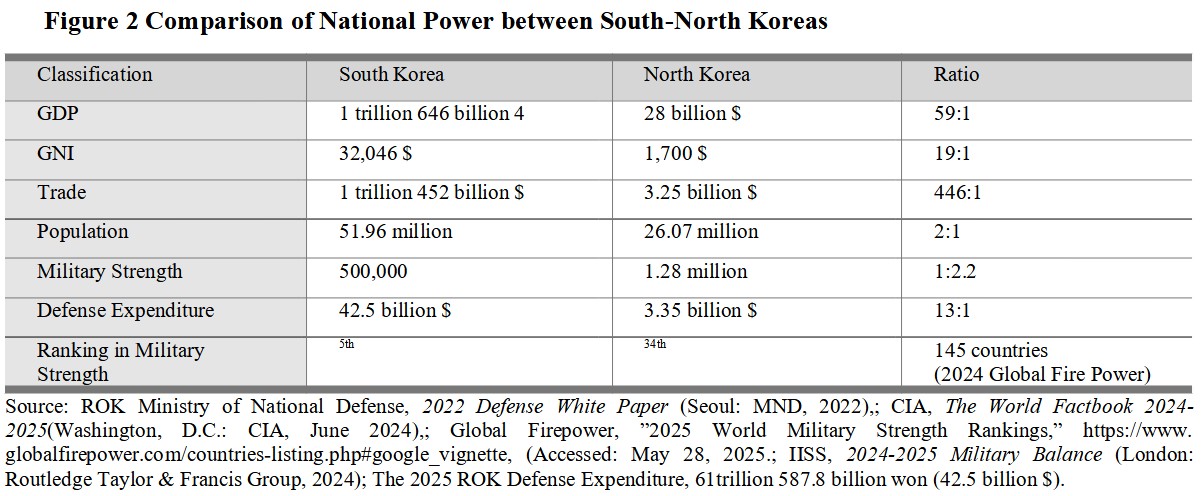
and comparison of the Two Koreas national power. It examines three-dimensional peace and unification efforts including
inter-Korean, international politics, and domestic politics to draw lessons. It will be followed by discourse
on U.S.-China hegemony rivalry and explore the Two Koreas strategy for U.S.-China support of Korean unification.
Finally, the study makes policy recommendations for building a peace regime on the Korean Peninsula.
The Catastrophe and Meaning of World History of the Korean War, Huge Gap between the Two Koreas
The Korean War resulted in four million four hundred sixty thousand casualties not only the Two Koreas but also the U.S.
and China, along with 15 member states of the United Nations along with destruction of huge property and
territorial degradation. The Korean War was international war, not local war. If anther war breaks
out on the Korean Peninsula, it looks like highly likely that a third world war will be.

The Korean War was the first case for the application of the UN collective security system.
One of the most important meanings of the war is that the war represented the struggle for power and influence
between free liberal bloc and the communist bloc. The Korean War began to be reevaluated after the victory
of free world in the Cold War.
The war resulted in the tightening of the bipolar structure between the U.S.-led North Atlantic Treaty Organization
and the Soviet Union-led Warsaw Treaty Organization. The U.S. also signed defense treaties with South Korea, Japan,
and Taiwan. The U.S. assumed the role of a balancer in Northeast Asia which greatly contributed to the stability
and prosperity of the region.
In particular, what factors made the Two Koreas, which shared same culture and language and political system
for 1300 years, to create huge gap between the Two Koreas in the past eighty years since liberation, division
and war of Korea. Freedom, liberal democracy, rule of law, human rights, and free market supersede personality cult,
garrison state, control economy
Comprehensive Review of Peace and Unification Effort on the Korean Peninsula
The unstable armistice structure continues to remain on the Korean Peninsula in the past seventy-two years despite
of peace and unification efforts between the Two Koreas, international politics, and domestic politics.
South-North Koreas have made peace and unification efforts since the Korean War.
Phase 1 is National Identity, July 4 Communique in 1974. The Two Koreas agreed self-reliance, peace, and national unity.
Phase 2 is South-North Detente, the Basic Agreement in 1991: Reconciliation, Non-Aggression, Exchange & Cooperation,
Phase 3 is Progress, June 15 South-North Joint Statement in 2001, one nation & two system unification, a
nd Oct 4 Summit Declaration in 2007, peace regime and judiciary institutionalization. Phase 4 is Turbulence,
the sinking of Cheonan Warship and the shelling of Yeonpyong-island, the shutdown of Kaesung Industrial Complex
due to the North Korea’s nuclear program and long ballistic missile in 2010. Phase 5 is Roller Coaster,
the April 27 Panmunjom Joint Statement, the Sep 19 Pyongyang Joint Statement and Sep 19 South-North
Comprehensive Military Agreement in 2018, and Explosion of South-North Liaison Office in 2020.
Phase 6 is Suspension, breakdown of South-North relations. abolition of the Sep 19 South-North Comprehensive
Military Agreement in 2024.
From the perspective of international politics, twenty nations which participated in the Korean War held Geneva conference
for political settlement of Korea in 1954. The Four Party Talks was held in Geneva from 1997 to 1999 for peace agreement.
The Six Party Talks was held in Beijing from 2003 to 2007 for North Korea’s denuclearization. At Camp David,
on Aug 18, 2023, the Japan-ROK-U.S. leaders support a unified Korean Peninsula that is free and at peace.
From domestic politics perspective of the Two Koreas, North Korea asserted the doctrine of Two Hostile States
in December, 2023. It has since encouraged their domestic population to brace for a major upheaval in the name
of territorial unification, while simultaneously mobilizing tactical nuclear units and conducting full-scale maneuver training
for its commanding officers aimed at occupying South Korea.
Meanwhile, the conflicts between factions and generations regarding perceptions and policies towards North Korea
in South Korea have struggled. Moreover, as can be seen in the changing public perception about unification,
interest in unification has significantly weakened. According to a survey conducted by the Institute for Unification
and Peace at Seoul National University since 2007, the percentage of respondents who believe unification
is necessary dropped from 63.8% in 2007 to a record low of 36.9% in the 2024 survey, while those who believe
it is not necessarily increased from 15.1% to 35.0%. The ROK adopted the Aug 15 Unification Doctrine in 2024
Lessons from the Instable Armistice Structure
Peace regime building is not possible solely between North and South Korea, cooperation between the U.S.
and China is essential. North Korea's nuclear issue is the biggest obstacle to establishing a peace regime
on the Korean Peninsula. Continuous political-military dialogue and civilian exchanges are crucial for building trust
between the North and South. Regardless of the ROK’s conservative or progressive administrations, there should be a consistent North Korean and unification policy. Political and military factors have a significant impact on economic exchange and cooperation between the Two Koreas. Arms control contributes to building a peace regime. The national will for unification has a decisive influence on achieving unification.
U.S.-China Hegemony Rivalry
To shape co-existence and stable strategic environment surrounding the Korean Peninsula is to contribute to building
a peace regime on the Peninsula. It is imperative to explore U.S.-China hegemony rivalry. The Indo-Pacific Strategy
is a U.S. initiative aimed at promoting a free, open, connected, prosperous, secure, and resilient Indo-Pacific region.
The U.S. led Indo-Pacific Strategy focuses on preventing China’s invasion of Taiwan and expansion of influence,
containing China’s maritime hegemony with allied and partner countries, including South Korea, Japan,
the Philippines, Australia, and India. From security perspective, isolating China in the international community,
along with inducing an arms race, and long-term depletion of Chinese support and capabilities. In a view of economy,
the Indo-Pacific Strategy attempt to exclude China from the industrial ecosystem through restructuring global supply chain
and blocking technological capabilities. From ideological perspective, the strategy aims to dismantle
China’s political system through discourse on democracy and human rights.
The Indo-Pacific Strategy mobilizes the alliance network for technology blocking, supply chain exclusion,
and military pressure.
In the meantime, China hegemony strategy attempt dominates the world through the Chinese order
by Belt and Road Initiative (B&LI), along with digital. China perceives American hegemony as the decline.
China establishes a pro-hegemony coalition with North Korea, Russia, and Iran to occupy Taiwan, control the Philippines,
and seize maritime hegemony through a focused sequential strategy.
China employs Anti-Access & Area Denial (A2&AD) strategy. China plan to control the First Island Chain connecting
southern Kyushu, Okinawa, Taiwan, and the Philippines by 2027. China installed structures
in the China-Korea Provisional Measures Zone in the West Sea. China attempts to seize Second Island
Chain connecting Ogasawara Islands, Guam, Saipan, and Papua New Guinea in the Western Pacific by 2035.
China will bisect the Pacific to advance as far as the vicinity of Hawaii by 2049.
The Two Koreas’ Strategy for Securing U.S.-China Support of Korean Unification
In conjunction with U.S.-China hegemonic rivalry, we cannot exclude the possibility of a third world war
on the Korean Peninsula in event of failing in managing the North Korean nuclear issue or and crises
on the Korean Peninsula. South Korea should take the lead in building a multilateral security cooperation organization
in Northeast Asia with its technological capabilities and K-culture to build a security regime in the New Cold War
between China-Russia-North Korea bloc and U.S.-Japan-South Korea in the region. North Korea must halt
the development of ICBMs and nuclear arsenal that threaten the U.S. mainland and the development
of nuclear-powered submarines.
The hostile relationship between the U.S. and North Korea must be resolved through normalization,
moving toward a path of peace and prosperity. North and South Koreas need to promote arms control
and persuade both the U.S. and China on the necessity of unification. Then it alleviates the threat of war.
North Korea can transition from a garrison state to a welfare state. The Two Koreas-U.S.-China need
to establish Korean Unification Council. The Korean Unification Council could develop unification strategies,
along with common tasks and individual tasks for each country to build a peace regime.
Two Strategies for Responding North Korea’s Nuclear Challenge
Option One: Strategy for Linking Denuclearization of the Korean Peninsula with the Unification Process
The denuclearization of the Korean Peninsula will be pursued in conjunction with the unification process.
Step 1: South Korea, North Korea, the United States, and China will reach a comprehensive agreement to conclude
a peace treaty aimed at the end state of dismantling North Korea's nuclear program. Step 2: Upon the dismantlement
of the Yongbyon nuclear facility and ICBMs, economic sanctions will be alleviated, peace negotiations
among the Two Koreas, U.S. and China and normalization talks between North Korea and the U.S. and North Korea
and Japan will commence. Step 3: Upon the complete dismantlement of all nuclear weapons
and long-range ballistic missiles, sanctions against North Korea will be totally lifted, a peace treaty will be signed
among South Korea, North Korea, the U.S., and China, and diplomatic relations will be established
between North Korea and the U.S. and between North Korea and Japan.
Option Two : Nuclear Balance on the Korean Peninsula and the New Peace and Security Strategy
The nuclear threat posed by North Korea's hypersonic missiles is serious. North Korea is training to occupy
South Korea by operating nuclear weapons. When North Korea launches a tactical nuclear preemptive strike,
the sacrifice is catastrophe. It is promoting integrated extended deterrence to deal with North Korea's nuclear threat. If the Washington Declaration agreed upon by President Biden and President Yoon is not implemented, or if the redeployment of tactical nuclear weapons is not carried out, South Korea's nuclear armament is inevitable.
The first stage is to build a control tower for nuclear armament and secure nuclear potential,
the second step is to withdraw from the NPT in the event of a national emergency,
the third stage is to persuade the United States and pursue nuclear armament with the connivance
of the United States, and the fourth stage is to sign a peace treaty through nuclear arms control with North Korea
after the North-South nuclear balance is realized.
When South Korea engages in nuclear armament, both South and North Korea will achieve stability
on the Korean Peninsula by relying on mutually assured destruction (MAD).
The only purpose of South Korea’s nuclear armament is to protect itself against North Korea's nuclear threats,
which is a matter of national survival. The United States would be able to deter North Korean nuclear threats
without deploying strategic assets to the Korean Peninsula, resulting in savings in defense expenditure for the U.S.
When nuclear-armed South Korea and Japan deter the nuclear threats from China and Russia,
the U.S. can more easily implement its Indo-Pacific strategy.
Transition from the Armistice Structure to a Peace Regime on the Korean Peninsula
North Korea and China should return their delegation to the Military Armistice Commission at Panmunjom to stabilize
the armistice structure. The Two Koreas need to achieve arms control by military confidence building measures,
operational arms control, and structural arms control. The Two Koreas, U.S.
and China need to sign the Korean Peninsula Peace Treaty and transforming the DMZ into a peace zone,
with U.S. troops stationed as peacekeeping forces and the MAC as international peace supervisory mechanism
In conclusion, the realization of a unified Korea embodying the philosophy of Hongik Ingan will not only signify
the peaceful development of the Korean Peninsula but also promises co-prosperity for Northeast Asia
and has the historical meaning of reborn as a global civilized community. Triangular harmony
of South Korea civil unification movement along with world community, the political, military, economic, social-cultural,
and territorial integration of the North and South, and the proactive U.S.-China support
and cooperation toward Korean unification will undoubtedly help a free, unified Korea be achieved in our generation.
-
PREV [Current Affairs Planning]
-
NEXT [Feature Article]