

Assessing the Lee Jae-myung Administration’s North Korea Policy: Strategic Goals and Policy Trajectory

Wang Seon-taek
Ajunct Professor
College of Media, Arts, and Science
The National Unification Advisory Council convened its inaugural session at KINTEX in Ilsan on December 2, drawing significant attention in anticipation of President Lee Jae-myung’s keynote address. Many observers expected the President to articulate the administration’s three core objectives for North Korea policy.
Although President Lee offered several notable insights relevant to inter-Korean relations, he refrained from outlining the so-called “three major goals” in a formalized manner. While some may interpret this as an omission, the strategic environment has not yet matured to a point where such goals can be publicly codified.
The primary reason the administration has yet to present a fully structured North Korea policy—more than six months into its term—is the sober assessment that Pyongyang is unwilling to engage. North Korea has consistently signaled, including through Kim Yo-jong’s July statement and Chairman Kim Jong-un’s September address, that it has no intention of entering dialogue with the new government in Seoul.
Under such circumstances, prematurely announcing detailed policy architecture risks creating the appearance of rhetorical overreach and could unnecessarily constrain the administration’s future diplomatic room to maneuver. In this light, President Lee’s restraint reflects not passivity but pragmatic judgment.
Nonetheless, efforts to improve inter-Korean relations must proceed despite the highly unfavorable circumstances. Clarifying the characteristics, prospects, and policy implications of the Lee administration’s approach remains an essential task, both for shaping a more conducive environment and for preparing to seize openings when they emerge.
Guiding Principles
Even without a formal unveiling of “three major goals,” the defining elements of the Lee administration’s North Korea policy are already discernible. President Lee has articulated a central guiding principle: to build a Korean Peninsula free from the fear of war and nuclear coercion, and ultimately to pursue unification through peaceful and democratic means.
He has repeatedly emphasized a key dictum from The Art of War—that preventing the conditions for conflict is wiser than prevailing in one. The President’s foundational view is that genuine prosperity is only possible once the threat of war has been mitigated; peace is understood as the bedrock of national economic stability.
From this principle flow three natural objectives: peaceful coexistence, shared growth, and denuclearization.
Peaceful coexistence entails reducing military tensions and hostile rhetoric through sustained dialogue, restoring communication channels, and normalizing basic inter-Korean interaction.
Once minimal trust begins to form, shared growth can be pursued through calibrated economic cooperation that leverages complementarities between the two very different systems. Precedents such as the Gaeseong Industrial Complex and Mount Geumgang tourism demonstrate the potential of such initiatives. Future projects might also include multilateral frameworks related to Tumen River basin development or exploratory cooperation along the Northern Sea Route.
However, progress on coexistence and shared growth remains structurally constrained as long as the nuclear issue stands unresolved. North Korea’s nuclear program, coupled with ongoing UN sanctions, makes large-scale economic cooperation effectively impossible within the current international regime. For this reason, denuclearization is not an optional component but an indispensable precondition.
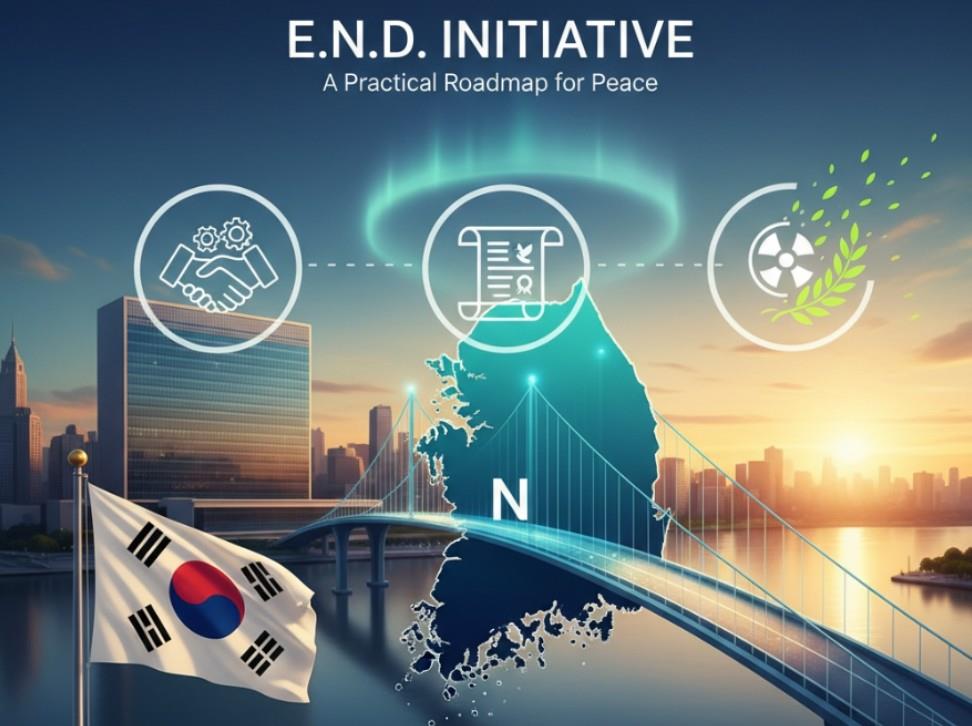
The administration’s END initiative—Exchange, Normalization, Denuclearization—outlines a phased process aimed at stabilizing inter-Korean ties and broader regional relations through exchanges, ultimately culminating in a three-stage denuclearization sequence of suspension, reduction, and abandonment.
Principles for Engagement
In pursuit of negotiations to advance these goals, President Lee has pledged adherence to three core principles: respect for the North Korean regime; opposition to unification by absorption; and abstention from hostile acts toward Pyongyang. These principles are intended to help rebuild the trust that has eroded sharply in recent years. They serve both as immediate confidence-building messages and as long-term norms the administration intends to maintain, even in periods of improved relations.
Taken together, the administration has already outlined the essential architecture of its North Korea policy, even if it has not formally packaged it as such. While Pyongyang remains unresponsive, several factors suggest that it may reassess its stance following the 9th Workers’ Party Congress scheduled for early next year. Chairman Kim Jong-un’s deep hostility toward former President Yoon Suk-yeol, coupled with President Lee’s overt willingness to improve inter-Korean relations, may influence Pyongyang’s strategic calculus.
Furthermore, President Donald Trump’s stated desire to meet Chairman Kim early in his second term may create additional incentives for diplomatic repositioning. Kim Jong-un’s participation in Beijing’s Victory Day parade last September, his first major appearance on a multilateral diplomatic stage in years, could also be interpreted as part of a broader effort to recalibrate his external strategy.
Prospects
If the Lee Jae-myung administration maintains a consistent, patient, and strategically disciplined approach aimed at reducing war risks and nuclear threats on the Peninsula, significant qualitative shifts in inter-Korean dynamics could materialize as early as the first half of next year.
While such outcomes are far from guaranteed, they remain plausible given current structural trends. Importantly, policy must continue to account for worst-case scenarios; inter-Korean relations in recent years have reached a level of deterioration unprecedented in the post-Cold War era.
However, both domestic and international environments are showing signs of gradually moving beyond the most difficult phase. If the administration employs measured tactics, prioritizes rational objectives, and refrains from actions that could unnecessarily provoke Pyongyang, or destabilize relations with neighboring states, the prospects for meaningful progress in the coming year fall well within the bounds of strategic reason.
-
PREV [Feature Article]
-
NEXT [Feature Article]