

Assessing North Korea’s Response and Likely Countermeasures Following the Fourth Nuri Launch

Lee Ho Ryung
Center for Security and Strategy, KIDA
South Korea’s successful second launch of the Korean Space Launch Vehicle-II (KSLV-II) on June 21, 2022, significantly accelerated the country’s indigenous launch vehicle development program. With this achievement, South Korea became the world’s seventh nation capable of deploying practical-class satellites—those weighing more than 1,000 kilograms—using a domestically developed rocket launched from its own territory. This milestone marked a major inflection point in more than three decades of Korean space development, affirming Seoul’s ability to place satellites into orbit at the time and place of its choosing.
The South Korean government subsequently articulated a series of follow-on objectives, including four additional Nuri launches between early 2023 and 2027 to further improve technical reliability. It also set a target of landing an unmanned spacecraft on the lunar surface by 2031 using domestically produced launch capabilities.
The fourth Nuri launch on November 27, 2025, was particularly noteworthy as the first in which Hanwha Aerospace led the end-to-end assembly process, reflecting the government’s long-term strategy to transition space technology to the private sector. The launch successfully placed 13 satellites, including the primary payload, CAS500-3, into a 600-km orbit. The mission therefore stands out not only for its technical achievement but also for its expanded private-sector participation and its unequivocally civilian orientation.
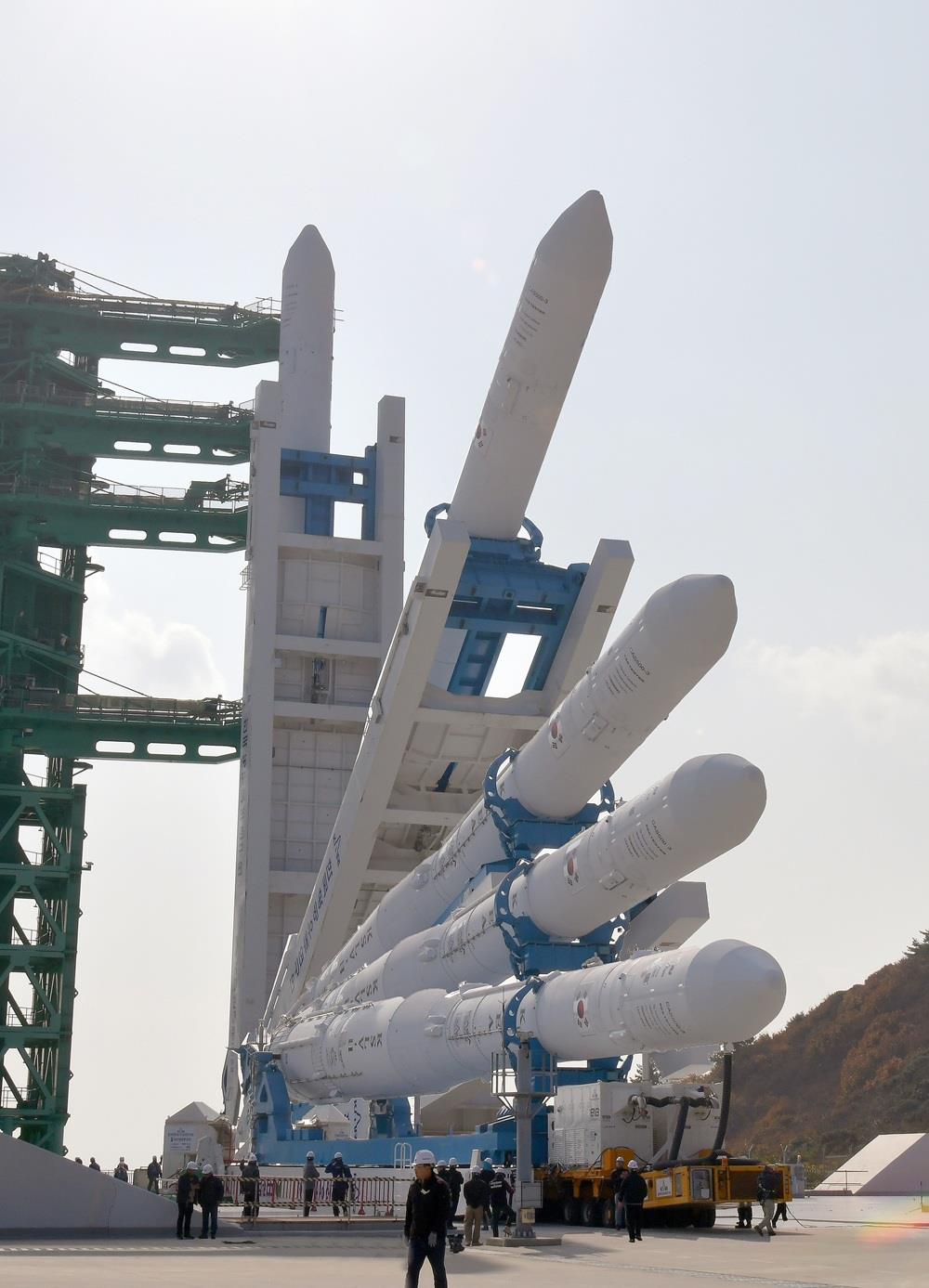
With the onset of a corporate-driven launch era led by firms such as Hanwha Aerospace, the South Korean government has elevated its ambitions to join the ranks of the world’s top five space powers. It has committed comprehensive support, spanning policy, industry, national security, and diplomacy, to sustain this trajectory.
North Korea’s Silence: Strategic Calculations and Domestic Constraints
Notably, Pyongyang has issued no formal response to the fourth Nuri launch, a departure from its earlier pattern of rapid messaging. During the first Nuri launch in October 2021, North Korea aired a 2020 Korean Central Television documentary highlighting the Kwangmyongsong-4 satellite and quickly ridiculed the mission’s partial failure. By contrast, following the second Nuri launch in 2022, Kim Jong-un convened an expanded Central Military Commission meeting, signaling heightened alarm.
Several factors likely explain the current silence.
First, North Korea’s own satellite program remains stalled. Although the regime declared its Mangyongbong-1 military reconnaissance satellite launch a success in November 2023, the satellite reportedly lacks functional reconnaissance capability. Moreover, despite announcing plans for three additional launches in 2024, the first attempt in 2024 ended in a first-stage explosion attributed to problems with new fuel and engine design, an assessment North Korean state media partially acknowledged by citing combustion system faults.
Since that failure, there have been no observable preparations for subsequent launches. In this context, public commentary on South Korea’s progress would risk highlighting the widening technological gap between the two Koreas, both domestically and internationally.
Second, the timing coincides with preparations for North Korea’s upcoming 9th North Korean Workers’ Party Congress. The regime must consolidate sector-by-sector “achievements,” including progress toward the five major strategic weapons goals set at the 8th Party Congress, and finalize policy direction for the next five-year period.
Although Pyongyang claimed accelerated progress in late 2023 with the introduction of the solid-fuel Hwasong-18, the Chollima launch vehicle, and Mangyonggong-1, the failed 2024 satellite launch forced a narrative adjustment. The regime subsequently spotlighted the test of the new Hwasong-19, characterizing it as a “final version ICBM,” and unveiled the Hwasong-20 multiple-warhead system during the military parade celebrating the 80th anniversary of the Party’s founding.
Given these political dynamics, Pyongyang may judge that its broader messaging at the 9th Party Congress, framing “successes” in defense and foreign policy and outlining future space and military development priorities, can sufficiently address the implications of the Nuri program without directly referencing the latest South Korean launch.
Finally, North Korea is likely to situate its criticism of South Korea’s expanding space capabilities within a broader narrative challenging the U.S.–ROK alliance posture, emerging trilateral cooperation among the United States, South Korea, and Japan, and discussions surrounding nuclear-powered submarine development. In keeping with past rhetoric accusing Seoul and Washington of “double standards,” Pyongyang will likely portray even civilian or commercial satellite launches as destabilizing acts that exacerbate regional arms competition.
It may attempt to frame these developments as evidence of an emerging confrontation between the “ROK–U.S.–Japan” bloc and the “DPRK–China–Russia” axis. Such framing would support North Korea’s efforts to secure deeper technological cooperation from Beijing and Moscow while positioning itself as part of a broader coalition resisting U.S. strategic influence.
Future Outlook
In response to South Korea’s expanding space and reconnaissance capabilities, North Korea is expected to resume efforts to launch a military reconnaissance satellite at the earliest feasible opportunity. As the regime approaches the 9th Party Congress, it is likely to double down on its policy of simultaneously advancing nuclear and conventional forces while accelerating modernization in emerging domains such as space, electronic warfare, cyber operations, and unmanned systems.
Pyongyang will likely intensify its long-standing narrative of “double standards” to extract diplomatic concessions or sanctions relief, portraying its satellite and missile tests as legitimate measures of national self-defense. At the same time, it will seek both domestic and international justification for the continued development of strategic weapons, using repeated tests and public demonstrations of new systems to reinforce its claimed sovereign rights in space and military technology.