

Strengthening South Korea’s Role as a Globally Responsible
Power Through the President’s Participation in the G7 Summit and European Tour
Soo-hyoung Lee
Senior Advisor
Institute for National Security Strategy
The Lee Jae-myung administration came to office at a time of growing geopolitical uncertainty and intensifying strategic competition. In response to these challenges, it has pursued a foreign policy centered on pragmatic diplomacy and the advancement of South Korea's national interests. Within this framework, the administration has developed a diplomatic strategy designed to enhance South Korea's role as a responsible global power through practical, interest-based engagement across three interconnected but distinct dimensions.
The first track emphasizes the pursuit of peaceful coexistence between North and South Korea, which the administration regards as the essential foundation for South Korea's development as a responsible global power.
The second track involves strengthening and managing relations with major regional stakeholders, including the United States, China, Japan, and Russia. Given their direct influence on the security environment of the Korean Peninsula and Northeast Asia, these relationships play a critical role in shaping the prospects for inter-Korean stability, regional peace, and strategic cooperation.
The third track, which most directly embodies the Lee Jae-myung administration's vision of South Korea as a "responsible global power," focuses on global multilateral diplomacy aimed at strengthening solidarity and cooperation with major middle powers and contributing to a stable, predictable, and rules-based international order.
Rather than functioning independently, these three tracks form mutually reinforcing layers of a comprehensive diplomatic strategy. Progress in one area can generate positive effects in the others, creating synergies that enhance South Korea's overall diplomatic influence and strategic flexibility.
Since assuming office in June 2025, the Lee Jae-myung administration has taken initial steps toward advancing South Korea's role as a "responsible global power" through active participation in major international forums, including the G7 Summit and the Asia-Pacific Economic Cooperation (APEC) Summit scheduled to be held in Gyeongju in October 2026.
The President's recent European tour from June 9 to 18, including his participation in the G7 Summit, constituted a significant diplomatic effort to strengthen South Korea's international standing and reinforce its image as a responsible and constructive contributor to global affairs.
The principal achievements of this diplomatic initiative can be summarized as follows:
Strengthening Strategic Cooperation with Europe
First, the Korea–EU Summit held on June 10 built upon a series of high-level engagements with key European partners, including France, Italy, Germany, and Poland. The summit marked an important milestone in the Lee Jae-myung administration's efforts to deepen engagement with Europe and underscored South Korea's commitment to strengthening international cooperation and supporting a more resilient multilateral order.
At the summit, South Korea and the European Union adopted a joint statement reaffirming their shared commitment to expanding cooperation across a broad range of areas, including security, defense, trade, investment, science and technology, and people-to-people exchanges. Both sides also pledged to work closely together in addressing challenges to multilateralism and responding to structural changes in the global economy and international trading system.
In particular, the conclusion of the Digital Trade Agreement between South Korea and the European Union—the world's largest single market and South Korea's third-largest trading partner—will help establish a more stable, transparent, and predictable framework for digital trade. The agreement is intended to facilitate cross-border digital commerce, strengthen consumer protection, and promote cooperation in emerging sectors of the global economy, where digital connectivity is playing an increasingly important role.
South Korea and the EU also agreed to deepen security cooperation by launching negotiations on a Security of Information Agreement and concluding an agreement on the transfer of Passenger Name Record (PNR) data. These measures are expected to enhance information-sharing, strengthen institutional cooperation, and improve coordination in addressing transnational security challenges.
Regarding the outcomes of the EU Summit, National Security Advisor Wi Seong-rak noted that both sides shared a common understanding of the need to explore ways to address the erosion of multilateralism and emerging shifts in the global economic and trade environment. He further emphasized that the two sides engaged in constructive cooperation to ensure that the EU’s ongoing regulatory initiatives do not inadvertently create new barriers to trade.
During the Korea–Italy Summit on June 11, the two countries agreed to elevate their bilateral relationship to a "Special Strategic Partnership," marking a new stage in the development of their ties. As a key member of both the G7 and the European Union, Italy is an important partner for South Korea in addressing shared global challenges amid an increasingly uncertain geopolitical environment.
The two sides also adopted the 2026–2030 Korea–Italy Strategic Action Plan, which was originally proposed by Prime Minister Giorgia Meloni during her visit to South Korea in January. The plan provides a framework for expanding cooperation across a wide range of areas, including the economy, science and technology, culture, education, people-to-people exchanges, defense, and public safety.
Reaffirming the Vision of Peace on the Korean Peninsula
Meanwhile, in a commemorative address delivered on June 14 at the “Special Mass for Peace and Solidarity” held at the Basilica of St. Paul Outside the Walls in Rome, President Lee Jae-myung once again underscored the importance of peaceful coexistence between North and South Korea.
President Lee made clear that his administration does not seek absorption-based unification or engage in a zero-sum competition between the two political systems. Instead, he reaffirmed his commitment to moving beyond the current armistice framework and working toward the establishment of a durable and sustainable peace regime on the Korean Peninsula.
He also highlighted the importance of establishing a virtuous cycle in which progress toward peace on the Korean Peninsula contributes to broader international peace and stability, while global cooperation and solidarity help create conditions conducive to peace on the peninsula.
South Korea’s Role at the G7 Summit
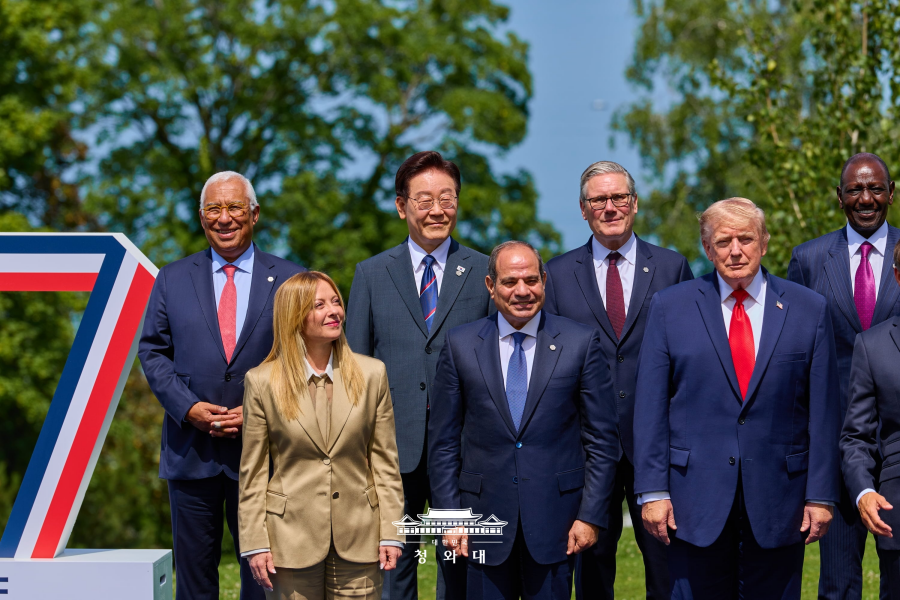
At the G7 Summit held in Évian, France, on June 16–17, President Lee Jae-myung engaged in extensive discussions with fellow leaders on a range of pressing international issues, including development cooperation, global economic imbalances, artificial intelligence, and digital transformation.
The summit underscored the growing importance of international cooperation in responding to increasingly complex transnational challenges. In each session, President Lee shared South Korea's policy experiences and perspectives, highlighting the country's capacity to contribute to global governance, technological innovation, and sustainable development.
In particular, President Lee highlighted South Korea’s role as a responsible global power capable of serving as a bridge between developed and developing countries. He emphasized that the G7’s efforts to promote global development should be based on mutually beneficial cooperation and inclusive partnerships.
President Lee also presented South Korea's vision of a "Global AI Society," in which the benefits of advances in artificial intelligence are shared broadly across humanity.
During a session on forging new partnerships through development cooperation, President Lee observed:
“As public resources alone are insufficient to meet growing development needs, we need partnerships in which development assistance, investment, technology, and institutional capacity work together.”
He further highlighted the importance of mobilizing private-sector investment to address the growing gap in development financing caused by declining aid resources. As an example, he cited a project implemented by the Korea International Cooperation Agency (KOICA), which supported local startups in Indonesia and helped leverage approximately $50 million in private investment through an initial grant contribution of just $1 million.
These initiatives reflect South Korea's evolving role in the international community—not merely as a beneficiary of the international system, but as a responsible contributor committed to advancing global cooperation, stability, and sustainable development.
President Lee Jae-myung's participation in the G7 Summit is expected to yield several important outcomes. First, it will help lay the groundwork for consolidating South Korea's position as a "G7 Plus" country with growing global responsibilities, following its participation in the summit for a second consecutive year since June 2025.
Second, South Korea seeks to make a more active contribution to international efforts aimed at addressing shared global challenges and supporting G7 initiatives in areas such as global economic imbalances, critical minerals, digital transformation, and transnational threats, including illicit drug trafficking. At the same time, the South Korean government aims to build on these efforts and strengthen the country's leadership role in global governance in preparation for its chairmanship of the G20 in 2028.
If the APEC Summit held in Gyeongju last October marked South Korea's initial step toward becoming a responsible global power and provided an opportunity to redefine a national identity commensurate with that role, then President Lee Jae-myung's participation in the G7 Summit and his European tour are significant in that they have helped lay the foundation for enhancing South Korea's strategic autonomy as a responsible global actor.
At the G7 Summit, President Lee Jae-myung held a direct meeting with U.S. President Donald Trump and urged him to play a leading role in pursuing a peaceful resolution to the North Korean issue, thereby advancing diplomatic efforts to bring North Korea back to the negotiating table.
President Lee also engaged in close consultations with President Trump on a range of global and regional issues, including the ROK-U.S. alliance, developments in the Middle East, and challenges on the Korean Peninsula. President Trump responded positively, pledging to “play the necessary role for peace on the Korean Peninsula.” This underscores the South Korean government’s continued commitment to advancing peace and stability on the Korean Peninsula.
This approach seeks to promote universal values and openness within the international system at a time of intensifying great-power competition, growing economic and security fragmentation, and the persistence of hierarchical power structures. At the same time, it emphasizes cooperation and solidarity with major middle powers that share a common interest in preserving a stable, inclusive, and rules-based international order.
As South Korea aspires to become a responsible global power, it must further consolidate the international identity and standing that such a role requires. Historically, the Korean Peninsula's location at the crossroads of major civilizations and competing great-power interests exposed it to prolonged periods of external intervention, colonial rule, national division, and hardship.
Today, however, South Korea is fundamentally different from the country it once was. It has emerged as a nation that commands international attention and contributes meaningfully to addressing major global challenges.
Despite its relatively limited territorial size and the unique geopolitical reality of remaining the world's only divided nation, South Korea has emerged as a capable and responsible actor on a wide range of international issues. According to assessments by leading international media outlets and research institutions, South Korea is now widely regarded as one of the world's most influential middle powers.
Beyond the traditional major powers such as the United States, China, and Russia, South Korea increasingly occupies a position comparable to that of leading European countries—including the United Kingdom, France, and Germany—in terms of its economic strength, technological capabilities, diplomatic influence, and contributions to global governance.
In this sense, South Korea has overcome the historical legacy of peripheralization and colonial rule, transforming experiences of hardship and adversity into a foundation for constructive and responsible engagement with the international community.
The next challenge is to build a broader domestic and international consensus—across intellectual, institutional, and societal spheres—regarding South Korea's identity, responsibilities, and role in global affairs. On the basis of this shared understanding, South Korea can further institutionalize and consolidate its position as a responsible global power.
To effectively project the Republic of Korea's identity as a responsible global power and communicate its role to the international community, South Korea must first articulate the core principles that define such a role.
A South Korea that has emerged as a responsible global power should embody a spirit of confidence, openness, and responsibility grounded in both contemporary global realities and the country's unique historical experience.
This identity should not merely replicate conventional interpretations of liberal democratic values. Rather, it should reflect South Korea's own historical trajectory, developmental experience, and strategic circumstances, while remaining consistent with universal principles of democracy, human rights, peace, and international cooperation.
As a responsible global power, the Republic of Korea bears both historical and contemporary responsibility to transform the constraints that once produced national suffering into sources of opportunity and constructive engagement. Through this transformation, South Korea can contribute to preventing the recurrence of historical tragedies that brought hardship not only to the Korean Peninsula but also to the broader Northeast Asian region.
To fulfill this responsibility effectively, the Lee Jae-myung administration must advance a vision of South Korea grounded in national confidence, openness, and inclusive international cooperation as it seeks to consolidate its role as a responsible global power.
South Korea must maintain a sense of national confidence that resists excessive dependence or undue deference in the face of pressure from major powers that continue to exercise significant military and economic influence. At the same time, in strengthening cooperation with smaller and middle-sized countries, it should avoid any perception of superiority or exclusivity.
Instead, South Korea should embrace a spirit of openness and inclusiveness, actively pursuing cooperation—and, where necessary, solidarity—with countries across the Korean Peninsula, Northeast Asia, and the countries across the globe
Without a firm commitment to national confidence and inclusive engagement, it will be difficult to establish and sustain South Korea's role as a responsible global power.
The Republic of Korea's emergence as a responsible global power grounded in confidence and inclusiveness is not merely an aspirational slogan. Rather, it reflects the country's current international position and the outcome of a careful assessment of its objective capabilities, strategic environment, and leadership potential.
In an international system still shaped by major powers—where strategic competition among great powers persists despite trends toward multipolarity, and where hierarchical structures remain embedded in global supply chains and security architectures—the need for national agency is closely linked to South Korea's geopolitical reality. The Korean Peninsula continues to occupy a strategically significant position at the intersection of major power interests, particularly those of the United States and China.
At the same time, South Korea's commitment to inclusiveness is rooted in its own historical experience: its transformation from a recipient of international assistance into a contributor to global cooperation; its earlier marginalization within the international system; its colonial past; and the enduring tragedy of national division. These experiences have collectively shaped South Korea's commitment to peaceful coexistence, shared prosperity, and international cooperation.
This approach is also consistent with the Lee Jae-myung administration's foreign policy orientation, which seeks to strengthen multilateralism and promote open and inclusive regional and global institutions amid an increasingly fragmented and unstable international environment.
South Korea's international position, together with the historical responsibilities facing the Lee Jae-myung administration and the demands of the current international environment, is reflected in the concept of a responsible global power grounded in confidence and inclusiveness.
For the Republic of Korea as a divided nation, the pursuit of an inclusive and peace-oriented state is not merely a policy objective of a particular administration. Rather, it represents a long-term national mission that transcends changes in government.
As President Lee Jae-myung stated in his commemorative address at the “Special Mass for Peace and Solidarity,” the establishment of a foundation for peaceful coexistence on the Korean Peninsula represents the first step toward becoming an inclusive, peace-oriented nation and a critical pillar in the construction of a responsible global power.
President Lee's attendance at the G7 Summit and his European tour should be understood as an opportunity to plant new seeds for peaceful coexistence on the Korean Peninsula and to lay a durable foundation for South Korea's role as a responsible global power in the international community.
-
PREV [Feature Article]
-
NEXT [Issue Analysis]