

Restraint by Design:
Korea’s Nuclear-Powered Submarine and the Low-Enriched
Case for Allied Confidence

Peter Jaegeul Song
Research Fellow, Korea Nuclear Security Strategy Forum
External Researcher, Korea Environment Institute
1. From "Whether" to "How"
In Gyeongju on October 29, 2025, a question that had shaped South Korea’s defense planning for more than three decades quietly changed form. For years, the debate over a nuclear-powered submarine had revolved around a single question: whether Seoul would ever receive U.S. approval to pursue such a capability. On the margins of the APEC summit, President Lee Jae-myung publicly asked President Trump for access to reactor fuel.
Within a day, the U.S. president signaled his support, and on November 13 the two governments formalized that understanding in a joint fact sheet. The document stated that the United States would support South Korea's development of conventionally armed nuclear-powered attack submarines and cooperate with Seoul on the project‘s key requirements, including arrangements for nuclear fuel.¹
The debate had fundamentally shifted. What had once been a question of permission became a question of implementation. The central issues were no longer political approval but engineering, governance, and alliance management: what type of fuel should be used, how it should be safeguarded, who should oversee compliance, where the submarines should be built, and what industrial base would sustain the program.
This essay examines the programme through that shift. It argues that the case for a South Korean nuclear-powered submarine rests on three propositions that must stand together: first, that the capability is strategically necessary; second, that it is compatible with the global nonproliferation regime rather than an exception carved out from it; and third, that it can be governed with sufficient transparency that South Korea's allies need never rely on trust alone. The thread connecting these three propositions is neither the submarine nor its weapons, but the fuel that powers its reactor.
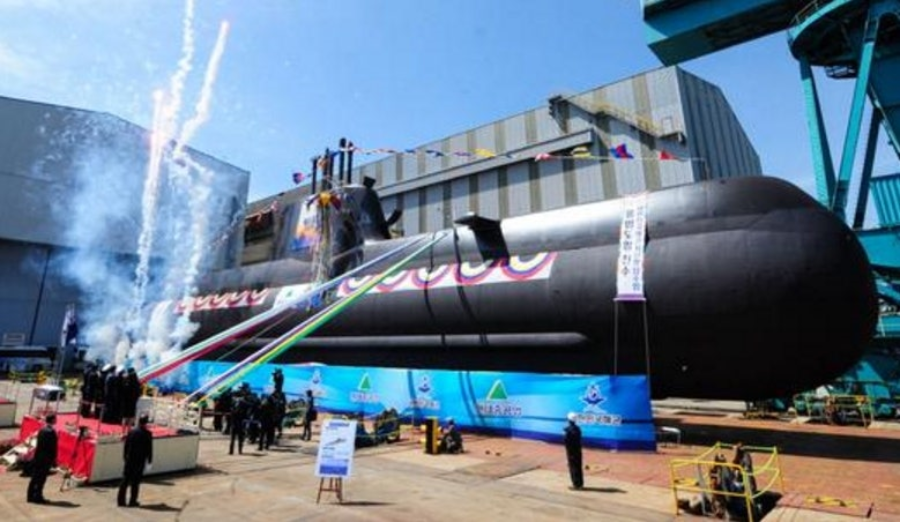
2. The Case from Beneath the Waterline
The argument for necessity begins with an uncomfortable reality: the threat South Korea must confront is itself going nuclear at sea. North Korea declared its intention to develop a nuclear-powered submarine at the Eighth Party Congress in January 2021, and it has since moved from aspiration to construction. In March 2025, Kim Jong-un inspected what North Korean state media described as a “nuclear-powered strategic guided-missile submarine” under construction. Later that year, he returned to unveil a completed hull reported to displace approximately 8,700 tonnes.²
South Korean defense analysts assess that such a platform, if completed and successfully commissioned, could carry both submarine-launched ballistic missiles (SLBMs) and submarine-launched cruise missiles (SLCMs). Its capacity for prolonged submerged operations would significantly complicate the preemptive operational concepts on which the U.S.–ROK alliance has long relied.³ Whether Pyongyang can master naval nuclear propulsion on its own remains uncertain; whether external assistance could substantially accelerate that effort is the more consequential—and unsettling—question.⁴
Against a submerged, mobile, missile-armed adversary, the limits of conventional propulsion are a matter not of prestige but of physics. A diesel-electric submarine must periodically surface or snorkel to recharge its batteries, and its submerged endurance is measured in days rather than months. By contrast, a nuclear-powered submarine can remain submerged for extended periods, transit across the theater at sustained speed, and maintain a persistent presence near an adversary's coast without surfacing. That endurance is precisely what is required to detect, track, and, if necessary, deter a strategic submarine before it can launch its missiles.
South Korea's own development plans reflect this operational logic. They identify the substantially greater endurance, sustained submerged operations, and mobility provided by nuclear propulsion as essential to countering North Korea's submarine-based nuclear and missile threat.⁵
There is also a broader alliance dividend. A South Korean submarine capable of conducting long-endurance anti-submarine warfare and sea-denial missions in its surrounding waters would allow U.S. submarines to concentrate on higher-priority requirements elsewhere in the Indo-Pacific. Properly understood, this is a contribution to alliance burden-sharing rather than a substitute for it.⁶
3. The Fuel is the Policy
The analysis now turns to the reactor—and to the single decision that does more than any other to make the programme strategically and politically defensible. South Korea has chosen to fuel its submarines with low-enriched uranium (LEU). The Ministry of National Defense's development plan, published on May 26, 2026, designates the programme as Jangbogo-N and specifies the use of LEU enriched to below 20 percent, paired with a long-life reactor core designed to minimize refueling over the submarine's operational life. The plan envisages launching the first boat in the mid-2030s following approximately a decade of development and construction.⁷
The significance of that choice is best understood by comparison. The United States, the United Kingdom, and Russia fuel their naval reactors with highly enriched uranium (HEU)—weapons-grade material enriched to more than 90 percent—which allows for compact reactor cores capable of operating throughout a submarine's service life without refueling. Australia, under AUKUS, will receive submarines using the same HEU-based approach.⁸
South Korea has deliberately chosen a different path. France, by contrast, has operated both its Rubis- and Barracuda-class submarines using low-enriched uranium (LEU) for decades, and Seoul's approach most closely resembles the French model rather than the Anglo-American one.⁹
The trade-off is genuine and should be stated plainly. An LEU-fueled reactor stores less fissile material per unit volume than an HEU design, requiring a larger reactor core and periodic refueling over the submarine's service life. That, in turn, places greater demands on refueling infrastructure, maintenance planning, and fleet-availability management.10 South Korea is accepting these industrial and operational costs in exchange for a significant political and legal advantage: fuel that is not directly usable in nuclear weapons and is therefore far less likely to generate proliferation concerns.
The reasoning is familiar in the energy sector. The true cost of a fuel is never measured solely by its energy density or price, but also by the system of dependence, oversight, and trust that accompanies it. Of all the fuels available for naval propulsion, low-enriched uranium carries the lightest burden in that regard.
4. A Seat Inside the Regime, Not Outside It
Fuel choice addresses the proliferation question at the level of physics; law and institutions must resolve it at the level of governance. South Korea proposes to remain exactly what it is: a non-nuclear-weapon state in full compliance with the Treaty on the Non-Proliferation of Nuclear Weapons (NPT), while operating a class of vessel that, until AUKUS, had been fielded only by nuclear-weapon states.
The programme's first commitment is unequivocal: the Republic of Korea will neither possess nor develop nuclear weapons of any kind.⁵ The capability it seeks is a conventionally armed nuclear-powered submarine—a platform designed for undersea surveillance, deterrence, and anti-submarine warfare, not the delivery of nuclear weapons. That distinction has also been reflected in the way the United States has described the programme.¹¹
The legal pathway runs through a provision that lay largely dormant for more than half a century. The Comprehensive Safeguards Agreement that every non-nuclear-weapon state concludes with the International Atomic Energy Agency (IAEA) contains, in Paragraph 14, a mechanism under which nuclear material may be used for a non-proscribed military purpose, such as naval propulsion, pursuant to a special arrangement with the Agency rather than being removed entirely from safeguards accountability. It is this provision that AUKUS brought back to the forefront, and it is through a comparable arrangement that South Korea's programme must proceed.10
Two additional legal considerations shape that pathway. First, the bilateral agreement governing U.S.–ROK civil nuclear cooperation—the so-called "123 Agreement"—defines the legal framework for the transfer of nuclear materials, technology, and equipment. The November joint fact sheet makes clear that U.S. support for South Korea's eventual civil enrichment and reprocessing for peaceful purposes would remain consistent with both the 123 Agreement and U.S. law.
Second, because naval nuclear propulsion falls outside the scope of ordinary civil nuclear cooperation, many analysts expect a dedicated bilateral arrangement for naval propulsion—analogous in principle, though not necessarily identical, to the separate legal framework established under AUKUS—rather than a simple amendment to the existing agreement.¹²
None of this will happen automatically. It will require sustained engagement with the U.S. Congress, close coordination with the IAEA, and careful consultation with the broader nonproliferation community. The critical point, however, is the direction of travel: South Korea is seeking to work through the institutions of the nonproliferation regime, not around them.
5. The Industrial Spine
A nuclear-powered submarine programme is, before anything else, an industrial enterprise. It is in this respect that South Korea's case is especially compelling. The Ministry of National Defense's development plan describes the programme as a national industrial undertaking extending over approximately four decades—roughly a decade for development and construction, followed by three or more decades of operation.
It brings together three sectors in which South Korea already possesses world-class capabilities: shipbuilding, civilian nuclear engineering, and defense manufacturing. The stated objective is to design, build, operate, maintain, fuel, and ultimately decommission these submarines domestically, drawing on an industrial base that has been developed over decades in both the nuclear and shipbuilding sectors.⁵
Anyone who has walked the quaysides and fabrication halls where South Korea builds large commercial vessels and nuclear-energy infrastructure will recognize what that industrial base actually comprises: heavy-plate fabrication held to exacting tolerances; pressure-boundary welding certified to uncompromising standards; the complex logistics of modular assembly; and a domestic supplier network capable of producing primary nuclear components.
The same heavy-engineering expertise that has made South Korean shipyards and their suppliers indispensable to the global maritime and nuclear-energy industries is precisely the expertise that a naval nuclear-propulsion programme demands.
The decision to use low-enriched uranium, though less efficient from an engineering standpoint, carries a quiet industrial advantage. A reactor core requiring periodic refueling transforms what might otherwise be a one-time construction programme into a decades-long cycle of maintenance, refueling, overhaul, and life-cycle support—sovereign, sustained, and highly skilled work undertaken domestically rather than exported abroad.10
This is precisely the logic reflected in the alliance's evolving maritime cooperation. The November joint fact sheet pairs support for South Korea's submarine programme with a bilateral shipbuilding initiative focused on maintenance, repair, and overhaul (MRO), workforce development, supply-chain resilience, and significant South Korean investment in U.S. shipbuilding infrastructure.¹ A country capable of sustaining its own naval reactors while also strengthening its ally's maritime industrial base is making an enduring contribution to alliance capability, not merely requesting a strategic concession.
6. What Transparency Buys
It is tempting to view transparency as merely the price of admission—the inspections and safeguards accepted in exchange for the capability a state seeks to acquire. That framing, however, understates its strategic value. For a country in South Korea's position, verifiable transparency is not a concession extracted by skeptical partners; it is the strategic asset that makes the entire enterprise credible, sustainable, and politically durable.
South Korea has, unusually, chosen to state its constraints in advance. Alongside its decisions on reactor fuel and domestic industrial development, the government's plan publicly commits the programme to fulfilling its nonproliferation obligations with full transparency, acquiring and managing low-enriched uranium in close consultation with the United States, and developing, together with the International Atomic Energy Agency (IAEA), a safeguards arrangement specifically tailored to naval nuclear propulsion.⁵
When the Agency's Director General, Rafael Grossi, visited Seoul in the spring of 2026, his message mirrored that commitment: if South Korea builds these submarines, it must be able to demonstrate—openly, continuously, and verifiably—that their nuclear fuel has not been diverted.⁸ The United States, for its part, has consistently framed its cooperation as fully consistent with the highest nonproliferation standards.¹¹ These are not competing demands but complementary elements of the same governance architecture, viewed from three different institutional perspectives.
The strategic value of that architecture is its durability. A capability granted as a bespoke exception is inherently fragile—vulnerable to the next administration, the next skeptical congressional committee, or the next state asking why it was denied the same opportunity. By contrast, a capability built on the least proliferation-sensitive fuel consistent with operational requirements, governed through an agreed safeguards arrangement, and publicly committed to before anyone demanded it is one that South Korea can defend in any forum where its legitimacy is questioned.
That is the deeper logic of designing restraint into the programme from first principles rather than bolting it on afterward. Strategic necessity gives South Korea reason to ask. Permissibility and transparency are what allow it to keep the answer.
The submarine itself will be silent beneath the surface because of its reactor. The programme that sustains it should aspire to the opposite: to be legible, accountable, and—for precisely that reason—enduring.
References
1. The White House, “Joint Fact Sheet on President Donald J. Trump’s Meeting with President Lee Jae Myung,” 13 November 2025. https://www.whitehouse.gov/fact-sheets/2025/11/joint-fact-sheet-on-president-donald-j-trumps-meeting-with-president-lee-jae-myung/
2. Bizhankook, analysis of North Korea’s disclosed 8,700-tonne strategic nuclear-powered submarine, 29 December 2025. https://www.bizhankook.com/bk/article/31028
3. Korea Institute for Defense Analyses (KIDA) assessment, reported in The Korea Economic Daily (Hankyung), 25 March 2025. https://www.hankyung.com/article/202503257196i
4. Financial News (FN News), on North Korea’s naval nuclear build-up and external-assistance variable, 24 June 2026. https://www.fnnews.com/news/202606240809315698
5. Republic of Korea Ministry of National Defense, “Basic Plan for the Development of the Republic of Korea’s Nuclear-Powered Submarine,” 26 May 2026 (National Strategy Portal). https://nsp.nanet.go.kr/plan/subject/detail.do?nationalPlanControlNo=PLAN0000063404
6. MBC News, on the Gyeongju summit, alliance burden-sharing and the domestic-build / low-enriched-fuel approach, 5 November 2025. https://imnews.imbc.com/replay/2025/nw1400/article/6772547_36776.html
7. The Kyunghyang Shinmun, on the basic plan’s five principles, low-enriched-uranium fuel and launch timeline, 26 May 2026. https://www.khan.co.kr/article/202605261829001/
8. Kookmin Ilbo, on the low-enriched-uranium and IAEA-cooperation approach, the highly-enriched fuel used by other operators, and IAEA Director General Grossi’s Seoul visit, 26 May 2026. https://www.kmib.co.kr/article/view.asp?arcid=1779786840
9. E-News Today, citing the Korea Institute for Maritime Strategy on France’s low-enriched Rubis and Barracuda reactors, May 2026. https://www.enewstoday.co.kr/news/articleView.html?idxno=2435922
10. Newspim, contributed analysis on low-enriched versus highly enriched naval fuel and the IAEA comprehensive-safeguards paragraph 14, 18 June 2026. https://www.newspim.com/news/view/20260618001148
11. VOA Korean, U.S. Department of State statement supporting the ROK’s conventionally armed nuclear-powered submarine programme under the strongest non-proliferation standards, 28 May 2026. https://www.voakorea.com/a/state-department-u-s-supports-south-korea-s-nuclear-powered-submarine-program-052826/8154841.html
12. The Sejong Institute, Sejong Focus, on the two routes for U.S.–ROK naval-fuel cooperation and the AUKUS naval nuclear-propulsion precedent, 2026. https://www.sejong.org/web/boad/1/egoread.php?bd=1&itm=&txt=&pg=2&seq=12917
-
PREV [Issue Analysis]
-
NEXT [Current Affairs Analysis]