

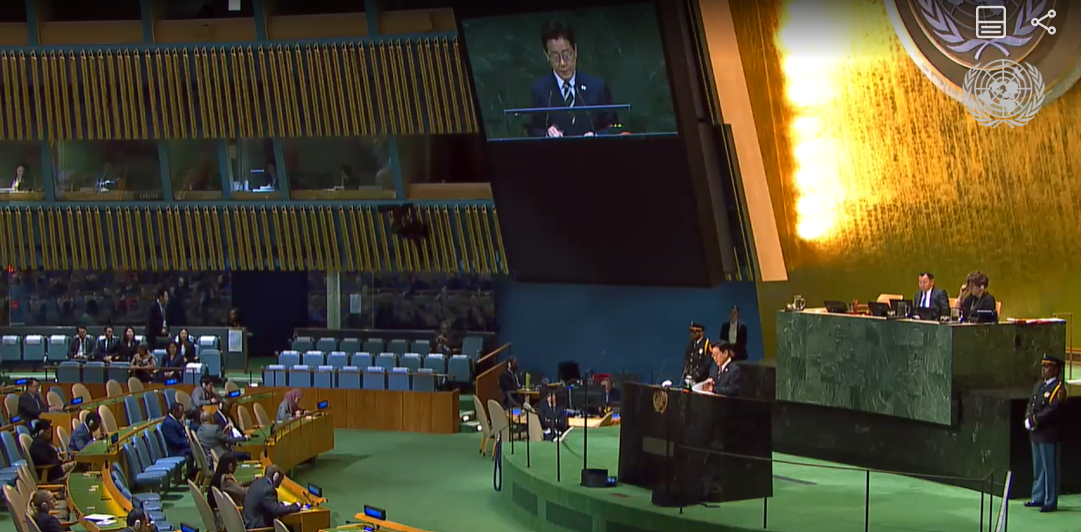
President Lee’s Keynote Address to the UN General Assembly and the Feasibility of Halting North Korea’s Nuclear Program

Ki-young Yoon
Adjunct Professor
Hankuk University of Foreign Studies
1. Introduction:
In his keynote address to the 81st United Nations General Assembly, held at UN Headquarters in New York on September 22 (local time), South Korean President Lee Jae-myung presented the international community with a phased approach to peace on the Korean Peninsula and the North Korean nuclear issue. At the core of this approach is the prompt resumption of the long-stalled U.S.–North Korea dialogue, with an immediate focus on halting further advances in North Korea’s nuclear and missile capabilities, followed by their reduction over the medium term and, ultimately, the pursuit of a “nuclear-free Korean Peninsula.”
President Lee stated, “The Republic of Korea will lay the groundwork for the prompt resumption of U.S.-North Korea dialogue—which has been stalled for a long time—and for its evolution into dialogue among the parties concerned aimed at ending the war on the Korean Peninsula and transitioning to a peace regime.” He noted that U.S. President Donald Trump’s recent decision has created an opportunity for renewed engagement with North Korea and emphasized South Korea’s determination, as a key stakeholder and “pace-setter” for peace on the Korean Peninsula, to open and sustain a path to dialogue.
A particularly noteworthy aspect of the speech is that it did not stop at reaffirming the ultimate goal of “denuclearization,” but instead outlined a phased pathway: “halting the advancement of nuclear and missile capabilities → medium-term reduction → a long-term nuclear-free Korean Peninsula.” Given the extent to which North Korea’s nuclear capabilities have already advanced, this approach can be understood as an effort to first prevent further expansion of those capabilities and then address the broader nuclear issue in stages, rather than seeking to achieve complete denuclearization in the short term.
This approach has practical value. Given the difficulty of resolving the North Korean nuclear issue in a single step, a phased approach can broaden the space for dialogue and help sustain momentum in negotiations. However, “suspension” must not become a substitute for the ultimate objective of denuclearization. It is therefore essential to make clear that preventing further advances in North Korea’s nuclear capabilities is not the endpoint of the denuclearization process, but rather the first step toward achieving that objective.
On August 16, 2026 (local time), U.S. President Donald Trump posted on social media that he intended to significantly scale back the U.S.-South Korea joint military exercise “Ulchi Freedom Shield (UFS).” He cited three reasons for the decision. First, he stated that his relationship with Chairman Kim Jong-un was very good. Second, he argued that the exercises were costly. Third, he said that he had asked President Lee Jae-myung whether South Korea was willing to participate in “Iran’s denuclearization,” but had received a “No, thanks” response. In citing the third reason, Trump acknowledged that it might be “somewhat unrelated” and did not disclose precisely what he had asked South Korea to do.
A single social media post thus combined conciliatory signals toward North Korea, financial considerations, and dissatisfaction with an alliance partner. Although the exercises began as scheduled the following day, South Korean and U.S. military authorities decided on August 19 to shorten the exercise from the originally planned 11 days (August 17–27) to five days (August 17–21). Part 2 of the exercise, which was designed to rehearse counteroffensive operations, was canceled, while only Part 1, focused on defensive operations, was conducted; related field training exercises were also scaled back.
It was unprecedented for a theater-level combined exercise that had already commenced to be curtailed midway through. Reports subsequently indicated that South Korean authorities had not been informed of Trump’s directive in advance, and that Canadian and New Zealand forces participating in the exercise had likewise not received prior notice. Nevertheless, on the evening of August 19, President Lee posted on social media that he welcomed Trump’s decision and said he would fulfill his role as a “pace-maker” in support of Trump, the “peacemaker.”
North Korea’s response was muted. Kim Yo-jong, Director of the General Affairs Department of the Workers’ Party of Korea, sought to downplay the significance of the decision in a statement issued on the evening of August 19, arguing that reducing the scale or duration of the exercises would not change their fundamental nature. The following day, August 20, North Korea launched approximately 10 short-range ballistic missiles from the Pyongyang area toward the East Sea. A month later, while in New York to attend the UN General Assembly, President Lee reiterated, in written interviews with the Associated Press and The New York Times released ahead of his keynote address, his proposal to address the North Korean nuclear issue through a phased and pragmatic approach of “suspension → reduction → dismantlement.”
He also argued that persuading North Korea to halt the development of additional nuclear weapons and intercontinental ballistic missile (ICBM) capabilities in exchange for lifting sanctions that had proven largely ineffective would constitute a deal of considerable strategic value. The framework for this phased approach was first outlined by President Lee in an August 2025 interview with the Yomiuri Shimbun as a three-step plan of “freeze → reduction → dismantlement.” He formally presented the proposal to the international community in his keynote address to the UN General Assembly that September, changing the first step from “freeze” to “suspension.”
The United States wants to engage North Korea in dialogue, but its motivations are multifaceted, and coordination with South Korea does not always appear to be the overriding consideration. The South Korean government has even supported scaling back alliance exercises in an effort to create space for dialogue, while North Korea continues to refuse to engage directly with South Korea.
If the central question in 2018 was, “Will North Korea give up its nuclear weapons?”, the question in 2026 is different: What leverage can South Korea use to shape an agreement between the United States and North Korea, each of which is pursuing its own distinct strategic interests?
No one can predict with certainty where the next phase of North Korea’s nuclear negotiations will lead. It is possible, however, to map out alternative pathways and prepare for each of them. This article examines, in sequence, the reasons behind North Korea’s changed posture, South Korea’s current position, four scenarios based on specific criteria, and South Korea’s possible responses. The factual information is based on verified data; the interpretations and projections presented here reflect the author’s judgment, and I wish to make this distinction explicit.
Why Has North Korea Changed?
North Korea’s changed posture can be explained by five factors.
A New Patron and Weakened Sanctions: In June 2024, North Korea signed a “Comprehensive Strategic Partnership Treaty” with Russia that includes a provision for mutual military assistance in the event of an emergency, and subsequently provided artillery shells, missiles, and troops to support Russia. South Korean and U.S. intelligence agencies, as well as outside experts, assess that North Korea received economic assistance, including oil and food, as well as military technology in return. However, the precise terms and scope of this exchange have not been officially confirmed. In March 2024, the UN Security Council’s Panel of Experts on sanctions against North Korea ceased operations at the end of April after Russia vetoed an extension of its mandate. In September 2026, the Tumen River Automobile Bridge—the first road bridge connecting Rason and Khasan in North Korea and Russia, respectively—opened. On the Chinese side, construction of the North Korean customs facility for the New Yalu River Bridge—which was completed in 2014 but remained closed for 12 years because of the lack of connecting roads and supporting infrastructure on the North Korean side—has reached its final stages.
Trade with China has also increased. According to statistics from the General Administration of Customs of China, North Korea-China trade reached approximately $2.73 billion in 2025, a 25 percent increase from the previous year. During the first half of 2026, bilateral trade reached approximately $1.51 billion, roughly 20 percent higher than during the same period in the previous year. These figures, however, should not be interpreted as evidence that “China has abandoned sanctions.” The 2025 trade volume merely returned to approximately the level recorded in 2019, when UN Security Council sanctions were already in place, and remained only about 40 percent of the approximately $6.9 billion recorded in 2014, before the major sanctions regime was imposed. Judging from trade statistics alone, China appears to be providing North Korea with some economic breathing room while remaining broadly within the existing sanctions framework rather than openly violating it.
What has more directly weakened the impact of sanctions is North Korea’s growing reliance on transactions with Russia and the theft of virtual assets through cyber operations. On February 21, 2025, approximately $1.5 billion worth of virtual assets were stolen from the cryptocurrency exchange Bybit, and the U.S. Federal Bureau of Investigation (FBI) attributed the attack to North Korea. The value of that single cyber theft exceeded half of North Korea’s annual trade volume with China in 2025. With Russia, China, and cyber-enabled cryptocurrency theft providing multiple sources of external support, North Korea has developed greater resilience in the face of sanctions. Having found ways to sustain itself without relying on South Korea, Pyongyang has little incentive to rush into negotiations at this time.
Deep-Seated Distrust of the United States Based on Past Experience: North Korea has witnessed, in succession, the collapse of Muammar Qaddafi’s regime in Libya in 2011—which had abandoned its weapons of mass destruction (WMD) programs, including its nuclear weapons development program, in 2003—the U.S. withdrawal from the Iran nuclear deal in 2018, and the breakdown of the Hanoi U.S.-North Korea summit in 2019.
Although Libya did not possess nuclear weapons at the time, North Korea has repeatedly invoked the Libyan experience as evidence that “giving up nuclear weapons leads to disaster.” The Iran nuclear deal was a 2015 agreement under which the international community agreed to provide sanctions relief in exchange for limits on Iran’s nuclear program. This history was compounded by the 2026 war involving Iran. On February 28—just two days after the third round of U.S.-Iran nuclear talks, mediated by Oman, was held in Geneva on February 26—the United States and Israel launched attacks against Iran. This marked the second instance in which military action occurred while negotiations were underway, following Israel’s June 2025 airstrikes on Iran, in which the United States subsequently joined, while U.S.-Iran talks were ongoing.
In his policy address to the First Session of the 15th Supreme People’s Assembly on March 23, Kim Jong-un condemned the United States for engaging in “state-sponsored terrorism and acts of aggression” around the world and argued that North Korea’s policy of firmly establishing its status as a nuclear-armed state was justified. Although he did not explicitly mention Iran, his assertion that North Korea enjoys a higher level of security than other regions because of its nuclear arsenal was widely interpreted as a reference to developments surrounding Iran.
Nuclear Weapons as a Pillar of the State System: Nuclear weapons serve not only as a deterrent against external attack but also as a pillar of domestic political legitimacy. In September 2022, North Korea enacted the Nuclear Forces Policy Law, which establishes conditions for the use of nuclear weapons, and in September 2023, it enshrined the strengthening of its nuclear forces in the Constitution. In his report on the work of the Ninth Congress of the Workers’ Party of Korea (February 19–25) this past February, Kim Jong-un declared that North Korea’s status as a nuclear-weapon state was “irreversible and permanent.” He stated that abandoning nuclear weapons was categorically out of the question and that North Korea would devote all necessary resources to increasing its nuclear arsenal, expanding its delivery capabilities, and broadening their operational scope.
Now that nuclear capabilities have been successively embedded in law, the Constitution, and the Party’s strategic line, relinquishing them would amount to the leadership undermining a central pillar of its own legitimacy. The National Intelligence Service has assessed that Kim’s daughter, Kim Ju-ae, is being positioned as a potential successor, and if such a succession were to occur, her legitimacy would likewise be difficult to separate from the nuclear program. Some analysts argue that North Korea’s nuclear arsenal serves not only as a means of deterring the United States but also as an instrument for preserving strategic autonomy vis-à-vis China and Russia.
Maturation of Nuclear Capabilities and Signs of De Facto U.S. Acceptance: On August 19, at the White House, Trump stated that Kim Jong-un possessed 57 “very powerful nuclear weapons.” This was the first time a U.S. president had publicly disclosed the number of North Korean nuclear weapons in such specific terms. The Stockholm International Peace Research Institute (SIPRI) estimates that, as of January 2026, North Korea may have assembled approximately 60 nuclear warheads and possesses sufficient fissile material to produce at least 30 additional warheads. Defense Minister Ahn Kyu-baek stated in the National Assembly on August 20 that the number was “generally estimated to be around 80 to 120,” but later clarified that the figure was based on an assessment by a domestic research institute and that it would be difficult to disclose the military’s own estimate.
While estimates vary across institutions, North Korea’s declared strategic direction remains consistent. At the Party Congress, it declared that it would continue expanding its nuclear arsenal and that its status as a nuclear-weapon state was irreversible; in his State of the Nation address, Kim vowed to make that status “absolutely unshakable.” Against this backdrop, it is increasingly likely that the negotiations North Korea seeks would focus not on denuclearization but on arms control conducted on the basis of its status as a nuclear-armed state. The U.S. president has publicly acknowledged North Korea’s nuclear arsenal and decided to scale back joint military exercises before Pyongyang offered anything in return. Although the decision was motivated by factors beyond North Korea, Pyongyang could reasonably interpret it as a signal that Washington may take unilateral steps even if North Korea simply waits.
A Policy Toward the South That Seeks to Erase South Korea: At the December 2023 plenary meeting of the Workers’ Party, North Korea redefined inter-Korean relations as “hostile relations between two states.” In his January 2024 policy address to the Supreme People’s Assembly, Kim Jong-un called for South Korea to be constitutionally designated as the “number one hostile state” and dismantled inter-Korean organizations such as the Committee for the Peaceful Reunification of the Fatherland. On October 15 of that year, North Korea destroyed sections of the inter-Korean roads connecting the Gyeongui and Donghae lines. Even amid the subsequent reduction in the scale of U.S.-South Korea military exercises, North Korea responded with derision rather than reciprocating the South Korean government’s outreach. In a statement on August 20, Kim Yo-jong dismissed President Lee’s message as “hypocritical words and deeds,” while emphasizing that relations between Trump and Kim Jong-un remained favorable. North Korea’s position is that it will engage with the United States while refusing to deal directly with South Korea. This remains the central obstacle to Seoul’s policy toward Pyongyang.
Why Is the United States Taking Such an Active Stance?
For Trump, North Korea may also represent a source of political leverage. With the November 3 midterm elections approaching, it may be difficult for the administration to portray the conflict involving Iran as an unambiguous diplomatic achievement. Against this backdrop, some analysts have pointed to the possibility that diplomatic engagement with North Korea could provide a political achievement, particularly following Trump’s August 19 announcement that he would meet with Kim Jong-un before the end of the year. However, U.S. activism does not necessarily guarantee sustained engagement. Washington’s attention and resources remain divided between the Middle East and efforts to manage strategic competition with China, while concerns about the potential neglect of U.S. allies have been raised both in Japan and within Congress. The Nuclear Non-Proliferation Treaty (NPT) framework presents another constraint. The NPT is the principal international treaty designed to prevent the spread of nuclear weapons beyond the five recognized nuclear-weapon states, and North Korea announced its withdrawal from the treaty in 2003. Taking these factors together, U.S. engagement is likely to be active but potentially short-lived. Summit-level diplomacy could therefore take precedence over the prolonged working-level negotiations required to address the details of denuclearization, arms control, and verification.
Where Does South Korea Stand?
South Korea faces three major constraints in negotiations involving North Korea.
First, North Korea does not recognize South Korea as a legitimate negotiating partner. Whether the issue involves climate cooperation or humanitarian assistance, direct proposals from Seoul are unlikely to receive a meaningful response in the near term. Washington therefore remains the practical channel through which South Korea can influence the substance and sequencing of negotiations.
Second, South Korea’s influence in Washington is increasingly shaped by a transactional dimension of the alliance. Trump’s decision to cite South Korea’s refusal regarding the Iran issue while simultaneously ordering a reduction in military exercises may have been intended to signal that Seoul’s unwillingness to support U.S. requests outside the Korean Peninsula could carry consequences for issues directly affecting the peninsula. Even where South Korea believes that a refusal is justified, it must assess in advance the potential costs and develop a strategy for managing them.
Third, South Korea’s own policy choices shape the negotiating environment. The government publicly welcomed the reduction in military exercises, despite the decision having been made without prior consultation. While this may have been intended to preserve momentum toward dialogue, accepting a unilateral reduction without securing a corresponding commitment from North Korea could establish a precedent in which alliance assets become bargaining instruments without reciprocal concessions. If Seoul seeks to serve as a “pace-maker,” it must first define clearly what it supports and where it is prepared to draw a line.
South Korea also possesses meaningful leverage. Investment in the United States, as well as cooperation in shipbuilding and defense, are among the priorities of the Trump administration. Whatever agreement may ultimately be reached, South Korea is among the countries best positioned to help bear the implementation costs—including financial contributions and infrastructure cooperation—and to monitor compliance with any agreement.
In the November 2025 U.S.-South Korea joint fact sheet, the United States agreed to support South Korea’s construction of nuclear-powered submarines and to support consultations regarding uranium enrichment and spent nuclear fuel reprocessing for peaceful purposes, consistent with the U.S.-South Korea Nuclear Agreement and applicable U.S. legal requirements. The fact that South Korea can potentially expand or adjust its strategic options depending on the outcome of negotiations is a variable that both Washington and Beijing are likely to take into account. Yet no comprehensive strategy has been developed for integrating these instruments into negotiations over the North Korean nuclear issue.
Four Scenarios
These four scenarios are not predictions about what will happen. Rather, they are conditional pathways intended to support strategic preparation. The scenarios are organized around two questions. First, will North Korea and the United States reach a nuclear-related agreement? Second, if they do, will the agreement be limited to ICBMs capable of threatening the U.S. homeland, or will it also address North Korea’s nuclear capabilities directed against South Korea—including the production of fissile material and short-range delivery systems—and establish a pathway for subsequent negotiations?
Even if the agreement includes a “suspension of ICBM development,” a deal that ends there would amount to tacit acceptance of North Korea’s broader nuclear program. By contrast, an agreement that includes a freeze on fissile-material production and a timetable for subsequent reduction negotiations would represent an initial step toward phased denuclearization. Even the Lee Jae-myung administration’s “suspension → reduction → dismantlement” framework could be characterized as a “small deal” if only the first stage were implemented. The critical distinction is whether the agreement establishes a credible pathway toward the second stage. If no agreement is reached, or if the outcome is merely a political declaration without substantive nuclear provisions, the result would be a continuation of the status quo. If tensions escalate into military confrontation in the absence of an agreement, the situation would instead move toward a crisis scenario.
Nuclear Tolerance Deal Scenario: This scenario envisions the United States effectively accepting the existence of North Korea’s nuclear arsenal while seeking to constrain or eliminate only its ICBM capabilities. ICBMs are generally defined as ground-launched ballistic missiles with ranges exceeding 5,500 kilometers; systems launched from North Korea could therefore threaten the U.S. mainland. Under this scenario, North Korean nuclear capabilities capable of threatening South Korea, Japan, and China would remain largely intact. The scenario can be divided into two pathways depending on the scale of U.S. concessions. If the concessions are limited—such as partial sanctions relief and further reductions in military exercises—it would constitute a “small deal.” If the agreement included more substantial concessions, such as a reduction in U.S. Forces Korea, suspension of major joint exercises, or even a peace treaty, it would amount to a “big deal.” The possibility of pursuing a “big deal” without meaningful South Korean participation is not merely hypothetical. Reports that the reduction of this year’s military exercises was decided without prior consultation with South Korean authorities illustrate the possibility.
This scenario, however, is more difficult to implement than it might initially appear. The central challenge is verification. Mobile, solid-fuel ICBMs can be dispersed and concealed, while their launch preparation times are relatively short. Verifying a commitment not to “develop” such systems would therefore require intrusive inspections that North Korea is unlikely to accept. A more realistic outcome might be a moratorium on ICBM launches and nuclear testing rather than a verifiable prohibition on development. Under the NPT framework, Washington would also face significant political and legal difficulties in formally recognizing North Korea as a nuclear-weapon state. The result would therefore amount to de facto, rather than formal, acceptance of North Korea’s nuclear status. Moreover, as the value of sanctions relief declines, Pyongyang is likely to demand greater security concessions in return. The greater those demands become, the more a limited arrangement could evolve into a “big deal.”
A Status Quo Scenario Lacking Substantive Progress: This scenario involves either the absence of dialogue or dialogue that fails to resolve the nuclear issue. One possibility is prolonged stalemate. It is unlikely that the current U.S. administration would maintain a maximalist commitment to complete denuclearization indefinitely if Pyongyang refuses to engage. Negotiations could instead stall over verification, sequencing, or the status of U.S. forces in South Korea. Given North Korea’s strengthened relationship with Russia and the economic and military benefits it has derived from the Russia-Ukraine war, Pyongyang has limited incentives to rush into negotiations. Another possibility is a largely symbolic summit. As in the 2018 Singapore summit, the two leaders could issue broad statements on “improved relations” and “peace” without reaching substantive agreement on the nuclear issue. Trump could claim a diplomatic achievement, while Kim Jong-un would gain international visibility and political legitimacy. Meanwhile, North Korea’s nuclear arsenal could continue to expand. Both pathways are already plausible and could become reality.
The Scenario of Phased Disarmament and Risk Reduction: This pathway would involve an exchange of measures such as a freeze on fissile-material production, advance notification of missile tests, establishment of a military hotline, and the opening of a liaison office in return for phased economic and diplomatic benefits. Crucially, the agreement would also include a timetable for subsequent negotiations on nuclear reductions. Denuclearization would remain the long-term objective, while immediate risks would be reduced first. This is the outcome most consistent with South Korea’s security interests and would require substantial diplomatic effort from Seoul, but it is also the most difficult scenario to achieve.
The difficulty arises not only from verification and the lack of mutual trust but also from the declining value of sanctions relief. The same factor that complicates a nuclear-tolerance arrangement also constrains a phased-disarmament approach. Limited sanctions relief alone provides North Korea with insufficient incentive to make the more consequential concession of freezing fissile-material production. For this scenario to become viable, China and Russia may need to provide forms of compensation that Western sanctions relief cannot replicate. The specific nature of such incentives requires separate consideration.
The end of the Russia-Ukraine war is often cited as a potential catalyst for negotiations, but it should not be treated as a guarantee. The North Korea-Russia treaty remains in effect regardless of the outcome of the war. After the conflict ends, Russia may continue to require North Korean military production as it rebuilds its defense industrial base. A reduced wartime burden could even increase Moscow’s capacity to provide certain forms of technology or economic assistance to Pyongyang. The end of the war should therefore be viewed as an opportunity to reassess the negotiating environment rather than as an automatic trigger for renewed diplomacy.
Crisis Escalation Scenario: This is a hypothetical sequence in which negotiations collapse, North Korea conducts a seventh nuclear test, Russia transfers additional nuclear-submarine or satellite-related technology, and accidental military clashes occur in the Yellow Sea. If such developments coincided with a crisis involving Taiwan, the Korean Peninsula could become a major theater in a broader confrontation among the great powers. Although the probability of this scenario may be relatively low, its potential consequences would be the most severe.
Leading Indicators by Scenario
To make these scenarios useful for strategic planning, policymakers need indicators that can reveal which trajectory is emerging. The table below summarizes the definition, leading indicators, and implications for South Korea associated with each scenario.
In practice, events rarely follow a single scenario in a linear fashion. A process could begin with a symbolic summit and evolve into a tacit nuclear-tolerance arrangement, or negotiations could reach an impasse and subsequently spiral into a crisis. South Korea’s task is therefore to identify shifts in trajectory as early as possible and, at those critical moments, use its available leverage to move the process in a more favorable direction.
Major Trends Shaping the Scenarios
All four scenarios will be influenced by broader developments beyond the Korean Peninsula. Three trends are particularly important.
Multipolarization and Sanctions Evasion: Political support from major powers and economic channels that circumvent sanctions increasingly reinforce one another. The most direct channels available to North Korea include the Russia-related transactions discussed above, trade with China conducted within or at the margins of the sanctions framework, and cyber-enabled theft. The BRICS payment-network initiative remains at an early stage. On September 11, 2026, the Russian Direct Investment Fund (RDIF) announced that it had reached an understanding with BRICS Pay to explore ways of linking BRICS Pay with India’s payment infrastructure and preparing for a potential pilot project, although no specific timetable was provided.
India, which holds the BRICS chair this year, has promoted discussion of linking central bank digital currencies (CBDCs) and high-speed payment systems among member states, while drawing a distinction between payment interoperability and the creation of a common currency. India has also remained cautious about allowing BRICS to be perceived as an explicitly anti-dollar bloc. Sanjay Malhotra, Governor of the Reserve Bank of India, stated on August 11 that various proposals, including the interconnection of CBDCs and high-speed payment systems, remained under discussion. These developments are unlikely to generate immediate benefits for North Korea. Over the longer term, however, the institutionalization of payment mechanisms outside Western financial networks could reduce the effectiveness of sanctions enforcement.
This trend changes the relative value of bargaining instruments. As the value of sanctions relief declines, the value of concessions that cannot easily be replicated through alternative economic channels increases. These include normalization of relations with the United States, access to international financial institutions, written security assurances, and mechanisms for coordinating military activities. This dynamic could push nuclear-tolerance arrangements toward broader “big deals” and require a fundamental reassessment of the incentives offered in a phased-disarmament framework.
Climate Change: North Korea’s extensive deforestation leaves the country highly vulnerable to flooding and drought. The massive Yalu River flooding that affected the Sinuiju and Uiju areas in late July 2024 demonstrated how climate-related disasters can aggravate food insecurity and increase the regime’s vulnerability. Early-warning systems, forest restoration, and management of shared waterways such as the Imjin River represent among the least politically sensitive areas for potential cooperation. Yet North Korea’s designation of South Korea as an enemy state makes even these issues difficult to address through direct inter-Korean channels.
International organizations and multilateral frameworks therefore provide a more realistic avenue. Under a phased-disarmament framework, such cooperation could form part of a broader package of incentives. The proposal to import Russian energy through North Korea cannot be pursued while sanctions on Russia remain in place and South Korea continues to participate in those sanctions; it therefore remains a distant, long-term possibility. Under the crisis-escalation scenario, climate-related disasters could further compound internal instability in North Korea.
Demographic Change: South Korea’s total fertility rate in 2025 was 0.80 on a preliminary basis, an increase of 0.05 from the previous year and the second consecutive annual increase. Nevertheless, the decline in the pool of military-age men is largely predetermined by birth cohorts from two decades earlier. According to analyses by the Korea Institute for Defense Analyses (KIDA) and others based on future population projections from Statistics Korea, the population of 20-year-old men declined from approximately 330,000 in 2020 to about 230,000 in 2025 and is projected to fall into the 120,000 range by the early 2040s. First and foremost, maintaining deterrence primarily through troop numbers will become increasingly difficult.
At the same time, demographic pressures could make conventional arms control more attractive to South Korea. A state facing a shrinking military has less to lose from mutually agreed limitations on force levels and forward deployments. This creates an incentive to combine phased nuclear risk reduction with conventional confidence-building measures similar to those contained in the September 19, 2018 inter-Korean military agreement. As fiscal pressures increase with population aging, debates over the costs of cooperation with North Korea and the potential costs of future unification will also become more consequential.
What Should South Korea Do?
If South Korea is to influence this trajectory, it needs both usable leverage and a strategy for connecting that leverage to the terms of negotiations. Seoul cannot determine which scenario will ultimately unfold. It can, however, do two things: establish a robust foundation capable of protecting national security under any scenario, and then use that foundation to steer developments toward a more favorable outcome.
Policies Necessary Under Any Scenario
First, South Korea needs a deterrence strategy that does not depend primarily on troop numbers and an alliance grounded in enduring shared interests. The military should continue shifting toward advanced technologies, unmanned systems, and highly capable specialized units, while the reserve-force system should be reformed. The principle that U.S. Forces Korea, extended deterrence, and the U.S.-ROK Nuclear Consultative Group (NCG) should not become bargaining chips in U.S.-North Korea negotiations should also be formally documented between the two governments. Extended deterrence refers to the U.S. commitment to defend its allies using the full range of available capabilities, including nuclear capabilities. The NCG, established in July 2023 following the April 2023 Washington Declaration, provides a bilateral mechanism for consultations on nuclear deterrence and related strategic issues.
Yet this year’s reduction in a major combined exercise after a single presidential social-media post demonstrated that written understandings alone may not be sufficient. South Korea should therefore broaden the U.S. domestic constituency supporting the alliance, including Congress, the Department of Defense, and industries and states that benefit from shipbuilding and defense cooperation with South Korea. Seoul should also maintain close engagement with Congress to preserve domestic legislative mechanisms—including provisions of the National Defense Authorization Act (NDAA) that place restrictions on reductions in U.S. Forces Korea—that reinforce alliance stability.
South Korea should not avoid debate over nuclear armament, but it should assess such options through a rigorous cost-benefit framework. Unlike North Korea, which has external partners capable of mitigating some sanctions pressure, South Korea is deeply integrated into the dollar-based international financial system and would bear substantial costs from any major sanctions regime. There is also a middle ground between nuclear armament and simply maintaining the status quo: continuing the development of nuclear-powered submarines under the pathway opened by the 2025 U.S.-ROK Joint Fact Sheet, while pursuing any future enrichment and spent-fuel-reprocessing activities strictly within the framework of the NPT, the U.S.-ROK Nuclear Agreement, and IAEA safeguards. Such capabilities could provide both strategic options and a potential hedge, but if transparency were compromised, they could be interpreted as contributing to a regional nuclear domino effect. Strict compliance with IAEA safeguards would therefore be indispensable.
Second, South Korea needs principles and standards governing alliance contributions that remain consistent across administrations. In an increasingly multipolar environment, Washington, Beijing, and Moscow all pay close attention to Seoul’s decisions. Inconsistent commitments are of limited value as bargaining instruments. The National Assembly should work toward bipartisan agreement on basic principles for North Korea policy and initiate a broader public debate over how South Korea should define its relationship with North Korea. Given the fiscal pressures associated with population aging, South Korea should also establish clear parameters for the maximum resources it is prepared to commit to inter-Korean cooperation. As in the case of Iran, Seoul should establish in advance criteria governing the extent to which it will respond to U.S. requests concerning issues outside the Korean Peninsula. Clear criteria would make even a refusal more predictable and could reduce the likelihood that disagreements over unrelated issues spill over into alliance management on the Korean Peninsula.
Third, South Korea should preserve open channels of communication. While maintaining the alliance as its strategic foundation, Seoul should avoid becoming confined to a rigid South Korea-U.S.-Japan versus North Korea-China-Russia framework. Relations with China should be managed in a stable manner, minimum channels of communication with Russia should be preserved, and coordination with Japan should continue given shared security concerns. With respect to North Korea, Seoul should advance low-politics initiatives—such as advance notification of dam releases, disaster early-warning systems, and forest restoration—through international organizations and multilateral mechanisms. Even if an immediate response is unlikely, South Korea should continue making proposals that are low-cost and carry little downside if rejected. During periods of strategic stalemate, such channels may provide one of the few remaining points of contact; during crises, they can help mitigate escalation.
Policies That Can Help Shape a Desirable Future
For South Korea, a desirable outcome would involve phased denuclearization accompanied by risk reduction. Although this pathway is difficult to achieve, Seoul can take steps to improve its prospects. Four approaches are particularly important.
First, attach conditions to support. Because North Korea is currently unwilling to engage directly with South Korea, Seoul should first communicate its position to Washington. While continuing to support U.S.-North Korea dialogue, South Korea should provide Washington with a written statement of the minimum conditions for an agreement that Seoul could support. South Korea should not support an arrangement limited to a suspension of ICBM launches. The agreement should also include a freeze on fissile-material production and a timetable for subsequent negotiations on nuclear reductions. U.S. Forces Korea and extended deterrence should remain outside the negotiating agenda.
If President Trump seeks a summit-level event, Seoul should work with Washington to ensure that any joint declaration includes at least a military hotline, advance notification of missile tests, and a schedule for follow-on working-level negotiations. These conditions will carry leverage only if they are tied to South Korea’s own contributions. The logic is straightforward: if South Korea will inevitably bear a substantial share of the implementation costs of an agreement, it has a legitimate interest in ensuring that the agreement reflects its core security requirements. Only under those conditions can a symbolic summit or limited “small deal” become the first stage of a credible phased process.
Second, design incentives that North Korea cannot readily obtain elsewhere. North Korea cannot be persuaded by benefits that China and Russia can provide relatively easily, such as oil, food, trade, or certain forms of military technology. The incentive structure should therefore focus on benefits that cannot be readily substituted. These could include calibrated adjustments to U.S. unilateral and secondary sanctions that permit third-country companies to engage in lawful trade with North Korea; pathways toward membership in or support from international financial institutions; the establishment of a U.S.-North Korea liaison office and eventual normalization of diplomatic relations; written security assurances; and adjustments to military activities based on the scope and sequencing agreed upon by South Korea and the United States. These incentives should be tied to clearly defined implementation benchmarks so that each concession is matched by a verifiable North Korean step.