

The
Dilemma of the Juche Idea: The Pillar of North Korea's Regime Sustaining Power
-
Hegemony through Kim Il-sung's Political Immortality
-
Lee Seung-hyun, Researcher(Ph.D. in Public Administration)
(Source : Rodong Sinmun)
In 2023, North Korea's primary goal is to sustain its regime by adopting a confrontational stance towards the United States, banking on nuclear weapons even with long-term sanctions and economic hardships caused by the COVID-19 pandemic. The country is making threats of a 7th nuclear test and announcing plans to launch a military satellite, highlighting its emphasis on military might. It is noteworthy that the cost of the 71 missiles launched by North Korea in 2022 was roughly 260 billion won (equivalent to around 200 million dollars), which could have been used to feed North Korean citizens for 46 days. A 2022 study by the Korea Institute for Defense Analyses (KIDA) revealed that the cost of North Korea's nuclear program ranges from a minimum of 1.1 billion dollars to a maximum of 1.6 billion dollars (equivalent to 2 trillion won), which could buy 1.41 to 2.05 million tons of rice or 2.82 to 4.1 million tons of corn. It is evident that the North Korean regime prioritizes the development of military capabilities centered around nuclear weapons and missiles for regime survival over ensuring its citizens' access to food.
Maintaining the power that a regime holds is essential for its survival, as numerous studies on power have shown. For authoritarian regimes like North Korea, the ruler's survival is closely linked to the regime's survival, and the people are the fundamental means by which the ruler maintains power. John Locke's "Two Treatises of Government", published in 1689, argue that individuals have the right to resist political power by force when a minority exercises tyranny and violates the rights to life and property. However, the fall of communism in Eastern Europe that occurred in the 1990s was primarily due to economic problems, which aligns with this argument. A 2022 study by the Korea Institute for Defense Analyses (KIDA) revealed that the cost of North Korea's nuclear program ranges from a minimum of 1.1 billion dollars to a maximum of 1.6 billion dollars (equivalent to 2 trillion won), which could buy 1.41 to 2.05 million tons of rice or 2.82 to 4.1 million tons of corn. It is evident that the North Korean regime prioritizes the development of military capabilities centered around nuclear weapons and missiles for regime survival over ensuring its citizens' access to food.
The fall of communism was limited to Eastern Europe and some Latin American communist countries, while communist countries in the Asian region, such as China, North Korea, and Vietnam, maintained socialist systems based on nationalistic and feudal societal structures and perceptions. In particular, North Korea has established the idea of 'Juche’ as an 'ideological system' in domestic and international situations, as well as developing the 'Juche ideology' into its unique ideological system of 'our-style socialism.' This has allowed North Korea to establish its own political ideology that differs from traditional socialism based on Marx's concept, Vladimir Lenin and Joseph Stalin's Real Socialism, and Antonio Gramsci's ‘revisionism in socialism’.
In the face of the Arduous March from 1995 to 1998, during which over a million North Koreans died from starvation, many expected the regime to collapse. However, there was no political resistance within North Korea. Instead, the regime implemented a "military-first" policy, prioritizing military power over securing food for its people. The regime has also relied on the ideology of 'Juche' to maintain its power and overcome crises, including the death of its supreme leader, long-term sanctions caused by nuclear development, and the COVID-19 pandemic.
The Juche idea, first introduced by Kim Il-ung, was institutionalized as an ideology during the Kim Jong-il era, shaping the North Korean society's governance structure and political system, and creating a distorted consciousness among the oppressed class. This political inertia reinforces the regime's hegemony, and the dominant ideology is further entrenched during the succession process to Kim Jong-un, allowing the regime to sustain and prolong its rule.
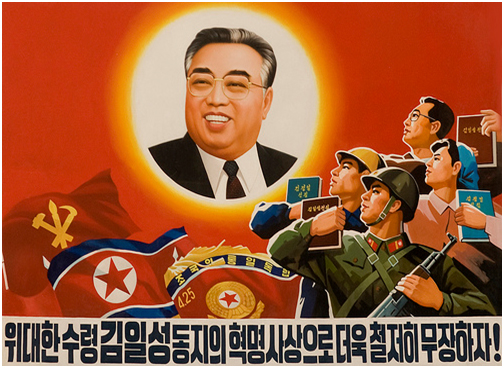
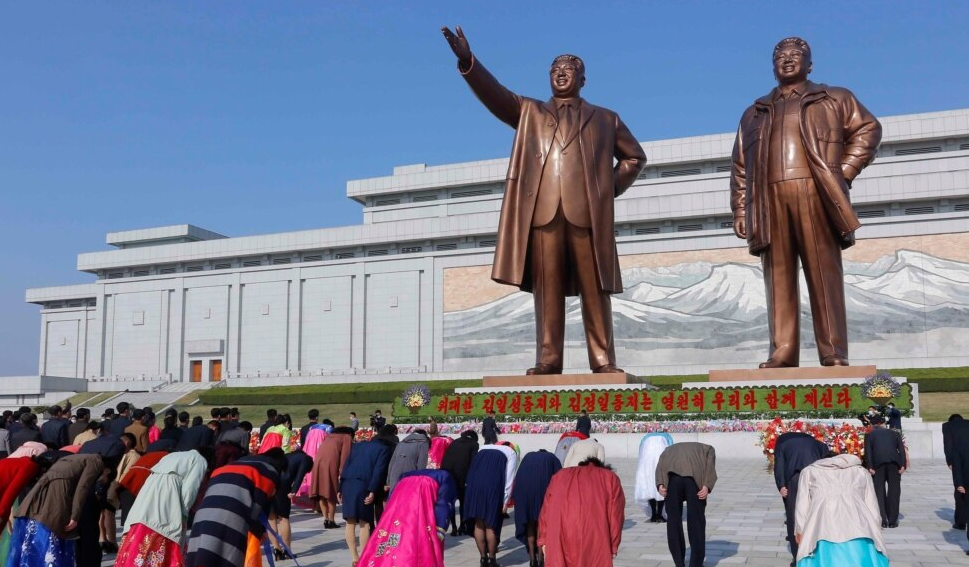
North Korea's dominant ideology is based on the Juche idea, which was formed by Kim Il-sung and became the foundation of the nation's political system. This ideology structures the mechanisms of governance, including the surveillance and punishment of the subjugated class, education and culture, information control, and institutionalized power relations. These mechanisms create a form of "non-voluntary consent" to the regime's power through political inertia and the perpetuation of false consciousness. Despite the absence of Kim Il-sung, his ideology continues to serve as the basis of North Korean society and governance as the “supreme leader” with "hegemony" that sustains the country.