
Nam Sung-wook
Chief of Convergence Institute of National Unification at Korea University

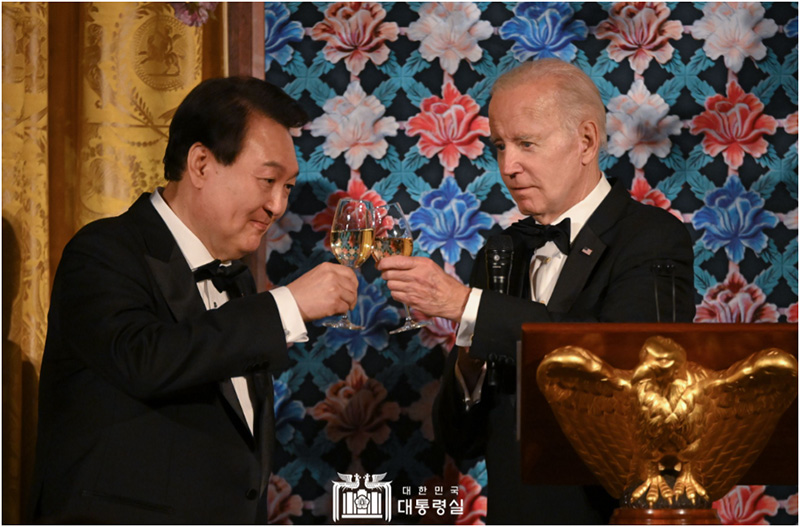
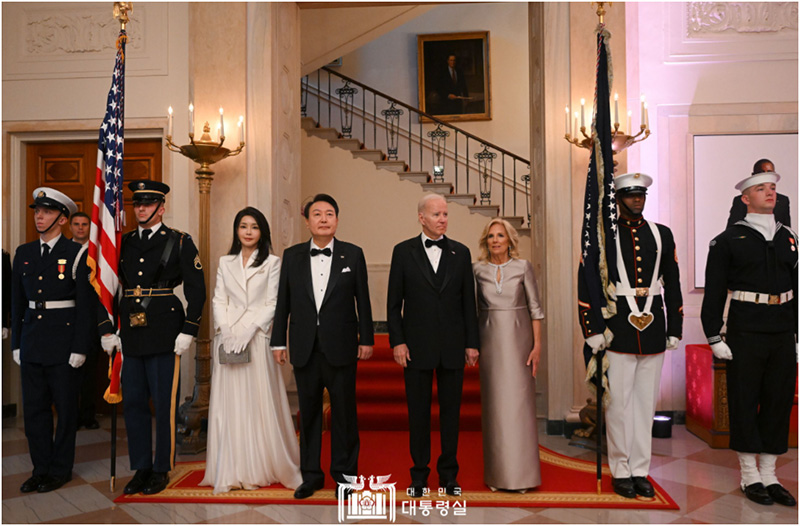
"The Washington Declaration is a heinous embodiment of a policy aimed at hostility and aggression towards North Korea, reflecting the most hostile and aggressive intentions. It has convinced us that 'our second mission to nuclear deterrence, must be complete.' And it has created an environment in which North Korea must take more decisive action. The delusions of the United States and South Korea will face an even stronger reality of power in the future." Kim Yo-jong, Deputy Director of the Workers' Party of Korea (WPK), responded strongly to the ROK-US summit's "Washington Declaration" for strengthened containment. She also had harsh words for the ROK-US summit. She referred to US President Joe Biden's comments about the "end of regime" as "the words of an old man with no future.", criticizing South Korean President Yoon Suk-Yeol as "a miserable person who blindly supports the meaningless declaration."
The parliamentary opposition has criticized the Washington Declaration as a mere symbolic gesture that appears impressive but lacks actual power in response to North Korea's nuclear threat. Some media outlets have criticized the White House for its response to the explanation given by the Office of National Security, which suggested that the operation of the Nuclear Consultative Group (NCG) could be interpreted as "nuclear sharing."
However, if the Washington Declaration is truly an empty gesture in response to North Korea's threats, then why is North Korea claiming that they will take "decisive action" against it?
Meanwhile, there are some nuclear proponents who have criticized South Korea for relinquishing its right to nuclear development by committing to non-proliferation. They express regret that South Korea's nuclear armament is hindered at its source due to the country's commitment to international obligations under the Treaty on the Non-Proliferation of Nuclear Weapons (NPT) and the Cooperation Agreement between the Republic of Korea and the United States for the Peaceful Uses of Nuclear Energy. Some proponents even express skepticism about the trustworthiness of the US nuclear umbrella, arguing that nuclear armament should be the ultimate security strategy. They often refer to a question posed by French President Charles André Joseph Marie de Gaulle to US President John Fitzgerald Kennedy in 1961: "Can you give up New York to save Paris?"
While some evaluate the Washington Declaration as a significant document as the "first nuclear pledge," others point out that it does not reach the level of NATO's nuclear sharing.
The National Security Office in Yongsan and the ruling party evaluate it as the second Mutual Defense Treaty Between the United States and the Republic of Korea.
According to them, while the 1953 Mutual Defense Treaty between the United States and the Republic of Korea was based on conventional weapons, the Washington Declaration is founded on nuclear weapons.
An objective and logical analysis of the security implications of the Washington Declaration reveals that its core lies in the NCG, which is the first permanent consultative body that specializes in nuclear-related discussions. The NCG comprises assistant secretaries from both the South Korean and US defense ministries.
The NCG established by the Washington Declaration is different from existing bodies such as the Extended Deterrence Strategy Consultation Group (EDSCG), which are not regular communication channels. The NCG holds meetings four times a year, with two to three meetings scheduled for this year. Through tabletop exercise (TTX), South Korea and the US will discuss various scenarios, leading to the emergence of concrete plans for nuclear operation.
Next, the question arises whether or not the situation can be considered as actual nuclear sharing. Kim Tae-hyo, the first Office of National Security, stated that "As we have established information sharing and joint planning mechanisms for US nuclear weapon operations, citizens may feel as if we are practically sharing nuclear weapons with the US."
The NCG, created by South Korea and the US, shares similar intentions with NATO's Nuclear Planning Group (NPG). However, the key difference is that NATO currently has over 150 tactical nuclear weapons (such as the Tactical Nuclear Weapon B61 nuclear bomb) deployed, while South Korea does not. In addition to the difference in actual deployment of tactical nuclear weapons, NATO conducts training exercises in which member states' combat aircraft fly simulated tactical nuclear bombs, while South Korea and the US have only conducted TTXs so far. However, the symbolic significance of the NCG is comparable to that of NATO.
The Mutual Defense Treaty between the United States and the Republic of Korea was a reflection of the security situation in the 1950s, whereas the Washington Declaration is tailored to reflect the current security characteristics of the Korean peninsula in 2023, and is referred to as a "Korean-tailored nuclear sharing" approach. However, comparing the NPG with the NCG is like comparing apples to oranges.
President Yoon stated in a press conference that "in the event of a nuclear attack by North Korea, we have promised to take an overwhelming response using all of our alliance's power, including US nuclear weapons." President Biden did not mention nuclear weapons specifically, but stated that "if North Korea carries out a nuclear attack, it will bring about the end of its regime." The Washington Declaration explicitly addresses the current security situation on the Korean Peninsula by stating that the US will support Korea's extended deterrence with its capabilities, including nuclear weapons and precision conventional weapons. However, the declaration emphasizes a defensive posture and will not conduct preemptive strikes unless provoked by North Korea.