

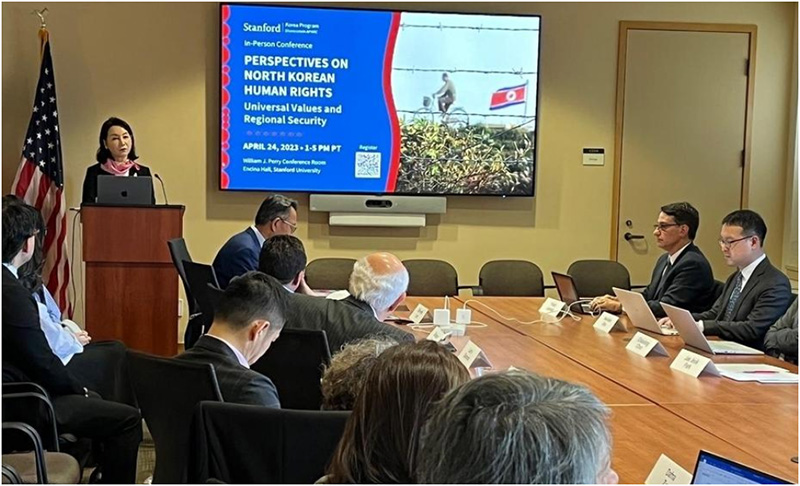
Shin-wha Lee
Ambassador for International Cooperation on North Korean Human Rights
Human rights, a universal value intrinsic to all individuals, should ideally exist beyond the realm of political disputes. However, the grim reality is that human rights issues in North Korea often become subject of political controversy. Undeniably, Kim Jong Un regime stands as one of the most oppressive, having committed some of the most egregious human rights violations compared to other dictatorships and authoritarian systems.
Primarily, there are three key areas of concern related to Human rights in North Korea. First is the gross human rights abuses committed against the North Korean people by the Kim regime. Second, the dire circumstances faced by North Korean defectors and workers overseas, particularly those who have experienced significant human rights infringements such as forced repatriation and trafficking in countries like China. Lastly, the kidnapping and detention of foreigners, including South Koreans and Prisoners of War(POWs), undertaken by the North Korean regime during and post-conflict.
In North Korea, the human rights condition is distressing. The ruling Kim family and a select few elites luxuriate in what they label "the ills of capitalism," whilst the vast majority of the population struggles with severe food shortages, lack of information, and restrictions on mobility and freedom of expression. Despite North Korea’s signature on multiple UN human rights conventions, it continues to rank among the worst countries for basic human rights, scoring a mere score of 3 out of 100 in a Freedom House survey.
It is important to highlight the connection between North Korea's military aggression and its human rights violations. North Korea require roughly 5.8 million tons of food annually, but habitually experiences a shortfall of about 800,000 to 850,000 tons each year. Despite this, the country has launched almost 100 missiles in the span of less than two years. These resources, spent on military weaponry, could have been allocated to alleviate the food scarcity. As stated by the Korean Ministry of Unification, the 71 missiles fired by North Korea last year could have been exchanged for 1 million tons of food. The food crisis in North Korea underscores the fact that the Kim regime is prioritizing ‘regime security’ over the ‘human security’ of its citizens.
The COVID-19 pandemic has further facilitated the Kim regime’s tightening grip on the population, the implementation of severe punishments, and an increase in isolationist policies. By portraying the U.S. and South Korea as external threats, the regime justifies its military aggression. The approach has resulted in worsened economic conditions, exacerbated food shortages, and increased human rights abuses.
The regime has implemented what can be referred to as the "Three Evil Laws," devised to restrict external influences and control information dissemination. These laws, namely the Law on Prohibiting Reactionary Thought, the Law on Ensuring Youth Education, and the Pyongyang Culture and Language Protection Law, represent grave human rights abuses that oppress the populace. Illicit content distribution or speaking non-official language can lead to severe punishments, including imprisonment or execution. Nevertheless, younger North Koreans, often referred to as the 'Jangmadang generation' or ‘MZ’ generation, continue to resist. They question the media and language restrictions, wondering aloud, “What is the harm in movies or words?” They express their struggling saying, “If we can’t gather with friends and discuss South Korean movies or dramas, and if we are not allowed to speak in the South Korean-language style, we have nothing to do. We are now more cautious than ever to evade severe crackdown,” as they simultaneously adapt their behavior to avoid such stringent enforcement measures. This reaction against the regime’s control highlights the embedded capitalist culture and Kim Jung Un’s fear of external influences that could jeopardize his rule.

Second, North Koreans who have escaped, particularly to China, face the potential risks of forced repatriation, human trafficking, labor exploitation, and sexual violence. Under an undisclosed agreement with North Korea signed in the early 1960s and the 1998 Jilin Provincial Border Management Ordinance, China classifies North Korean defectors as illegal immigrants who are guilty of border violations. Thus, hundreds to thousands of defectors were apprehended and deported back to the North annually before the Covid-19 outbreak. With borders currently closed due to the pandemic, over 2,000 North Koreans are poised for deportation when the border reopens, according to the United Nations. These repatriated North Koreans would face the imminent threat of torture, imprisonment, and even execution upon return.
Prior to the Covid-19 blockade, it is estimated that between 50,000 and 100,000 North Korean laborers were sent to nine countries, including China and Russia, serving as ‘foreign currency earners.’ With little knowledge of labor laws, these overseas workers often suffer from wage theft and excessive labor conditions, akin to modern-day slavery. However, recent reports of North Koreans bribing officials to work abroad when the border reopens may reflect the harsh living conditions within North Korea.
Third, during the Korean War, estimates suggest that between 80,000 and 90,000 South Koreans were abducted. Moreover, as of 2016, there were reports of 516 cases of abduction occurring after the war. As recently as July 2021, it was estimated that about 170 of these abductees were still alive in North Korea. However, due to aging, the number of surviving abductees is likely to be minimal. For comparison, Japan officially recognizes 17 of its citizens as abductees. Five of these individuals were able to return home following the Koizumi-Kim Jong-il summit. Since then, successive Japanese Prime Ministers and cabinet ministers have made the repatriation of abductees a top priority, publicly wearing ‘blue ribbons’ to signify their commitment. Contrastingly, South Korea, despite having a substantially larger number of abductees and prisoners of war, has only recently begun to formally address these issues at a government level. There is a pressing need for increased empathy towards the victims and their families, and proactive efforts to find solutions.
This summary of North Korean human rights issues is by no means exhaustive, but the importance of addressing them is clear for several reasons. Firstly, basic human rights are universal values that extend to all human beings, including North Korean citizens. As we mark the 75th anniversary of the Universal Declaration of Human Rights, it is our responsibility as global citizens to reassess the North Korean’s human rights situation in North Korea and actively pursue viable solutions.
Secondly, for a South Korean, a North Korean is not just any individual. The prolonged division between North and South has inflicted suffering on countless Koreans, most of whom are either no longer alive or in the twilight years. As South Koreans, we must acknowledge our shared humanity with North Koreans and prioritize their basic rights. Reuniting separated families, repatriating abductees, and resolving illegal detentions are not be considered ‘gifts’ or ‘favors’ that can be acquired by appeasing the Kim regime. Instead, these are fundamental individual rights. If the Kim regime denies family reunions, it should be held accountable under international law, which forbids forced family separation.
It is worth noting that South Korea's progressive parties often stress the idea of ‘uri minjok kkiri, or ‘among our own people,’ urging peace and cooperation with the North Korean government. Their focus is on providing humanitarian aid from South Korea and the international community. Yet, most of these resources end up serving the luxuries of the Kim family and a few elites, If North Korean people are not just ‘anyone,’ and if ‘we are one people,’ then prioritizing the protection of their basic rights and human rights, which the Kim regime infringes up, is essential.
Thirdly, North Korea’s nuclear program and human rights issues have often been treated as separate matters, leading to the neglect of the latter. It is critical to understand nuclear and missile provocations, economic difficulties, food shortages, information control, diplomatic isolation, and emergencies are all intertwined with North Korea’s human rights situation. Both the Kim regime’s reckless military threats and their strong-handed population control and repression serve the purpose of ‘regime maintenance.’ While nuclear provocations are externally motivated, human rights abuses ensure internal control through fear and repression. Lately, there has been a growing consensus in the international community, including South Korea, the United States, and European countries, to address North Korea’s human rights and nuclear issues concurrently.
Approaching human rights from the perspective of universal human rights associated with freedom, democracy, and basic individual rights poses a challenge to the Kim regime, striking at its Achilles heel. While Kim Jong-un has remained indifferent to international condemnation of his nuclear tests and missile launches, he tends to react more defensively when human rights issues come before the international community, as evidenced by the release of the UN Commission of Inquiry in 2014. Yet it is essential for the international community to understand that improving human rights is not merely a means to an end but an end in itself. This calls for a careful and deliberate approach, along with consistent, principled, and cooperative efforts from the international community.
Fourth, some have argued that the Yoon Seokyeol administration's focus on North Korean human rights detracts from the discourse and strategy of ‘peace’ in inter-Korean relations. However, addressing North Korean human rights is an integral component of achieving the ultimate goals of freedom, democracy, and reunification, and should not be considered as separate from these objectives. The North Korean human rights situation, characterized by a regime that prioritizes ‘regime security’ through dictatorship, population control, and military adventurism, stands in clear violation of international norms. Advancing the human rights of ordinary North Korean citizens serve as the vanguard for achieving peace and unification grounded in the principles of freedom and democracy.
It is important to acknowledge that the prior administration's policy of engaging North Korea, which emphasized peace on the Korean Peninsula and the declaration of the end of the Korean War, resulted in emboldening and benefiting the Kim regime. This outcome led to the strengthening of its nuclear capabilities, the deterioration of inter-Korean relations, and pushed peace on the Korean Peninsula further out of reach.
In summary, two key points must be understood. First, as long as Kim Jong Un holds power, it is improbable that North Korea will relinquish its nuclear and missile programs. The nation will persist in its demands for recognition as a nuclear-armed state from the United States. This scenario will contribute to escalating volatility and instability on the Korean Peninsula and the region, moving further away from peace. Second, the root cause of both North Korea’s nuclear program and its severe human rights abuses is the lack of accountability for the regime’s actions and crimes. North Korea seeks exceptionalism, undermining international norms and hindering global accountability efforts.
So, what should the international community do in response? Firstly, we must prioritize holding the North Korean regime accountable by diligently and systematically documenting and preserving evidence of human rights violations. This effort will establish a legal foundation for punitive measures and deter further abuses by reinforcing the principle of 'no impunity.'
Second, we must recognize that the North Korean nuclear program and human rights abuses are interconnected. Kim Jong-un relies on both these elements to maintain his regime. Faced with challenge such as economic and food shortages, he is likely to increase control and repression. We must acknowledge the failure of isolated denuclearization negotiations and take into account the relationship between missile expenditure, food shortages, and potential radioactive contamination near the Punggye-ri nuclear test site. This connection underlines that Kim’s military adventurism and human rights violations are interlinked, and we should incorporate human rights issues into North Korean policy, independent of regime or leadership changes.
Third, we must acknowledge that despite various UN efforts to address North Korean human rights, structural limitations persist due to North Korea’s membership and China's growing influence within the United Nations. For example, a 1995 special agreement between the United Nations and China stipulated that the UN High Commissioner for Refugees (UNHCR) should be granted access to North Korean defectors, but Chinese sanctions have impeded the full implementation of this agreement. Despite UNHCR’s right to request mediation from a third party in such cases, China has not done so. Although the UNHCR included some North Korean defectors as refugees in its annual report on refugee numbers a few times in the late 1990s and early 2000s, no North Korean refugees have been listed in the past two decades. This is partly because the UNHCR, dealing with tens of millions of global refugees, is not immune to Chinese influence, including financial power.
To overcome this predicament, it is vital to strengthen the unity among like-minded nations, enabling them to act collectively and vocally in defense of human rights. Simultaneously, we should strive to persuade countries with differing viewpoints. Initiating human rights dialogue with China is key to ensuring North Korea’s compliance with treaty obligations and international human rights protection mechanisms, especially by engaging with countries that can be seen as middle ground or swing states.
Forth, since 2018, only informal discussions regarding human rights in North Korea have taken place in the UN Security Council. To facilitate formal, open discussions, support from nine out of 15 permanent and non-permanent members is necessary.
Fifth, recent discussions during the COI+10 conferences have emphasized the need for political will and international pressure for implementation, rather than producing another COI report or new reports. While I concur with this sentiment, there is also a need to update reports or documents that expose human rights abuses under Kim Jong-un regime. The COI report was conducted in 2013 and released in early 2014, while Kim Jong-un assumed power in 2012. This timing could enable Kim Jong-un to argue that the content of the COI report does not pertain to his regime. Hence, it is critical to disclose the human rights abuses that have occurred during his reign, which have been even more egregious than those under his father or grandfather have, over the past decade.
Sixth, we should express our profound appreciation to both domestic and international NGOs that are working relentlessly to ameliorate the human rights situation in North Korea. Their invaluable, tireless efforts have stopped the situation from worsening further. While these NGOs have recently received increased recognition and support, apprehensions regarding future challenges persist. We call upon governments and the international community to persist in supporting and sponsoring these NGOs, thus ensuring their effectiveness even amidst political and leadership transitions. In this endeavor, it is essential to support not only globally active NGOs and a handful of well-known defectors, but also local, non-English speaking NGOs and defectors seeking to help their country and people, but struggling with limited knowledge, resources, and networks. Both government and non-governmental backing is crucial.
To conclude, as the Ambassador for International Cooperation on Human Rights in North Korea, I want to assure the North Korean people: “We stand beside you, working relentlessly to assist you in reclaiming your rights to food, information, mobility, and freedom of speech. Equally important, we are here to remind you that you are not merely victims of the Kim regime's atrocities, but individuals capable of bringing about meaningful change. We stand firmly beside you in this endeavor.” Indeed, the people of North Korea, particularly the younger generation, are not just victims of the regime’s human rights abuses. They are individuals who possess the capability to shape their own destiny and the future of their country, and they should be empowered to do so.