


Unraveling the Realities of Kim Il-sung's Anti-Japanese Struggle
Lee Seung-hyun
Ph.D in Public Administration (Research Fellow at the SAND Institute)
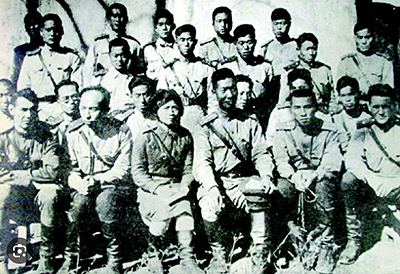
July 8th marks the 39th anniversary of the death of Kim Il-sung, the founding leader of North Korea, who passed away in 1994. Before the liberation of Korea, he was an independence activist under the armed anti-Japanese organizations affiliated with the Communist Party of China and the Union of Soviet Socialist Republics. He was strategically chosen by Joseph Vissarionovich Stalin for political purposes and emerged as the leader of North Korea after liberation, maintaining the highest authority until his death. Kim Il-sung laid the foundation for the three-generation lineage of leadership in North Korea, which continued with his son Kim Jong-il and grandson Kim Jong-un.
It is known that Kim Il-sung was born in Pyongyang in 1912 during the period when Korea was under Japanese rule. At a young age, he migrated to Manchuria and received education at a local primary school there. During his time in Manchuria, he acquired a moderate level of proficiency in the Chinese language. At the age of 11, he returned to his homeland and attended Changdeok School while living with his relatives. However, when he turned 14 in 1925, he once again returned to China. It should be noted that the records of Kim Il-sung's education found in publications in North Korea until 1968 may have been manipulated as his power and influence grew.
Kim Il-sung was indeed born with the name Kim Sung-ju. Even in the revolutionary history of North Korea, there are records of his childhood under that name. However, after the liberation of Pyongyang on August 15, 1945, he began using the name Kim Young-ho. It was on October 14th when he made his first official appearance on the grandstand at a mass rally in Pyongyang that he adopted the name "General Kim Il-sung." There have been claims suggesting that Kim Sung-ju impersonated the renowned figure of the anti-Japanese struggle, Kim Il-sung.
The name Kim Il-sung, when translated into Chinese characters, means "sun." North Korea attributes the choice of Kim Il-sung's name to the people's aspirations at that time, who longed for the sun. This is why it is used in Kim Il-sung's idolization. However, the North Korean residents are unaware of the period when Kim Yong-hwan, who was a Soviet soldier, existed, as it is concealed from them.
Grigory Konovich Mekler, a propaganda secretary who was dispatched to North Korea in 1945 to assist Kim Il-sung, testified that before his entry into North Korea, he had a meeting with the “real” Kim Il-sung in Khabarovsk in 1944 and revealed that someone was impersonating the name of Kim Il-sung, the anti-Japanese hero widely known among the Koreans at that time.
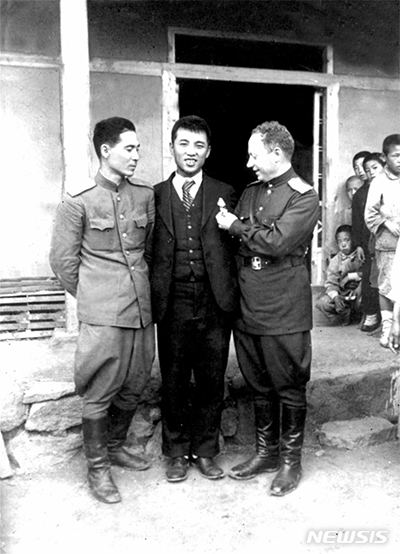
<On October 14, 1945, after the celebration event held at Pyongyang's Open-Air Theatre, Kim Il-sung visited his hometown and was accompanied by Mekler, the Soviet 25th Army's political representative (on the right), and interpreter Khan Mikhail Ivanovich for a commemorative photograph. / by Media Korea News Agency>
Due to Kim Il-sung's childhood spent in Manchuria, he had limited opportunities to deeply learn about Korean history and the Korean people. During his time in the Northeast Anti-Japanese United Army and later in the Soviet 88th Separate Rifle Brigade, he was able to speak Chinese fluently in his daily life. "Park Il," who taught Marxism-Leninism to Kim Il-sung after his entry into Pyongyang, shortly after liberation, recalled that although Kim Il-sung was proficient in Chinese, he struggled with the Korean language and had a habit of organizing his thoughts in Chinese, making it difficult to distinguish whether he was Chinese or Korean. "Leonid Timofeevich Vassin," a KGB officer who was responsible for writing Kim Il-sung's speeches before the 1st Congress of the Communist Party of Korea, confessed that Kim Il-sung had very limited knowledge of the Korean language, which posed challenges in preparing appropriate speeches.
There are research findings that suggest North Korea may exaggerate or fabricate certain aspects of Kim Il-sung's anti-Japanese struggle experiences and achievements. For instance, while North Korea claims that Kim Il-sung established an independent anti-Japanese guerrilla unit in 1932, historical evidence indicates that it was actually part of the guerrilla organizations organized by the Communist Party of China in various provinces of Manchuria. Kim Il-sung's unit was known for engaging in banditry and looting activities.
Furthermore, the existence of the "Korean People's Revolutionary Army," which North Korea claims was independently established by Kim Il-sung in 1934, lacks historical records and is not mentioned in Japanese literature documenting the presence of anti-Japanese armed forces in Manchuria.
Additionally, in 1935, during the "Minsaengdan incident" where Japanese spy organizations infiltrated anti-Japanese armed forces in Manchuria, Kim Il-sung was in danger of execution but reportedly survived with the help of a Chinese officer named Wang Yunseong. However, North Korea conceals these facts and propagates a narrative where Kim Il-sung burned the Minsaengdan list to save the Korean people.
It is important to highlight that North Korea's portrayal and promotion of the organization known as the "National Liberation Organization," which is claimed to be formed by uniting overseas Korean anti-Japanese forces in places like Manchuria and the Korean Peninsula, does not correspond to the actual organization. In reality, the organization referred to was created by "Wei Zhengmin" specifically for the 7th Congress of the Communist Party of China.
-
PREV [North Korea Glossary]
-
NEXT [Defectors' Podium]