

Korean Armistice Agreement
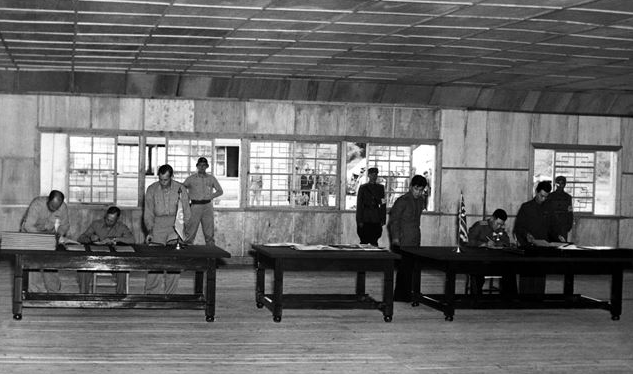
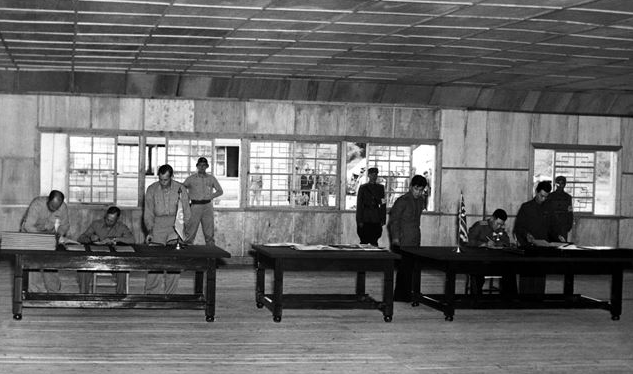
On July 27, 1953, at Panmunjom, Lieutenant General William Henry Harrison (seated on the left), the chief representative of the UN forces, and Nam-il (seated on the left), the chief representative of North Korea, signing the armistice agreement. / Photo by Yonhap News Agency
The Korean Armistice Agreement, signed on July 27, 1953, is an agreement concerning the military armistice in Korea. It designated the Supreme Commander of the United Nations Command as one party and the Supreme Commander of the Korean People's Army and the Commander of the Chinese People's Volunteers as the other party.
After the outbreak of the Korean War on June 25, 1950, and during the protracted conflict, the United Nations Command and the communist army engaged in secret contacts, leading to the first armistice talks held in Kaesong on July 10, 1951. Subsequently, the talks moved to Panmunjom in July 1952 but were suspended for nine months due to issues like prisoner of war problems. Finally, on July 27, 1953, at Panmunjom, the Supreme Commander of the United Nations Command, Mark Wayne Clark, together with the Supreme Commander of the Korean People's Army, Kim Il-sung, and the Commander of the Chinese People's Volunteers, Peng Dehuai, signed the agreement, stopping the Korean War.
The agreement was drafted in English, Korean, and Chinese, consisting of a preamble, five articles with 63 clauses, and an appendix with 11 articles and 26 clauses. The preamble stated the purpose, nature, and application of the agreement. Article 1 addressed the Military Demarcation Line and the Demilitarized Zone, Article 2 specified measures for the cessation of hostilities, Article 3 dealt with prisoner-of-war issues, Article 4 made recommendations regarding the governments involved, and Article 5 included additional provisions. The appendix covered the scope of authority of the Neutral Nations Supervisory Commission.
As a result of the armistice agreement, hostilities between North and South Korea ceased temporarily, but the war state continued, entering a localized ceasefire situation. The Demilitarized Zone (DMZ) and the Military Demarcation Line (MDL) were established as physical boundaries between the two countries. The Military Armistice Commission, located in Panmunjom, comprised officers from the United Nations Command and the communist army. Additionally, the Neutral Nations Supervisory Commission, consisting of Switzerland, Sweden, Czechoslovakia, and Poland, was established. The armistice agreement has remained in effect for over 60 years, making it a unique case in terms of its longevity.
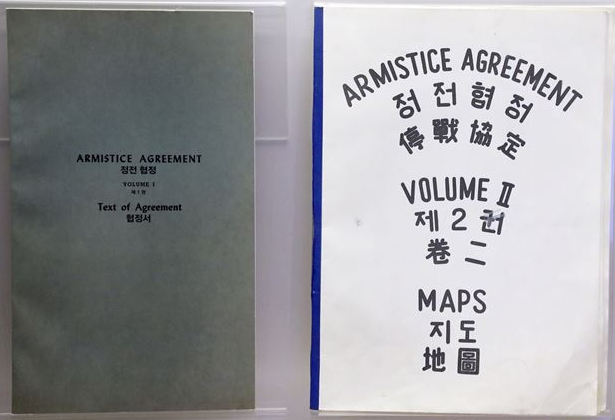
A map and Korean Armistice Agreement signed by North Korea, China, and the United States on July 27, 1953, without South Korea. / Photo by Yonhap News Agency
However, in March 1991, a senior representative of the Korean military was appointed to the Military Armistice Commission, and in the following year, North Korea and China withdrew from the commission, rendering many provisions of the agreement ineffective. Consequently, there was a growing consensus among South and North Korea, as well as the United States and other countries involved, that a peace agreement should replace the armistice agreement. In 1997, representatives from North and South Korea, the United States, and China convened for the Four-Party Talks in Geneva, Switzerland, but no significant progress was achieved.
Since 1974, North Korea has consistently advocated for replacing the armistice agreement with a peace agreement, specifically between the United States and North Korea. They argued that as the United States signed the armistice agreement as the Supreme Commander of the United Nations Command, a peace agreement should also involve the United States. However, it is important to recognize that South Korea, as a main belligerent and a direct party affected by the conflict, plays a crucial role and is a key participant in pursuing a substantive peace agreement.