


North Korea's July 27 Parade Showcases Advanced UAVs and UCAVs Resembling Global Hawk and Reaper
On July 27, during the Military Parade commemorating the 70th anniversary of the Korean Armistice Agreement, North Korea showcased unmanned vehicles resembling the U.S. RQ-4 Global Hawk, strategic reconnaissance drone and the Unmanned Combat Aerial Vehicle, General Atomics MQ-9 Reaper. Korean Central Television reported on the parade the next day, stating, "The newly developed and produced Unmanned Aerial Vehicles and Unmanned Combat Aerial Vehicles, which will be equipped in our Air Force, flew in the skies above Kim Il Sung Square during the parade."
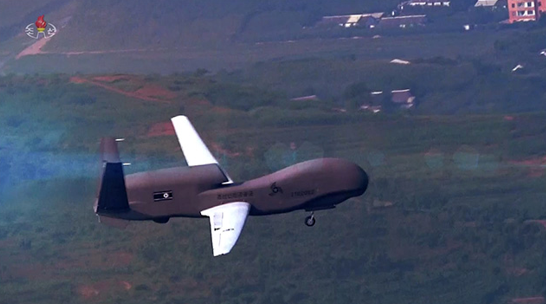
North Korea's Unmanned Aerial Vehicle on display during the military parade in Pyongyang on July 27, commemorating the 70th anniversary of the Korean Armistice Agreement – Photo by Korean Central Television
The unmanned vehicle revealed by North Korea bears a striking resemblance to the United States Air Force's Unmanned Aerial Vehicle 'Global Hawk,' from its appearance to the markings on its body, making it almost look the same.
The Global Hawk is a highly acclaimed long-range strategic Unmanned Aerial Vehicle, recognized for its exceptional performance on a global scale. On the other hand, the Reaper, nicknamed the 'Silent Assassin,' is a widely used Unmanned Combat Aerial Vehicle, notably deployed in actual combat scenarios like the Iraq War, Afghanistan War, and the War on Terrorism. While countries like China, Russia, Iran, and others have developed unmanned vehicles resembling those of the U.S., none have been as remarkably similar as North Korea's, sparking speculation about possible hacking of U.S. defense contractor blueprints. North Korea is known for engaging in cyber espionage activities that target defense industries worldwide, aiming to gather essential information.
During the military parade, North Korea unveiled its Unmanned Aerial Vehicle named 'Saetbyeol-4' and the versatile Unmanned Combat Aerial Vehicle named 'Saetbyeol-9,' which interestingly share the same numerical designations as the 'RQ-4 Global Hawk' and 'MQ-9 Reaper,' respectively. Notably, the attack-type Unmanned Combat Aerial Vehicle, Saetbyeol-9, was observed being transported on vehicles, with a total of five units seen— one in flight and four on the ground, suggesting at least five units have been produced. North Korea also presented a video showcasing the Saetbyeol-9 launching a surface-to-surface missile, indicating significant progress in its development.
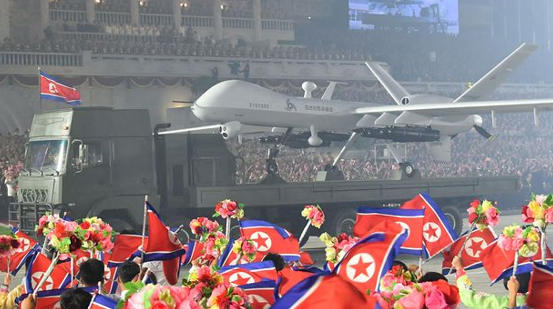
North Korea Showcases Its Version of the Reaper, Unmanned Combat Aerial Vehicle at the Military Parade on the 70th Anniversary of the Korean Armistice Agreement in Pyongyang's Kim Il Sung Square. - Photo by Korean Central Television
During the 8th Congress of the Workers' Party of Korea in January 2020, Kim Jong-un assigned the development of Unmanned Aerial Vehicles and Unmanned Combat Aerial Vehicles. The actual unveiling of these drones has happened faster than expected, leading to the need for performance analysis and countermeasures. Last month, the U.S.-based NK News, which covers North Korea issues, reported the sighting of a drone with a wingspan of approximately 35 meters at Panghyon Airport in North Phyongan Province on July 14th. This drone was about twice the size of another one with a wingspan of approximately 20 meters, spotted at the same location on July 3rd. Considering the wingspans of the U.S. Global Hawk (40 meters) and Reaper (20 meters), it is likely that these sightings were indeed unmanned vehicles.
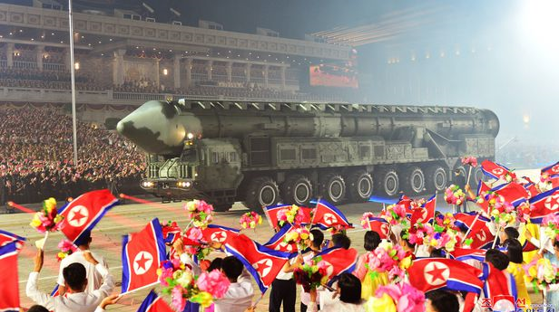
North Korea Unveils Intercontinental Ballistic Missile (ICBM) at the Military Parade on the 70th Anniversary of the Korean Armistice Agreement in Pyongyang's Kim Il Sung Square. - Photo by Korean Central Television
Despite their resemblance to the original drones, there are doubts about the actual performance of North Korea's versions. Replicating engines and advanced sensors like Electro-Optica (EO) cameras and synthetic aperture radar (SAR) is a challenging task, raising questions about their capabilities. The U.S. Global Hawk, for instance, is equipped with a powerful 10,000-pound Rolls-Royce turbofan engine, allowing it to fly for over 32 hours and cover a maximum range of 22,000 km. Additionally, it can detect objects as small as 30 cm from an altitude of 20 km, having a length of 14.5 meters and a cruising speed of 570 km/h.
The MQ-9 Reaper is equipped with a 900 horsepower Honeywell turboprop engine, enabling it to remain airborne for 14 to 28 hours. It measures 11 meters in length, has a maximum speed of 480 km/h, and a range of 6,000 km. The Reaper can carry up to 14 AGM-114 Hellfire missiles and other munitions, including Joint Direct Attack Munition (JDAM), Laser-Guided Bombs, and AIM-92 Stinger. Currently, the South Korean Air Force operates four units of the Global Hawk, while the Reaper is not deployed by the South Korean military or the US forces stationed in South Korea. Instead, the US forces in South Korea utilize the Gray Eagle-Extended Range (ER) Unmanned Combat Aerial Vehicle, which has slightly lower performance compared to the Reaper but consists of 12 units.
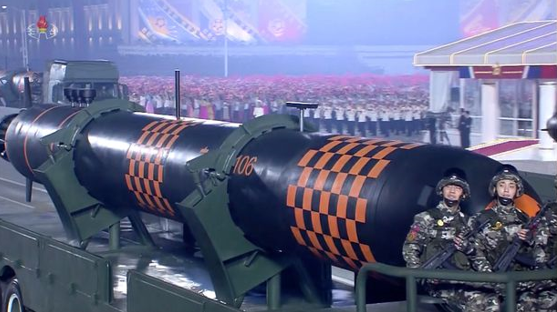
North Korea Reveals 'Haeil' Nuclear Torpedo at the Military Parade on the 70th Anniversary of the Korean Armistice Agreement in Pyongyang's Kim Il Sung Square. - Photo by Korean Central Television
Concerns have been raised regarding the core sensor and equipment capabilities of North Korea's unmanned vehicles. For instance, the electronic optical camera capabilities (resolution) observed in the satellite imagery of the 'Manri-gyeong-1' military reconnaissance satellite, salvaged by the South Korean Navy after a failed launch on May 31, were found to be significantly lower. Additionally, the lack of satellite communication capability poses a problem as it hinders real-time information relay from ground relay stations for long-range operations. During the Military Parade, North Korea publicly revealed the nuclear torpedo 'Haeil,' which was first showcased during the 'Armed Equipment Exhibition 2023' on the 26th and later appeared in photos from the 'Military Parade' in Rodong Sinmun on the 28th.
During the Military Parade, Intercontinental Ballistic Missiles (ICBMs) named 'Hwasong-17' and 'Hwasong-18' were showcased. Rodong Sinmun reported their presence during the parade and emphasized that these missiles are the most potent core means of North Korea's strategic military power. They are capable of effectively deterring hostile forces' threats of nuclear war and provocative acts of invasion while ensuring the country's safety.