

Camp David Time: Resolving the Trilateral Summit of South Korea, the United States, and Japan

Won-gon Park
(Ewha Womans University)
⦁ Discourse on the Change of World Order
⦁ A Shared Worldview
⦁ Restoration of the Norm-Based International Order
⦁ US-Korea-Japan Action Plan
⦁ Camp David Time
The Camp David summit on August 18, 2023, marked a historic turning point for security and economic cooperation among the United States, South Korea, and Japan. As defined by the South Korean Presidential Office, this summit holds such immense significance that it will divide our history into "before" and "after." Beyond its symbolic location and being the first independent meeting of these three nations, the summit presented a united vision for the global order and a shared Indo-Pacific strategy. If this cooperative momentum continues to evolve, future historians may well refer to August 18, 2023, as the "Camp David Time."
Discourse on the Change of World Order
In the year 2023, the world finds itself deeply immersed in debates regarding the transformation of the global order. The conversation on global order, initially sparked by the 2008 U.S.-triggered financial crisis, reached its zenith with the U.S.-China rivalry in the latter half of 2018 and Russia's incursion into Ukraine in 2022. Economist Niall Ferguson boldly asserts, "Much like the Korean War ushered in the Cold War, the war in Ukraine will serve as the catalyst for a new Cold War." North Korea's Kim Jong-un has joined this chorus, heralding the dawn of a 'New Cold War.' Samuel Phillips Huntington's seminal work, 'The Clash of Civilizations and the Remaking of World Order,' originally published in the early 1990s, is now experiencing a resurgence in relevance. There are growing predictions that the liberal normative system rooted in Western modernity may no longer suffice, hinting at a resurgence of particularistic civilizationism, akin to China's historical stance. Anticipating an "ambiguous divide," many nations are opting not to align with major powers such as the U.S. or China, instead choosing to employ hedging strategies. German Chancellor Olaf Scholz goes even further, discussing a 'global paradigm shift' known as Zeitenwende, which signals the decline of U.S.-centric unipolarity and the rise of a multipolar system. Some even draw parallels to the historical "Interregnum" period in German history between 1254 (or 1256) and 1273 when the enthronement of a king (Holy Roman Emperor) failed to materialize, underscoring the uncertainty surrounding the fate of the United States, currently the world's most powerful nation.
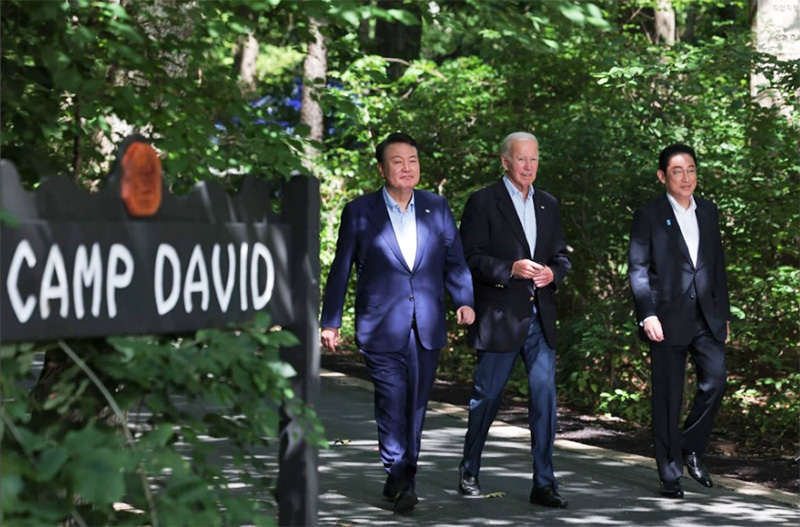
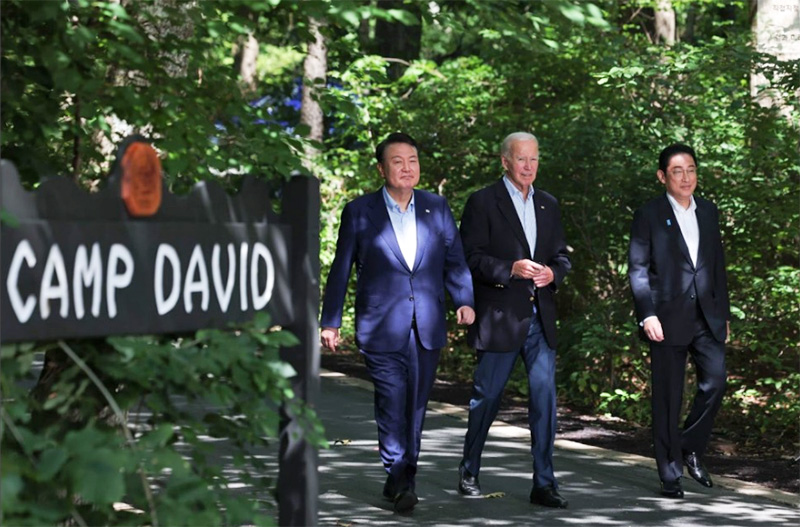
Presidents Yoon, Biden, and Prime Minister Kishida meet for a photo before the trilateral summit at Camp David, Maryland, on August 18th (Photo by Newsis).
A Shared Worldview
The trilateral summit held at Camp David between South Korea, the United States, and Japan assumes profound significance as it showcased the shared worldview of these three nations during a period of unprecedented global upheaval. It also presented a strategic vision for the Indo-Pacific region founded on this shared perspective. If the collective efforts of these nations succeed in restoring stability to the world order, the Camp David Agreement will undoubtedly leave an indelible mark on history. All three nations have acknowledged that the traditional global order is currently under duress, and the world is confronting an unparalleled crisis. During their joint press conference, President Joe Biden characterized the current situation as an "inflection point," President Yoon Suk-yeol labeled it an "unprecedented complex crisis," and Prime Minister Kishida said it's a "crisis threatening the free and open international order rooted in the rule of law." In particular, the trio perceives that the international order established on norms dating back to 1945 is encountering formidable challenges. This norm-based global order encompasses principles such as free trade, adherence to the rule of law, respect for sovereignty, territorial integrity, open multilateralism, freedom of navigation, non-proliferation, and opposition to altering the status quo through force. The jointly agreed-upon document, referred to as the "Spirit of Camp David," underscores that the very "foundation of the international order," centered on respect for sovereignty and territorial integ rity, faced a grave challenge on February 24, 2022. This was when Russia, a nuclear-armed and one of the P5, embarked on an aggressive imperialistic campaign by invading a neighboring sovereign state with territorial ambitions reminiscent of 19th-century imperialism. China's economic coercion and blatant disregard for the July 2016 ruling by the International Court of Arbitration, which deemed China's claims in the South China Sea illegal, are perceived as actions violating the rule of law and freedom of navigation, amounting to attempts to "alter the status quo through force." North Korea's pursuits in nuclear and ballistic missile development are characterized as clear-cut illegal activities that pose a severe challenge to the nuclear non-proliferation regime. In summation, the consensus among South Korea, the United States, and Japan is that the world stands at a critical juncture, with the established order facing profound challenges.
Restoration of the Norm-Based International Order
South Korea, the U.S., and Japan have aligned their stance on restoring the norm-based international order, emphasizing their commitment to liberal democracy in the face of global order threats. During the summit, President Joe Biden stressed that "strengthening our bonds among democratic nations would enhance global security”. President Yoon Suk-yeol, in a joint press conference, highlighted “the essential role of South Korea, the U.S., and Japan in advancing a norm-based international order based on shared principles of freedom, human rights, and the rule of law for regional stability and prosperity”. Prime Minister Kishida echoed this sentiment, deeming trilateral cooperation as a "historical necessity" in addressing challenges to a free and open international order.
The Camp David Agreement is not aimed at any specific nation but rather identifies challenges in the pursuit of a rule-based international order aligned with their shared values. Rooted in the 'Spirit of Camp David,' the three countries endorse a "free and open international order based on the rule of law," champion democracy, and advocate for human rights protection. Importantly, they emphasize that this partnership benefits not only their citizens but the entire Indo-Pacific region. It signifies their concerns about actions that undermine regional peace and prosperity and deviate from the norm-based international order. This includes addressing disruptive actions by China, North Korea, and Russia. Contrary to some assertions, the Camp David Agreement is not a precursor to a new Cold War but rather a response to countries undermining efforts to restore and sustain the norm-based international order.
US-Korea-Japan Action Plan
The three pivotal documents - 'Spirit', 'Principle', and 'Commitment' - adopted during the Camp David summit lay out a tangible action plan for the United States, South Korea, and Japan to revive a norm-based international order. Their initial objective is to institutionalize the shared worldview and its implementation strategy. Of paramount importance is the regularizing of the US-Korea-Japan summit and various ministerial meetings. In particular, the annual US-Korea-Japan summit can serve as a mechanism to dispel uncertainties in trilateral cooperation and ensure its ongoing continuity. A notable challenge to this trilateral cooperation is the upcoming US presidential election next November. The potential return of former President Donald Trump to the White House might herald a reinforced 'America First' policy rooted in increased isolationism and sovereignty. His approach during his previous tenure, which reduced alliances to a cost-benefit calculus, could reemerge. The established regular US-Korea-Japan summit through the Camp David agreement can facilitate direct communication between South Korea, Japan, and the US president, fostering mutual understanding. It also plays a significant role in managing Korea-Japan relations. Given the historical and territorial sensitivities between these two countries, the risk of conflict is ever-present. While it may be challenging to fundamentally alter the conflict structure, effective conflict management is paramount, with a primary emphasis on maintaining open channels of communication between South Korea and Japan. Considering previous communication breakdowns during Korea-Japan disputes, the trilateral summit ensures consistent consultations at the highest level. Within this trilateral framework, the US can also assume a mediation role between Korea and Japan.
The most attention-grabbing announcement after the agreement was the ‘Commitment to Consult among Japan, the Republic of Korea, and the United States of America’. It states that the three nations will coordinate their responses to regional challenges, provocations, and threats that impact their shared interests and security by promptly consulting, sharing information, aligning messages, and coordinating response actions. This agreement showcases several features. First, the Camp David 'Spirit' emphasizes the 'commitment' as voluntary, not a mandatory 'duty', reiterating its content in a separate document. While open to interpretation, it's understood to consider potential military conflicts in the Taiwan Strait, South China Sea, and the Korean Peninsula.
At the Camp David Summit, a key focus was on advancing integrated deterrence. South Korea, the United States, and Japan have committed to conducting annual trilateral exercises designed to bolster coordinated capabilities and cooperation. These exercises will be named, with multi-year training plans established for their regular implementation across a range of domains. Importantly, the exercises are not geared toward addressing potential global military conflicts but rather to counter threats originating from North Korea, with a primary goal of normalizing existing training areas.
Examples of these exercises include anti-submarine drills held in September 2022 and April 2023, maritime missile defense exercises for detecting, identifying, and intercepting North Korean missiles conducted in October 2022, as well as in February, April, and July 2023. Additionally, plans involve the resumption of maritime blockade and anti-piracy exercises, alongside the introduction of disaster response and humanitarian assistance drills. In the domain of space, a cornerstone for modern security, South Korea, the U.S., and Japan have also reached a cooperative agreement. They intend to address space domain threats, develop national space strategies, and responsibly utilize space through trilateral security conferences aimed at countering shared threats.
These collaborative endeavors significantly bolster deterrence against North Korea's nuclear capabilities. In essence, North Korea no longer faces only the U.S.-South Korea alliance but confronts a formidable security cooperation network encompassing the U.S., South Korea, Japan, and core NATO allied nations across multiple domains, including cyber and space. The overarching goal is to effectively deter North Korea, a nation that challenges the non-proliferation regime, while preserving an international order grounded in established norms."
Camp David Time
The recent Camp David agreement has opened up opportunities for South Korea to expand its global horizons and significantly enhance its capacity to respond to North Korean nuclear threats. Despite being the world's sixth-largest military power and ranking in the top 10 in terms of economic strength, South Korea has historically tended to focus inward on the Korean Peninsula, albeit to varying degrees depending on the government in power. The Camp David summit showcased South Korea's emergence as a 'Global Pivot State' (GPS), confidently articulating its worldview beyond the Korean Peninsula, elucidating the principles of the international order it seeks, and solidifying its approach through Indo-Pacific strategies.
Consequently, South Korea's approach to North Korea, which previously relied solely on the U.S.'s extended deterrence, has undergone a fundamental shift, significantly bolstering its deterrence capability by participating in the global alliance transformation. Moreover, concerns about potential involvement in regional conflicts, which were previously viewed with apprehension, can now be addressed more proactively and assertively, as South Korea has established mechanisms to assert its position confidently.
However, this marks just the beginning of the journey. No matter how well-crafted an agreement may be, its implementation is of paramount importance. Given the multitude of challenges that lie ahead, maintaining consistency and steady progress is essential to ensure persistence and stability. It is imperative to keep in mind that South Korea must shoulder certain responsibilities and costs as it moves forward with this endeavor.