


North Korea’s Violation of the 9.19 Inter-Korean Military Agreement and Our Response Strategy

Moon Seong-mook
Director, Center for Korean Unification Strategy
Korea Research Institute for National Strategy
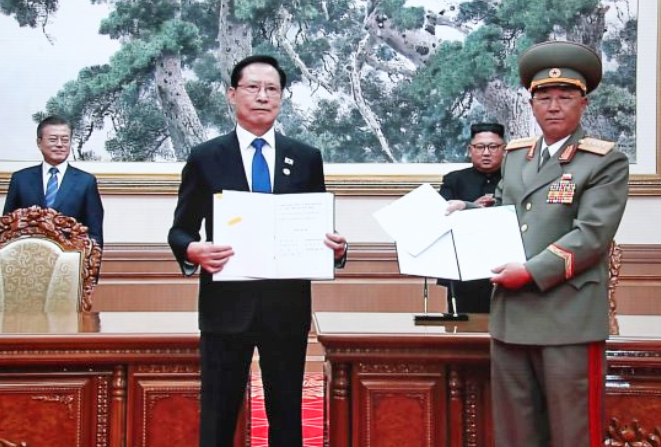
On the morning of September 19, 2018, at Pyongyang's Paekhwawon State Guest House, former South Korean President Moon Jae-in and North Korean leader Kim Jong-un observed the signing and exchange of a military agreement for the Panmunjom Declaration's implementation. Former South Korean Defense Minister Song Young-moo and former North Korean Minister of People's Armed Forces No Kwang-chol conducted the signing. / Photo by Pyongyang Joint Press Corps
It's been five years since the 9.19 Inter-Korean Military Agreement, often referred to as the 9.19 Agreement, was finalized. Initially, North Korea showed some willingness to comply with the terms of the agreement. However, after the inconclusive outcome of the Hanoi summit in 2019, Kim Jong-un took a more direct and blatant approach in violating the agreement. According to the 2022 Defense White Paper, there have been 17 documented instances of North Korea's violations of the agreement since 2019. However, this number only includes major violations, and the actual count would be much higher if we consider other unrecorded cases. The 9.19 Agreement explicitly prohibits any hostile actions against the other party. North Korea's various provocations against South Korea are clearly hostile acts and thus constitute violations of the agreement. If we define "violation of agreement" as engaging in prohibited actions or failing to fulfill obligations, then North Korea is in violation of most of the agreement's provisions. Furthermore, North Korea has consistently used the agreement as a tool to threaten South Korea, even going as far as threatening to discard it.
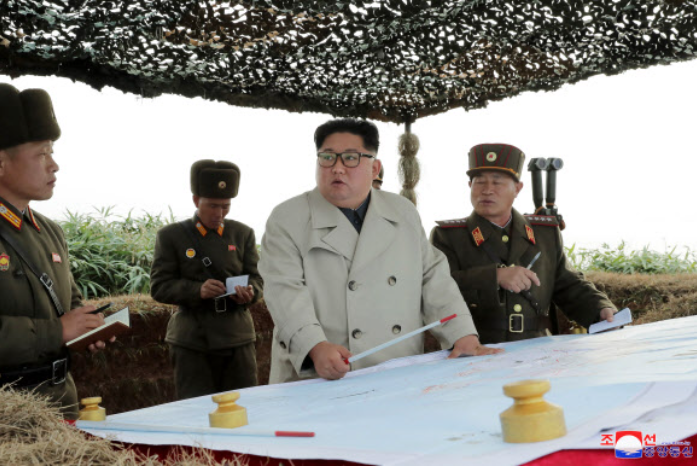
Korean Central News Agency reported that on November 25, 2019, North Korean leader Kim Jong-un inspected the Changrin Island Defense Force, located on the western front. / Photo by Korean Central News Agency
So, how should we respond to this situation? Firstly, while we continue to encourage North Korea to uphold the 9.19 Agreement, we must also maintain a strong military readiness. If North Korea fails to adhere to the agreement's terms, we shouldn't feel obligated to fulfill our part either. Secondly, in the event that North Korea violates the agreement and provokes us, we must respond with determination. It's essential to make them understand that provocations come with significant consequences. Thirdly, if North Korea persists in ignoring the 9.19 Agreement, as it currently does, we need to make a serious decision. As the president has previously warned, if North Korea engages in extreme provocative actions such as territorial incursions or additional nuclear tests, we should promptly consider suspending the implementation of the Inter-Korean Agreement. We should also be prepared to take all necessary subsequent measures, including the immediate reactivation of the Voice Of Freedom (VOF) directed at North Korea.
1) In 2019, Kim Jong-un made a visit to Changrin Island in the West Sea and ordered shooting, despite it being designated as a no-fire zone.
2) As per the 2022 Defense White Paper on page 353, under General Appendix 12, there are documented major violations of the 9.19 Military Agreement by North Korea.
3) Article 1 of the 9.19 Agreement explicitly states, "Both South and North Korea have agreed to cease all hostile actions against each other across all domains, including land, sea, and air, that contribute to military tensions and conflicts."
Keywords:
hostile actions, violation of the agreement, military readiness
-
PREV [Feature Article]
-
NEXT [North Korean Terminology]