


2023 Unification Perception Survey
by the Institute for Peace and Unification Studies at Seoul National University
South Korean Sentiments toward North Korea: A Rising Tide of Distrust and Vigilance Not Seen Since 2007
The current global tensions, akin to a new Cold War, coupled with North Korea's aggressive military actions, have notably altered South Korean views. Our 2023 survey shows an unprecedented wariness towards North Korea since 2007. Concurrently, there's a rising recognition of the alliance between South Korea, the US, and Japan, even as threats from North Korea, China, and Russia intensify.
Last week, Seoul National University's Institute for Peace and Unification Studies, led by President Kim Bum-soo, presented their '2023 Unification Perception Survey' at the Hoam Faculty House. The data revealed a rise in negative views towards North Korea: those seeing it as adversarial increased to 18.6% from 13.6%, caution grew from 17.7% to 24%, and overall negative sentiment reached a record 42.6% since 2007.
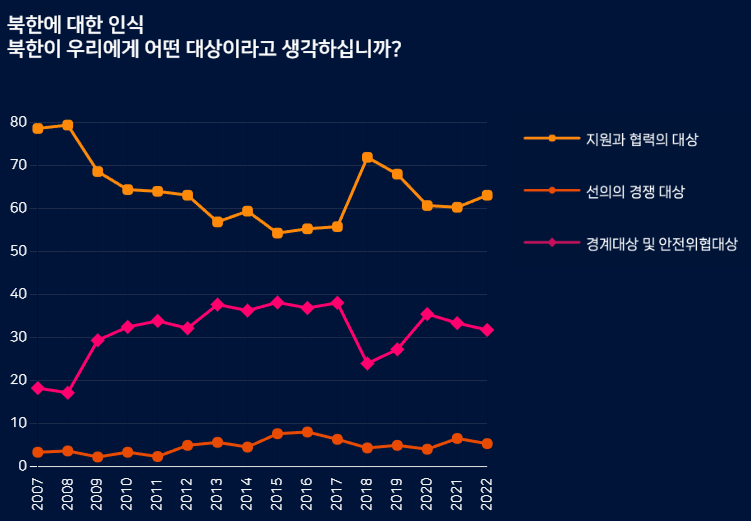
Survey Results: What do South Koreans think about North Korea? (Data from a 2022 survey conducted by the Institute for Peace and Unification Studies at Seoul National University)
The data shows that individuals in their 20s have a deep distrust towards North Korea at 49.3%. In contrast, those in their 50s, though more trusting of North Korea, also see a greater likelihood of its military aggressions.
The numbers further unveil that 64.8% of respondents now believe in North Korea's likelihood to resort to military provocations, a slight increase from the previous year’s 60.9%. Contrarily, the spirit of collaboration has taken a hit, plummeting from 47.9% to 37.7% — a steep decline of over 10%.
The Institute opined, "Considering North Korea's anticipated missile initiatives, it's improbable that the prevailing negative sentiments will dissipate anytime soon." Furthermore, they project continued divides in opinion, stemming from generational, regional, and ideological differences.
The Institute speculates, "Post-COVID-19, if the global media were to highlight positive changes in North Korea, especially in sectors like tourism, education, and international cultural exchanges, we could potentially witness a shift in perceptions."
Another pivotal revelation from the survey was the declining sentiment for unification. Only 43.8% now believe in its necessity, the lowest since 2007. Conversely, those skeptical of unification have risen to an all-time high of 29.8%. The Institute stresses, "To foster a positive sentiment for unification, both external diplomatic maneuvers to mitigate geopolitical threats and internal strategies to address socio-economic challenges are imperative."
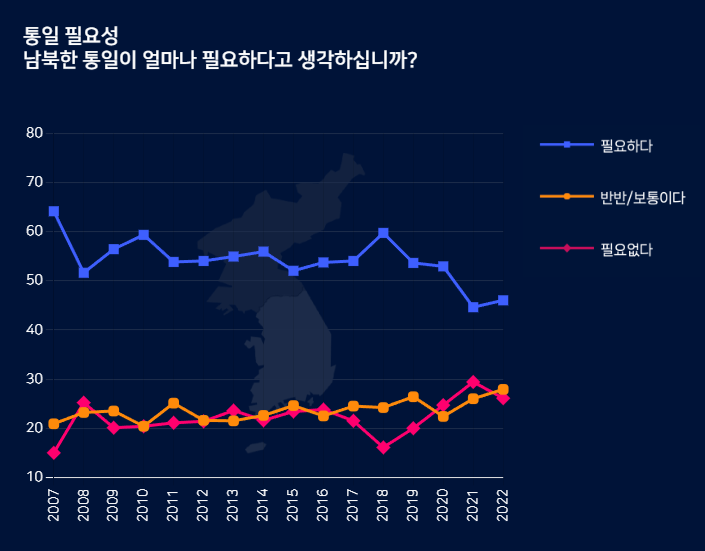
Survey Response Rate on the Topic of Korean Unification among South Koreans (Data from a 2022 survey conducted by the Institute for Peace and Unification Studies at Seoul National University)
South Koreans seem to appreciate the firm stance of the Yoon Suk-yeol administration towards North Korea, evident from the increasing satisfaction rate, which now stands at 54.3%. The present sentiment of heightened distrust and caution towards North Korea likely amplifies this approval.
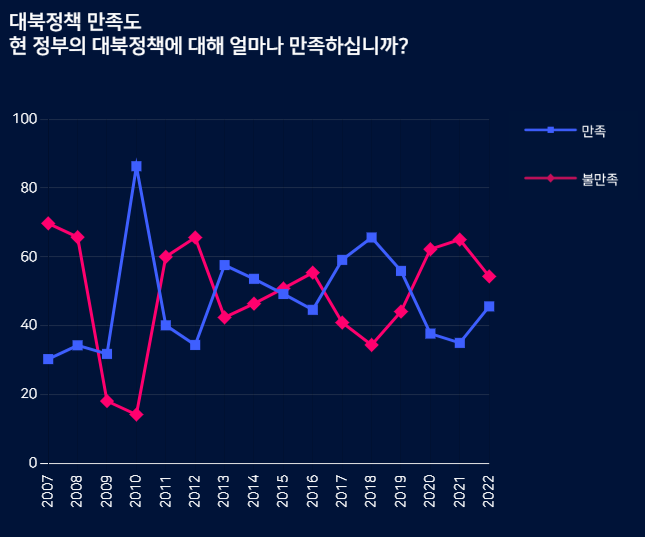
Public Satisfaction Survey Results Regarding the Current Government's Policy on North Korea.(Data from a 2022 survey conducted by the Institute for Peace and Unification Studies at Seoul National University)
On the nuclear front, even though support for South Korea's nuclear armament has marginally dipped to 52.3%, it remains significant. Interestingly, 49.3% endorse the idea of indigenous nuclear development, while 23.6% advocate for the deployment of US tactical nuclear weaponry.
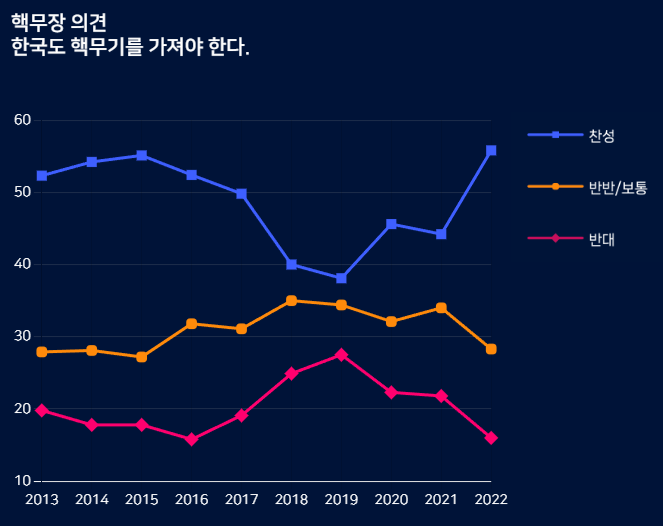
Survey Results on Public Opinions Regarding South Korea's Nuclear Armament. (Data from a 2022 survey conducted by the Institute for Peace and Unification Studies at Seoul National University)
Perceptions about threats from neighboring countries also emerged prominently. North Korea unsurprisingly tops the list with 45.8%, followed closely by China at 36.8%. Japan, Russia, and the US follow in succession with 8.3%, 4.6%, and 4.5% respectively.
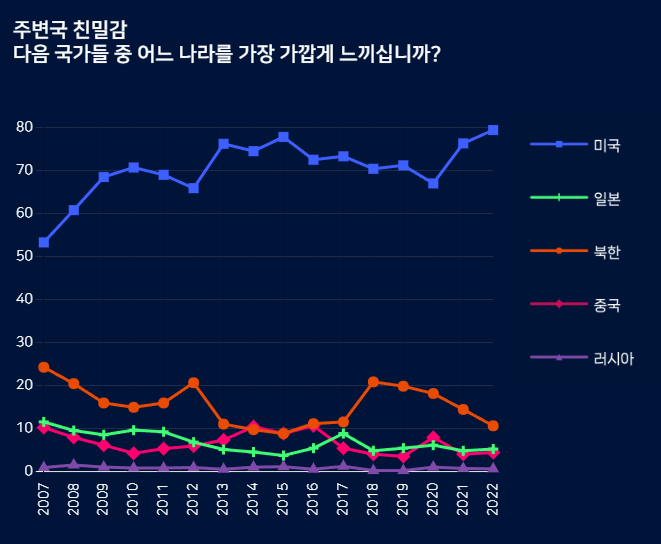
Survey on Relations and Perceptions of Neighboring Countries. (Data from a 2022 survey conducted by the Institute for Peace and Unification Studies at Seoul National University)
Lastly, an endearing revelation: South Koreans’ affinity for the United States has been on a steady climb. A heartening 81.5% now feel a closeness to the US, up from 53% in 2007. The emotional connection with North Korea, however, has dwindled dramatically from 24% in 2007 to a mere 7% in 2023. Japan, China, and Russia follow, with 5.3%, 2.8%, and 0.6% respectively indicating a sense of proximity.