

A Study on North Korea's Nuclear Economic Policy: Focusing on Correlation
Editorial Note: |
1. Background and Purpose
One of the most significant questions in North Korea's denuclearization negotiations concerns the North Korean regime's will to denuclearize. Specifically, whether North Korea is willing to abandon its nuclear program for economic development remains a matter of debate. Some argue that Kim Jong-un has a strong intention to denuclearize for economic growth, depending on the conditions presented in the negotiations. On the other hand, others believe that Kim Jong-un has no intention to give up nuclear weapons and that his goal in denuclearization talks is to become a legitimate nuclear state. While providing a definitive answer to this crucial question is challenging, one approach is to examine the relationship from North Korea's perspective.
This study aims to analyze how North Korean intellectuals, experts, or official propaganda understand the relationship between the nuclear program and the economy using text mining techniques on North Korean data. More specifically, three possible relationships exist: a positive correlation (complementary goods), an independent relationship (independent goods), and a negative correlation (substitute goods). If many of the related terms for nuclear and economy overlap and reinforce each other's meanings, and there's a high correlation in their frequency of appearance, then North Korea may view their relationship as complementary. Conversely, if there's little overlap in terms but a negative impact on each other's meaning, they can be understood as substitutes.
Through this analysis, this study aims to determine why North Korea shifted from its 2013 "Byungjin policy (parallel development)" to focusing on economic development in 2018. The study also seeks to derive implications for North Korea's national development strategy and future nuclear and economic development plans.
In this study, we mainly analyze the leading North Korean journals, namely "Economic Research", "Political Legal Research", and "Kim Il Sung University Journal: Philosophy, Economy". These journals are significant representatives in their respective fields and provide valuable insights into the logical structure and evolution of the nuclear and economic discourse.
2. Analytical Methodology and Application
In information retrieval theory, documents are represented as sets of word arrays for search and access. The Document-Term Matrix (DTM) and Term-Document Matrix (TDM) allow the extraction of word frequency per document. These methodologies are applied to extract related terms and their frequencies concerning nuclear and economy from "Economic Research", "Political Legal Research", and the “University Journal (Philosophy, Economy). Beyond the traditional approach, this study forms word matrices based on sentences and paragraphs to grasp the context-centric meaning.
Association analysis employs the multiplication of the aforementioned TDM (Term-Document Matrix) and DTM (Document-Term Matrix) to depict a relative association scale for individual words. This method facilitates the extraction of terms that hold substantial relevance to "nuclear" and "economy" from the data analyzed in journals such as "Economic Research", "Political Legal Research", and "University Journal (Philosophy, Economy)".
Correlation analysis evaluates the model based on correlation coefficients and adjusted coefficients of determination. This method ascertains the statistical significance of each variable using the P-value. Within the pages of the "Economic Research", "Political Legal Research", and "University Journal (Philosophy, Economy)", we have designated the quarterly frequency (or ratio) of the term "nuclear" as variable 1 (X1), and that of "economy" as variable 2 (X2). Subsequent statistical analysis is conducted to determine the correlation between these variables over distinct periods.
3. Principal Findings: Quarterly Frequency Analysis of "Nuclear" and "Economy" Terms
Within the scholarly contexts of 'Economic Research', 'Political and Legal Studies', and the 'Academic Journal (Philosophy, Politics)', we systematically extracted and quantified the quarterly occurrences of the terms “nuclear” and “economy” as well as the frequency of paragraphs wherein these terms appeared. The goal of this extraction process was twofold: firstly, to evaluate the relative emphasis or importance placed on these terms over time, and secondly, to discern evolving patterns or dynamics between their respective usages.
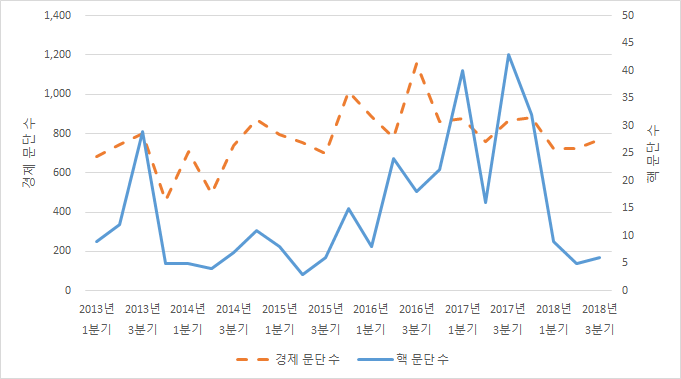
Upon thorough analysis, distinct patterns emerged concerning the trends of the terms 'economy' and 'nuclear'—both in terms of isolated word frequency and broader paragraph occurrence. As delineated in <Figure 1> and <Figure 2>, the term 'economy', both in its isolated occurrences and within paragraph contexts, maintained relative stability from the first quarter of 2013 through the third quarter of 2018. Contrarily, the term 'nuclear' exhibited notable fluctuations, with a pronounced surge in its frequency from the initial quarter of 2016 extending to the final quarter of 2017.
To refine our understanding and provide a more nuanced interpretation, correlation coefficients were derived between the datasets, pertaining to these terms. Recognizing a possible inflection point around Q3 2016, the analysis was bifurcated to evaluate periods before and post this quarter. The ensuing results, encapsulated within <Table 3>, denote a correlation coefficient of 0.4198 across the entire timeline, which, notably, achieves statistical significance at a 5% confidence threshold. Post the third quarter of 2016, the correlation coefficient amplified to a noteworthy 0.8212, remaining statistically significant at the 5% level. Yet, precluding this period, the coefficient stood at a modest 0.3345—indicating a positive yet comparatively subdued correlation, with diminished statistical significance. Interestingly, patterns discerned from paragraph-based analyses were in alignment with those derived from isolated word counts.
To encapsulate, our frequency-based assessment from Q1 2013 to Q3 2018 illuminated a prevailing positive correlation between the terms 'nuclear' and 'economy'. A segmented analysis of this timeline revealed that from Q1 2013 to Q2 2016, the terms operated more as Independent Goods, while the span from Q3 2016 to Q3 2018 saw them functioning more symbiotically as Complementary Goods.
Table 1: Quarterly Frequency of the Terms 'Nuclear' and 'Economy' (Based on Word Count)
분기 |
총 단어 수 |
핵 단어 수 |
경제 단어 수 |
핵 단어 비율 |
경제 단어 비율 |
2013.1 |
80,766 |
9 |
1,181 |
0.00011 |
0.015 |
2013.2 |
84,016 |
14 |
1,301 |
0.00017 |
0.015 |
2013.3 |
79,196 |
39 |
1,423 |
0.00049 |
0.018 |
2013.4 |
61,574 |
8 |
792 |
0.00013 |
0.013 |
2014.1 |
73,416 |
5 |
1,388 |
0.00007 |
0.019 |
2014.2 |
61,764 |
2 |
951 |
0.00003 |
0.015 |
2014.3 |
74,515 |
8 |
1,319 |
0.00011 |
0.018 |
2014.4 |
79,744 |
12 |
1,678 |
0.00015 |
0.021 |
2015.1 |
80,431 |
6 |
1,569 |
0.00007 |
0.020 |
2015.2 |
82,818 |
3 |
1,381 |
0.00004 |
0.017 |
2015.3 |
82,715 |
7 |
1,172 |
0.00008 |
0.014 |
2015.4 |
89,421 |
32 |
1,915 |
0.00036 |
0.021 |
2016.1 |
89,199 |
9 |
1,541 |
0.00010 |
0.017 |
2016.2 |
81,019 |
48 |
1,334 |
0.00059 |
0.016 |
2016.3 |
113,017 |
22 |
1,836 |
0.00019 |
0.016 |
2016.4 |
87,326 |
21 |
1,409 |
0.00024 |
0.016 |
2017.1 |
83,759 |
70 |
1,576 |
0.00084 |
0.019 |
2017.2 |
82,246 |
22 |
1,430 |
0.00027 |
0.017 |
2017.3 |
85,003 |
62 |
1,648 |
0.00073 |
0.019 |
2017.4 |
91,246 |
40 |
1,468 |
0.00044 |
0.016 |
2018.1 |
75,671 |
15 |
1,232 |
0.00020 |
0.016 |
2018.2 |
82,918 |
6 |
1,235 |
0.00007 |
0.015 |
2018.3 |
82,896 |
7 |
1,453 |
0.00008 |
0.018 |
Figure 1: Quarterly Trends in the Frequency of 'Nuclear' and 'Economy' Terms (Based on Word Count)
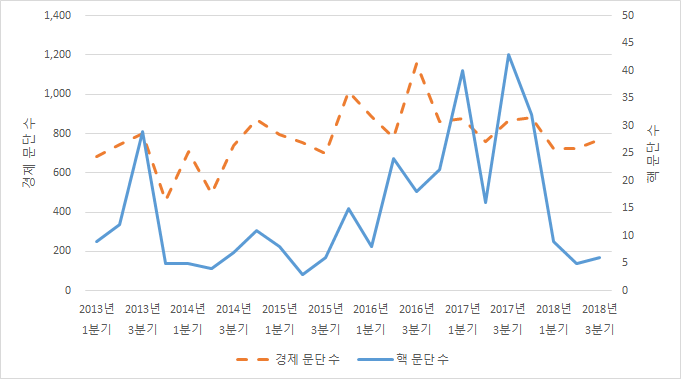
Table 2: Quarterly Frequency and Proportion of the Terms 'Nuclear' and 'Economy' (Based on Paragraph Count)
구분 |
총 문단 수 |
핵 문단 수 |
경제 문단 수 |
핵 문단 비율 |
경제 문단 비율 |
2013.1 |
3,656 |
9 |
683 |
0.00246 |
0.187 |
2013.2 |
3,858 |
12 |
745 |
0.00311 |
0.193 |
2013.3 |
3,468 |
29 |
799 |
0.00836 |
0.230 |
2013.4 |
3,076 |
5 |
459 |
0.00163 |
0.149 |
2014.1 |
3,222 |
5 |
711 |
0.00155 |
0.221 |
2014.2 |
2,848 |
4 |
494 |
0.00140 |
0.173 |
2014.3 |
3,383 |
7 |
738 |
0.00207 |
0.218 |
2014.4 |
3,534 |
11 |
871 |
0.00311 |
0.246 |
2015.1 |
3,579 |
8 |
794 |
0.00224 |
0.222 |
2015.2 |
3,529 |
3 |
754 |
0.00085 |
0.214 |
2015.3 |
3,918 |
6 |
700 |
0.00153 |
0.179 |
2015.4 |
4,082 |
15 |
1,013 |
0.00367 |
0.248 |
2016.1 |
3,782 |
8 |
889 |
0.00212 |
0.235 |
2016.2 |
3,675 |
24 |
778 |
0.00653 |
0.212 |
2016.3 |
5,245 |
18 |
1,158 |
0.00343 |
0.221 |
2016.4 |
4,062 |
22 |
860 |
0.00542 |
0.212 |
2017.1 |
3,909 |
40 |
879 |
0.01023 |
0.225 |
2017.2 |
3,574 |
16 |
757 |
0.00448 |
0.212 |
2017.3 |
3,940 |
43 |
865 |
0.01091 |
0.220 |
2017.4 |
4,181 |
32 |
884 |
0.00765 |
0.211 |
2018.1 |
3,453 |
9 |
725 |
0.00261 |
0.210 |
2018.2 |
3,620 |
5 |
726 |
0.00138 |
0.201 |
2018.3 |
3,721 |
6 |
771 |
0.00161 |
0.207 |
Figure 2: Quarterly Trends in the Frequency of 'Nuclear' and 'Economy' Terms (Based on Paragraph Count)
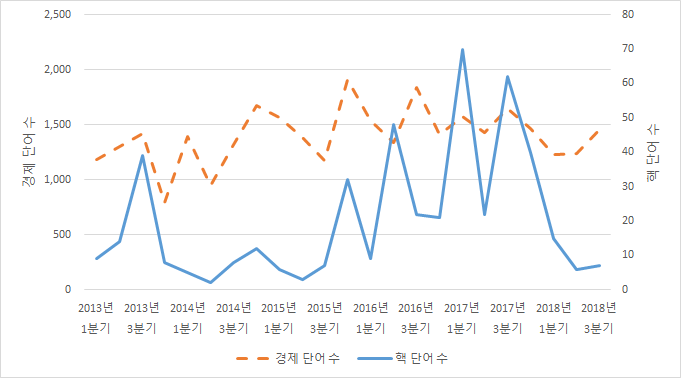
Table 3: Correlation between the Frequencies of 'Nuclear' and 'Economy' Terms by Time Period
|
기준 분류 |
전 기간 |
2016년 3분기 이전 |
2016년 3분기 이후 |
상관계수
(p-값) |
단어 수 |
0.4198* |
0.3345 |
0.8212* |
문단 수 |
0.4637* |
0.4144 |
0.8874* |
Note: The (*) symbol indicates statistical significance at the 5% confidence level.
4. Implications
The words "nuclear" and "economy," as well as paragraphs containing these terms, display a positive correlation in their frequency, and the overall trend showcases a parallel trajectory. Considering North Korea's practice of scrutinizing all publications, it can be inferred that after North Korea declared its simultaneous nuclear and economic development policy (also known as Byungjin policy or parallel development) in 2013, the country's leading academic journals have reflected this fundamental policy direction of the party.
However, the fact that the correlation coefficient between "nuclear" and "economy" significantly increased post-Q3 2016, achieving statistical significance, can be interpreted as being related to North Korea's series of military provocations from the start of 2016 to the end of 2017. This includes nuclear tests and the testing of Intercontinental Ballistic Missiles (ICBMs), and the global community's response to such actions.
As military and political tensions escalate, North Korea, facing international criticism, appears to have intensified its domestic justification for nuclear development. One manifestation of this emphasis is evident in the increased frequency of terms like "nuclear" and "economy", especially "nuclear", in academic journals and other publications.
(To be continued in the next issue)