

A Study on North Korea's Nuclear Economic Policy: Focusing on Correlation(2)
This research is a joint endeavor from the 2019 initiative aiming to lay the groundwork for reunification. This initiative was spearheaded by the SAND Research Institute in partnership with the Institute of Economic Research at Seoul National University. Within, we provide an up-to-date analysis examining the frequency, significance, co-occurrence, and implications of the terms "nuclear" and "economy" in various contexts.
(Continued from Issue No. 13)
5. Analysis of the Characteristics of the Occurrence of "Nuclear" and "Economy"
In order to understand the North Korean authorities' perception of nuclear issues and the economy, an analysis was conducted on the trend of the simultaneous occurrence ratio of "nuclear" and "economy." This was based on analytical documents, as well as the frequency of each word group's appearance in documents where both "nuclear" and "economy" were present.
1) Results of the Simultaneous Occurrence Ratio Analysis of "Nuclear" and "Economy"
According to Table 4 below, the number of documents in which economic terms appeared (Column 2) was significantly higher than the number of documents in which nuclear terms appeared (Column 3). The number of documents in which nuclear and economic terms appeared separately (Column 6) was significantly higher than the number of documents in which nuclear and economic terms appeared simultaneously (Column 5).
The ratio of documents in which economy appeared alongside nuclear terms (Column 5) out of the documents in which nuclear terms appeared (Column 3) was quite high. On the other hand, the ratio of documents in which nuclear appeared alongside economic terms (Column 5) out of the documents in which economic terms appeared (Column 2) was low. The ratio (Column 7) of the documents in which nuclear and economy appeared together (Column 5) out of all documents in which nuclear and economy appeared (Column 4) ranged from a minimum of 0% to a maximum of about 15%, which is not high.
Comparing the trend of the number of documents in which nuclear and economy appeared separately with the number of documents in which they appeared simultaneously (Figure 3), it is found that the number of documents in which nuclear and economy appeared separately had a relatively small fluctuation range. On the other hand, the number of documents in which nuclear and economy appeared simultaneously saw a significant increase starting from the third quarter of 2016, decreased after peaking in the third quarter of 2017, but increased again in the third quarter of 2018.
<Table 4> Results of Simultaneous Occurrence Ratio Analysis of Nuclear and Economy
| 구분 | (1) | (2) | (3) | (4) | (5) | (6) | (7) |
| Total Documents | Documents with Economy | Documents with Nuclear | Documents with Both Nuclear and Economy | Documents with Concurrent Occurrences | Documents with Separate Occurrences | (5)/(4) | |
| 2013.1 | 112 | 86 | 6 | 87 | 5 | 82 | 0.05747 |
| 2013.2 | 112 | 75 | 10 | 76 | 9 | 67 | 0.11842 |
| 2013.3 | 107 | 83 | 11 | 84 | 10 | 74 | 0.11905 |
| 2013.4 | 86 | 55 | 4 | 56 | 3 | 53 | 0.05357 |
| 2014.1 | 105 | 82 | 5 | 84 | 3 | 81 | 0.03571 |
| 2014.2 | 87 | 55 | 2 | 57 | 0 | 57 | 0.00000 |
| 2014.3 | 103 | 77 | 6 | 78 | 5 | 73 | 0.06410 |
| 2014.4 | 109 | 86 | 9 | 88 | 7 | 81 | 0.07955 |
| 2015.1 | 112 | 80 | 5 | 84 | 1 | 83 | 0.01190 |
| 2015.2 | 110 | 77 | 3 | 79 | 1 | 78 | 0.01266 |
| 2015.3 | 122 | 80 | 6 | 81 | 5 | 76 | 0.06173 |
| 2015.4 | 125 | 92 | 8 | 93 | 7 | 86 | 0.07527 |
| 2016.1 | 132 | 91 | 6 | 92 | 5 | 87 | 0.05435 |
| 2016.2 | 119 | 89 | 7 | 91 | 5 | 86 | 0.05495 |
| 2016.3 | 159 | 114 | 11 | 118 | 7 | 111 | 0.05932 |
| 2016.4 | 138 | 95 | 15 | 97 | 13 | 84 | 0.13402 |
| 2017.1 | 127 | 90 | 15 | 95 | 10 | 85 | 0.10526 |
| 2017.2 | 117 | 84 | 9 | 85 | 8 | 77 | 0.09412 |
| 2017.3 | 114 | 85 | 14 | 86 | 13 | 73 | 0.15116 |
| 2017.4 | 128 | 90 | 14 | 94 | 10 | 84 | 0.10638 |
| 2018.1 | 108 | 78 | 7 | 79 | 6 | 73 | 0.07595 |
| 2018.2 | 109 | 80 | 1 | 80 | 1 | 79 | 0.01250 |
| 2018.3 | 109 | 82 | 5 | 82 | 5 | 77 | 0.06098 |
<Figure 3> Quarterly Trend of the Proportion of Documents with Concurrent Occurrence of "Nuclear" and "Economy"
(Based on the Number of Documents)
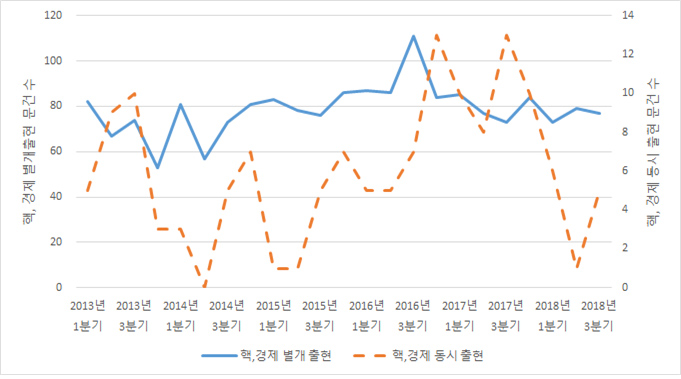
ㅡSeparate Occurrences of Nuclear and Economy --Concurrent Occurrences of Nuclear and Economy
2) Analysis Results on the Relevance of the Occurrence of "Nuclear" and "Economy"
According to <Table 5>, it is confirmed that the rank of economic terms within the group of nuclear-related words is significantly higher than the rank of nuclear terms within the group of economy-related words in the previous quarter. While nuclear terms are often ranked beyond 1000th in the group of economy-related words, economic terms are ranked as high as 178th at the lowest within the group of nuclear-related words, indicating a significant difference between the two cases.
<Table 5> Positions of Nuclear- and Economy-Related Words in Each Other’s Contexts
| Year-Quarter | Economy-Related Terms in Nuclear Context | Nuclear-Related Terms in Economy Context |
| 2013.1 | 6 | 608 |
| 2013.2 | 9 | 854 |
| 2013.3 | 29 | 710 |
| 2013.4 | 173 | 1628 |
| 2014.1 | 20 | 1716 |
| 2014.2 | 107 | 1911 |
| 2014.3 | 85 | 1804 |
| 2014.4 | 45 | 1938 |
| 2015.1 | 76 | 2491 |
| 2015.2 | 16 | 1566 |
| 2015.3 | 148 | 2522 |
| 2015.4 | 28 | 900 |
| 2016.1 | 81 | 2306 |
| 2016.2 | 178 | 1529 |
| 2016.3 | 65 | 1495 |
| 2016.4 | 1 | 637 |
| 2017.1 | 52 | 808 |
| 2017.2 | 31 | 1291 |
| 2017.3 | 15 | 894 |
| 2017.4 | 20 | 875 |
| 2018.1 | 61 | 1279 |
| 2018.2 | 31 | 1723 |
| 2018.3 | 2 | 1204 |
※ Note: The ranking is based on the sum of the matrix multiplication results, not on the absolute frequency of each word, when the co-occurrence word matrix is derived.
3) Implications
From the results in <Table 4>, the number of documents in which the economy appears is greater than the number of documents in which nuclear appears. This seems to be partly due to the inclusion of economic academic journals in the analysis target, and the characteristics of academic journals compared to popular magazines.
While it’s comparatively straightforward to delve into economic topics in academic discourse, nuclear subjects often lend themselves more readily to political discussions. Consequently, considering that the study’s dataset is heavily academic, the prevalence of "economy" in comparison to "nuclear" is an important factor to take into account.
From the results in <Table 4>, comparing the number of documents in which nuclear and economy appear separately with the number of documents in which they appear together, it is analyzed that the number of documents in which the two words appear separately is significantly greater. This suggests that the parallel advancement of nuclear and economic development is more likely to assert the legitimacy and utility of each, rather than being connected by a logical link between nuclear and economy.
According to <Table 5>, while the economy is actively utilized to explain nuclear, it is rare to use nuclear to explain the economy. This result can be interpreted as recognizing the utility value of the economy over nuclear for North Korean citizens, even in academic journals. In other words, it is inferred that while the economy needs to be emphasized along with nuclear for the survival of North Korean citizens, when explaining the economy, nuclear is either deemed unnecessary or there is a failure to find an intrinsic connection between the two.
6. Analysis of the Co-occurring Word Groups of "Nuclear" and "Economy"
By examining word groups that tend to appear together with "nuclear" and "economy," we aim to grasp the concepts and meanings that authorities associate with these terms.
1) Analysis Results
According to <Table 6>, the analysis of co-occurring word groups reveals that, with the exception of 8 words, the top 25 related words for "nuclear" and "economy" differ significantly. For "nuclear," the associated words mainly include technology, war, energy, weapons, world, country, powerhouse, and imperialists. Meanwhile, the "economy" is frequently described alongside words like development, socialism, people, country, management, construction, state, and production.
There are 8 words in total that appear in both economy-related and nuclear-related word groups. These words are development, socialism, people, country, construction, powerhouse, science and technology, and technology. Among them, development, socialism, people, country, construction, and powerhouse seem to be interconnected, highlighting the results of nuclear development and economic progress. Science and technology, as well as technology, are perceived as common tools applicable to both the nuclear sector and economic development. However, a clear logical link connecting nuclear and economic development remains elusive.
Despite the presence of 8 common related words, their rankings vary noticeably between the economy-related and nuclear-related word groups.
According to <Table 7>, in the economy-related word group, words such as development, socialism, and people, which rank 1st, 2nd, and 3rd, respectively, record relatively low rankings of 21st, 16th, and 11th in the nuclear-related word group.
On the other hand, "technology," ranking first in the nuclear-related group, falls to the 17th position in the economy-related group. Hence, words highly ranked in the nuclear context tend to appear lower in the economic context, and vice versa.
Moreover, other high-ranking words in the nuclear-related word group are absent from the economy-related word group.
<Table 6> Words Related to Nuclear and Economy
| Words Related to Economy | Words Related to Nuclear |
|
|
|
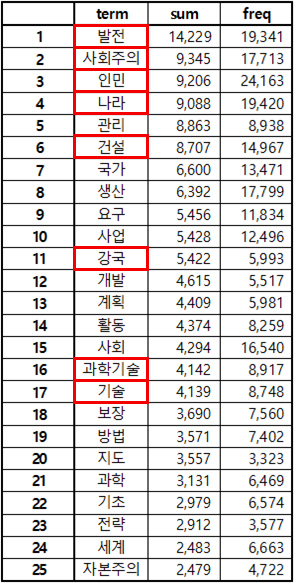
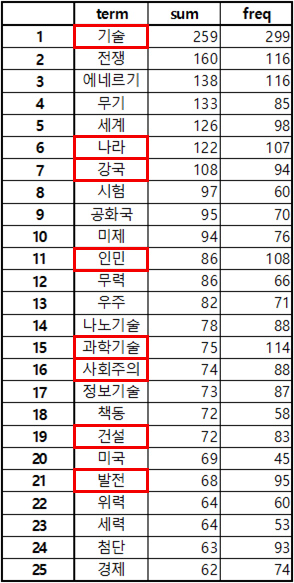
※ Note: The ranking is not based on the absolute frequency of each word. Instead, it is derived from a co-occurrence word matrix. The rankings are determined by the sum resulting from matrix multiplication, with words included in both the economy-related and nuclear-related word groups highlighted.
<Table 7> Common Related Word Rankings for Economy and Nuclear-Related Words
| Common Related Words | Rank in Economy-Related Word Group | Rank in Nuclear-Related Word Group |
| 발전 Development | 1st | 21st |
| 사회주의 Socialism | 2nd | 16th |
| 인민 People | 3rd | 11th |
| 나라 Country | 4th | 6th |
| 건설 Construction | 6th | 19th |
| 강국 Strong Nation | 11th | 7th |
| 과학기술 Science and Technology | 16th | 15th |
| 기술 Technology | 17th | 1st |
2) Implications
The ranking results convey a clear message; only 8 out of the 25 related word groups have made their way into both the nuclear and economic domains, underscoring the distinct nature of the two terms. The pronounced disparities in the rankings of shared words between the nuclear and economic word groups reinforce the notion that nuclear and economy are perceived as separate entities.
Examining the nature of the words in each related word group, nuclear-related words include terms like technology, war, weapons, strong nation, and science and technology, mainly composed of technology-related words and reasons for nuclear development claimed by North Korea. On the other hand, economic-related words are mainly composed of terms related to economic development, such as development, socialism, people, construction, production, and development.
In summary, nuclear is often explained as a means to protect the people from international political threats, such as the threat of war from the United States. In contrast, economy is described in terms of the elements necessary for economic development, suggesting a fundamental dissimilarity between the two words. Furthermore, there is no internal link presented that connects these two words.
-
PREV [Opinion]
-
NEXT [North Korean Terminology]