

North Korean High School Students Sentenced to 12 Years of Hard Labor for Watching South Korean Content
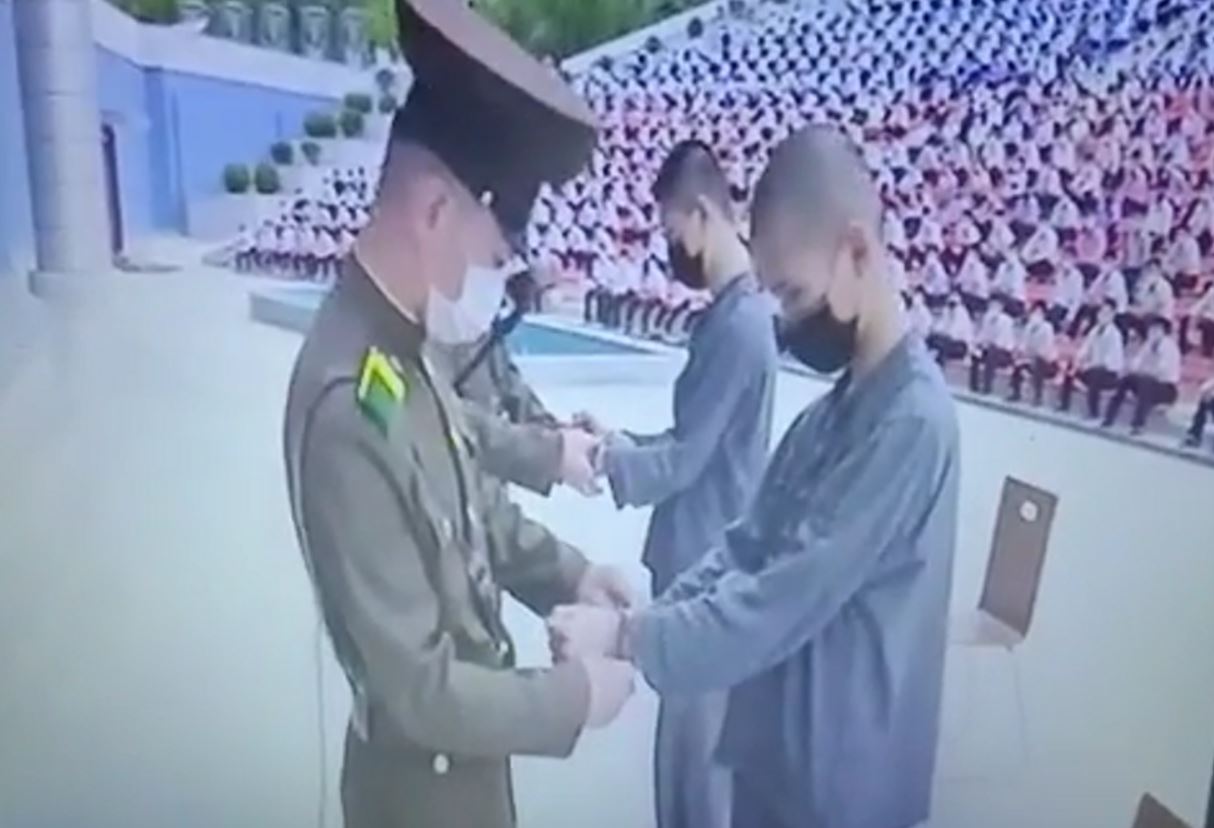
Recently, North Korea publicly released footage showing high school students in Pyongyang being subjected to a severe punishment of 12 years of hard labor. They faced this penalty for watching South Korean movies and music videos, thereby violating the 'Reactionary Ideology and Culture Rejection Law.' This footage, titled ‘Let’s Intensify Efforts to Eradicate All Forms of Reactionary and Non-Socialist Phenomena’ and obtained by SAND from an inside source, underscores the government's stringent efforts to suppress what it considers harmful foreign influences.
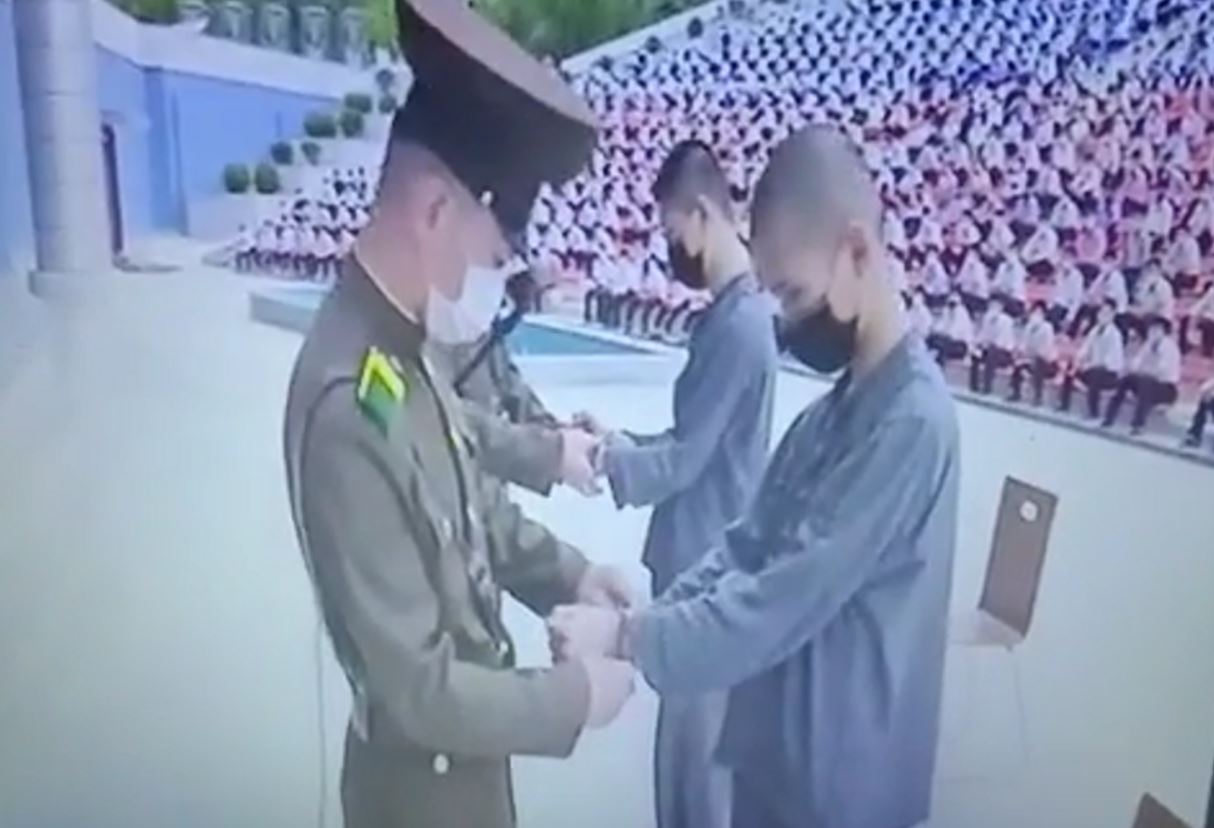
A photo from last summer shows students Lee Kwang-bok and Moon Kwang-rim from Samma High School in Tongdaewon District, handcuffed after being sentenced for watching South Korean content / Photo by SAND
The video, created as internal educational material by North Korean authorities, highlights cases that emerged during the implementation of the 'Reactionary Ideology and Culture Rejection Law,' which was established in December 2020. This law aims to curb the widespread influence of South Korean culture and content in North Korea. It features high school students engaging with South Korean movies, dramas, music videos, and mimicking the language and tone. The video also criticizes Pyongyang women for adopting South Korean fashion and hairstyles, revealing their identities to publicly shame them. Additionally, it condemns the influence of South Korean common-law marriages in Pyongyang as 'social contamination.'"
This video confirms that South Korean culture has reached Pyongyang, which North Korea sees as the center of its ideology. It shows that there are big and fast changes happening in the culture and thinking of people in North Korea.
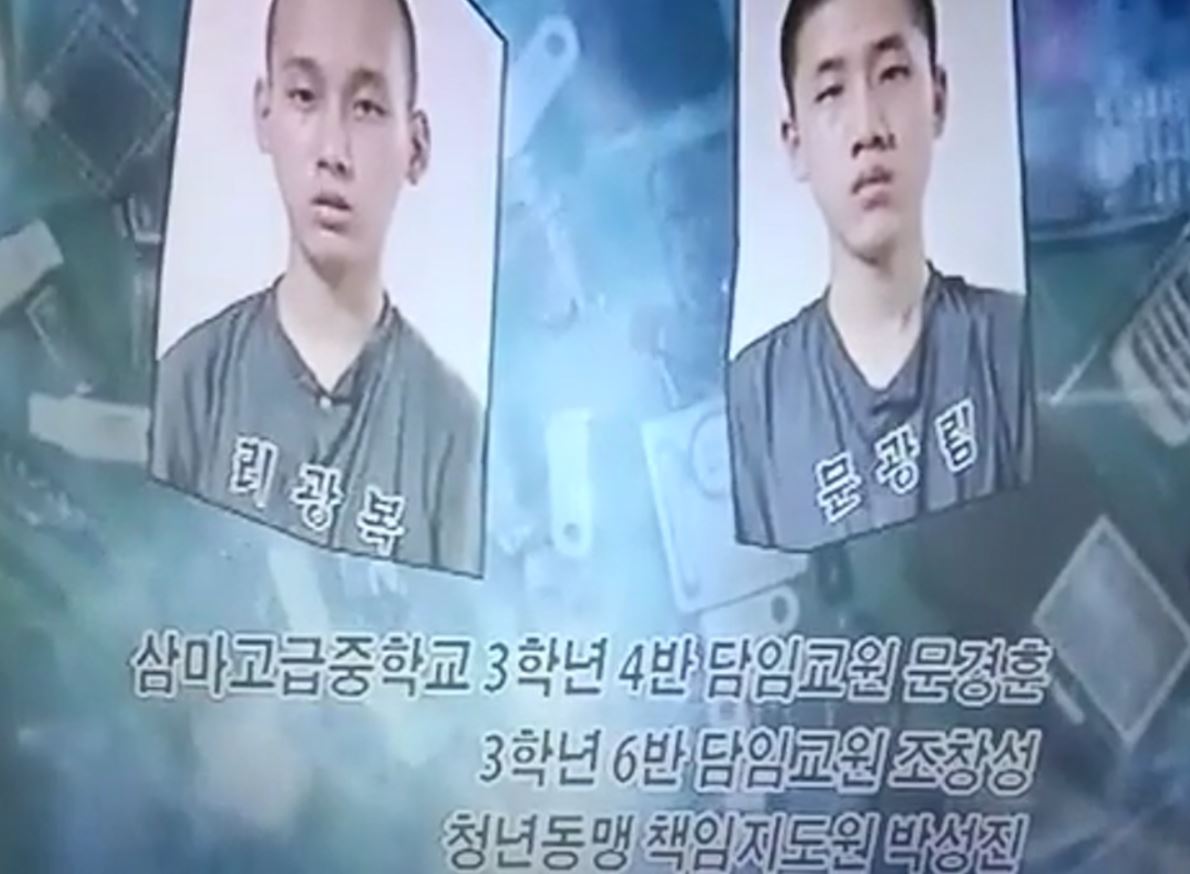
Students Lee Kwang-bok and Moon Kwang-rim, who were sentenced to 12 years in prison for watching South Korean content; alongside them, the names of their teacher and a youth leader were also revealed / Photo by SAND
The video also talks about more cases, showing South Korean culture as harmful and negatively affecting young people in North Korea.
The video reveals that a big public trial was held at the Youth Park Open-air Theatre in Pyongyang last year, with more than a thousand students watching. The trial was for Lee Kwang-bok and Moon Kwang-rim from Samma High School. They were accused of watching and spreading South Korean movies, music, and 20 music videos from November 2021 to January 2022, breaking the 'Reactionary Ideology and Culture Rejection Law.'
Even though they were only 16 years old, both students were given 12 years of hard labor as punishment. The video shows them with shaved heads and wearing prison clothes, being handcuffed by security officers. It also shows a young girl being handcuffed.
The video says that these students were drawn to South Korean culture, and this led to them ruining their own lives.
Since the 'Reactionary Ideology and Culture Rejection Law' was made in December 2020, North Korea has been more strict in stopping people from watching South Korean content. There have been other cases like this in different parts of the country.

Students Lee Kwang-bok and Moon Kwang-rim from a Pyongyang high school during their public trial for watching South Korean content, observed by hundreds of fellow students. / Photo by SAND
The punishments for these actions are getting harsher. This year, it was reported that a teenager in Ryanggang Province's Hyesan City was executed in public for sharing South Korean dramas and music.On the 26th of last month in Seoul, the Ministry of Unification hosted a discussion titled 'Improving Conditions and Enhancing Access to Outside Information for North Korean Residents.' During the seminar, it was revealed that in June, two farmers from Chondan County, South Hwanghae Province, were publicly executed for secretly watching South Korean movies and news. Additionally, in April, a military official from Pyongyang City was reportedly executed for distributing files with global news and street scenes.
North Korea has also focused on the attire and hairstyles of residents influenced by South Korea. The video states, 'Some residents and teenage students are being influenced by propaganda from South Korea and Western capitalist countries. They copy everything from their clothing and hairstyles to what are perceived as odd South Korean accents. This leads to engagement in unconventional behaviors like common-law marriage, marking the infiltration of South Korean and Western cultures and disrupting our traditional culture.'
The video shows Choi Ok-hyun from Taesong District, criticized for her clothing, and publicly shamed. Her personal details were shared as part of the effort to make people follow the rules. She is criticized for acting as though she has done nothing wrong, with the commentary suggesting that her behavior is a clear indication of her deep involvement in Western and South Korean cultures. The video goes on to declare her unfit to be a resident of Pyongyang City. A defector from Pyongyang noted that such public criticism in a broadcast could lead to expulsion from the city."
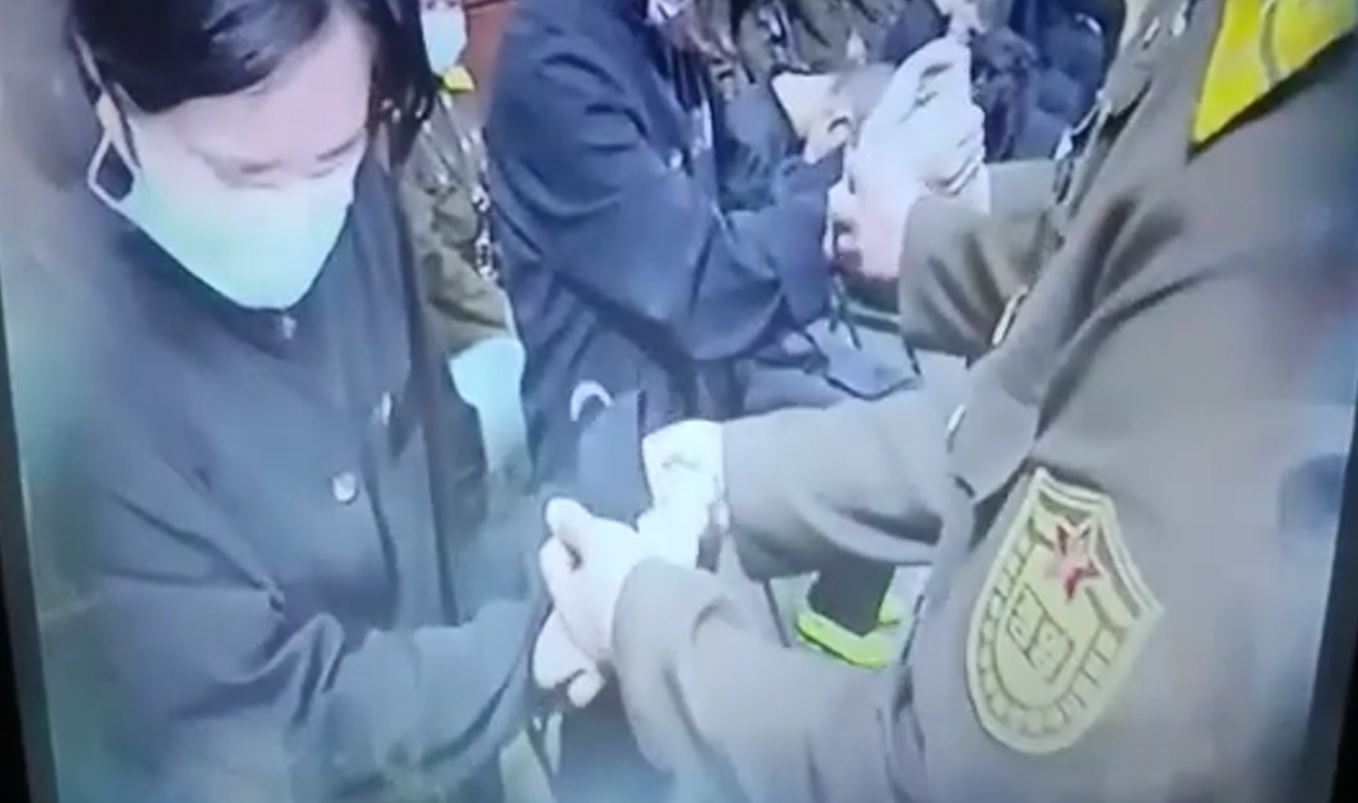
Teenagers in Pyongyang City pictured in handcuffs following a public trial for watching South Korean content / Photo by SAND
Additionally, the video tackles the issue of women wearing leggings. It features Shin Yang-sim from Yeongsan-dong, Mangyongdae District, dressed in leggings. The video criticizes this choice of attire, declaring it to be 'a shameful style unbecoming of our refined culture.'
North Korea has intensified its enforcement efforts while also actively encouraging residents to voluntarily confess. In line with directives from Kim Jong-un, authorities are assuring residents that those who admit their wrongdoings will be forgiven, with a clear emphasis that no punitive measures will be imposed on those who come forward and confess.
People are being told to give up any material that goes against the state's ideas, including religious books, foreign movies, and dramas. Individuals engaged in drug use, trafficking, or in the consumption and distribution of pornographic material are being encouraged to step forward and make honest confessions.
North Korea reports significant results in the Sosong District of Pyongyang City, with over a thousand residents and students making voluntary confessions. However, the reliance on tactics like offering 'forgiveness upon confession' suggests a departure from previous, more unilateral control strategies. Despite earlier efforts to strengthen crackdowns and heighten punishments for consuming South Korean content, its influence has only continued to expand. This has led to a shift towards a combined strategy of strict enforcement and persuasive tactics. Under Kim Jong-un's rule, which has spanned over a decade and seen a reversion to anti-market policies, North Korean cultural and artistic output has increasingly focused on repetitive expressions of loyalty and patriotism. This departure from innovative and change-reflective artistic works has led to a sense of monotony among the youth and the general population. Those exposed to the advancements of South Korea through various media are growing increasingly hopeful for a future reunification.