

Pyongyang City Residents Convicted of Prostitution, Drug Offenses, Embezzlement, and Theft Deported to Rural Areas After Public Trials
It has been officially confirmed that residents of Pyongyang City involved in crimes like prostitution, drug offenses, embezzlement, and theft faced public trials and were subsequently deported to rural areas. While North Korea promotes its crime-free socialist system and typically conceals domestic crime statistics, this information reveals the involvement of North Korean citizens in a range of crimes, including not only theft but also prostitution, drug offenses, and embezzlement.
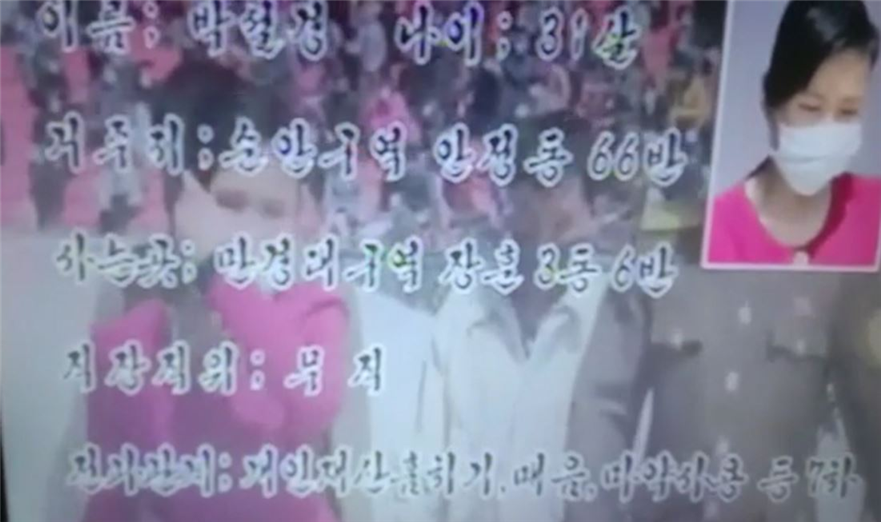
Pak Sol-gyong, arrested in Pyongyang City last year for crimes including prostitution and drug use / This photo was captured from the news
The recent internal footage acquired by SAND includes scenes from a public trial held at a sports stadium in Pyongyang City last year, with the theme "Eradicating Anti-Socialist and Non-Socialist Phenomena."
In front of a crowd of thousands, high-ranking officialsfromthe Police Department in Pyongyang City, dressed in military uniforms with one star, publicly listed the charges against five criminals, revealing their faces, photographs, workplaces, and home addresses. These individuals were arrested and prosecuted for crimes including theft, assault, prostitution, drug offenses, and embezzlement.
According to the video footage, Kang Chul (37 years old), a laborer at the Hwacho Development Office in Pyongyang City's Sosong District, committed crimes such as theft and assault four times. It was revealed that Kang resided at 72 Wasan-dong, Sosong District.
The video footage also indicates that Moon Young-hak (49 years old), a laborer of the Taesong District Automobile Development Office, had a criminal record of theft and was a repeat offender six times. Moon lived at 9Nangrang 1-dong, Nangrang District.
Lee Jeong-ryeol (31 years old), a farm worker at the Songshinnam-sae Cooperative Farm in Sadong District, was identified as a repeat offender with a criminal record that included stealing both state and private property, totaling five offenses. He resided at 55Songhwa 1-dong, Sadong District.
These crimes highlight the increasing prevalence of economic crimes such as theft and robbery, as well as social crimes such as corruption, in North Korea due to economic difficulties.
Amidst the prominence of theft as a representative case of economic crime in North Korea, thieves are reported to steal national property such as essential goods distribution centers, factory components, telephone lines, electrical cables, and cultural assets. They also engage in pickpocketing from people encountered in Jangmadang (marketplaces), stations, and trains.
There are also criminal organizations involved in various illicit activities, including smuggling essential goods in the black market and extorting rent fees. Violent gangs engage in smuggling cigarettes, alcohol, clothing, and pharmaceuticals through connections with the security officials. Even young people are drawn into violent gangs, committing crimes such as robbery, theft, rape, and pickpocketing in ports, major cities, and border regions.
Prostitution has also been observed as a prevalent activity alongside theft.
According to the video footage, Moon Cheol (31 years old), a laborer who worked inChanghun 3-dong, Mangyongdae District, committed six crimes, including theft of personal property and involvement in prostitution. Moon lived at 6Changhun 3-dong, Mangyongdae District.
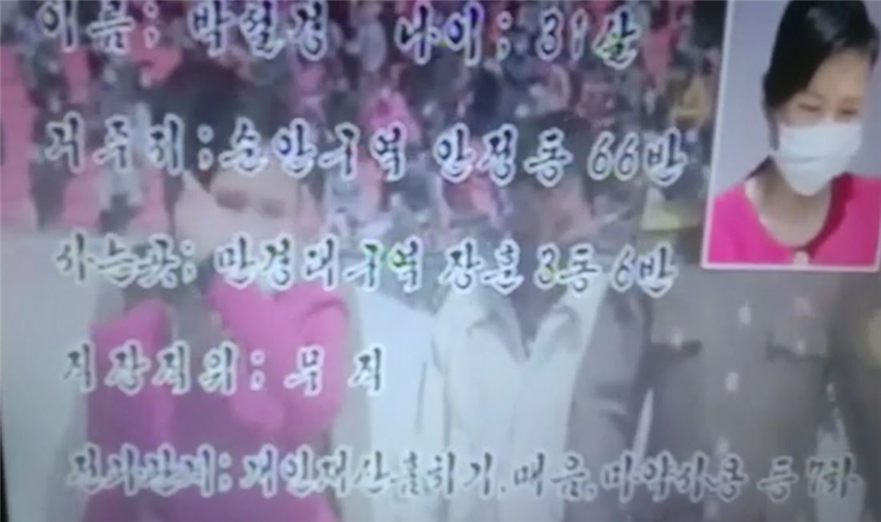
Pak Sol-gyong (31 years old), an unemployed resident of 6 Changhun 3-dong, Mangyongdae District, was involved in seven crimes, including theft of personal property, prostitution, and drug use. Importantly, Pak Sol-gyong's place of residence differed from the officially registered locationwhich is 66 Anjeong-dong, Sunan District, Pyongyang City
Moon Cheol was a pimp procuring and facilitating prostitution, while Pak Sol-gyong directly engaged in prostitution.
While North Korea officially prohibits prostitution and upholds the idea that Pyongyang should symbolize revolutionary and moral purity, according to North Korean defectors, prostitution is widespread throughout the city. Women are involved in prostitution, often managed by pimps, as a means to address their economic hardships. Some individuals even combine prostitution with providing accommodation services for people waiting at train stations near Pyongyang City. There are also reports of high-end prostitution rings serving the elite and foreigners operating around luxury hotels.
Sexual crimes are also occurring frequently in North Korea. Unlike the 1980s when cases of prostitution were rare, sexual crime incidents have increased since the 1990s, with rape and sexual harassment primarily committed by officials in positions of power.
Furthermore, drug-related crimes are becoming increasingly serious, with around 30% of North Korean residents reportedly using drugs. Pak Sol-gyong, for example, was involved in both prostitution and drug use. These drug-related crimes are not confined to border areas but are also prevalent in central locations like Pyongyang City. Some North Korean residents have turned to drugs as a means of coping with tension and stress. Additionally, the economic hardships worsened by the COVID-19 pandemic have led many individuals to engage in drug trafficking as a source of income. These five individuals were all deported from Pyongyang City to rural areas, along with their families.
Several factors underlie the rise in criminal activities in North Korea. The country's excessive control system, aimed at maintaining its dynastic dictatorship, has inadvertently led to frequent social injustices and deviant behavior due to the rigid nature of the regime and its distorted centralized structure. The economic challenges worsened by the COVID-19 pandemic and lockdown have fueled discontent among the population. Furthermore, the breakdown of distribution systems, increasing wealth disparities, and the influence of external factors have eroded collectivism and promoted individualistic values, resulting in various forms of deviant behavior.
However, North Korea often overlooks these root causes and instead attributes criminal behavior to external forces, portraying it as actions aligned with 'enemy' interests.
In the video, North Korea stated, "These crimes align with the actions of those challenging North Korea's sacred and dignified socialist system. We call for strict and unwavering punishment." Additionally, they emphasized their commitment to "safeguarding political stability in the capital."
Choi Kyong-hui, the director of SAND, commented, "Pyongyang City, where Kim Jong-un resides, endeavors to present itself as a crime-free and pristine city. But, beneath the surface, various criminal activities are prevalent."
-
PREV [Story on support for North Korea]
-
NEXT [Analysis]