


North Korean Economy:
Insights and Outlook from the 9th Plenary Meeting of the 8th Central Committee of WPK

Hong Jae-hwan
Korea Institute for National Unification
North Korea held its 9th Plenary Meeting of the 8th Central Committee of the Workers' Party of Korea from December 26th to 30th last year. Detailed reports on the meeting were published in Rodong Sinmun, covering the economic achievements of 2023 and the goals for 2024. This article analyzes North Korea's current economic situation and prospects for the coming year, with a focus on Rodong Sinmun's reporting during the plenary meeting.
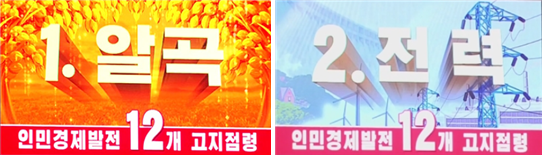
Promoting ‘Grain’ and ‘Electricity’ as part of the '12 Key Heights of Economic Development for -People' announced in 2023. (Photo by Korean Central News Agency)
Significant Emphasis on Publicizing Economic Achievements in 2023
According to Rodong Sinmun's article, North Korea's economic achievements are highlighted with specific figures. In 2022, North Korea had set "12 important goals for people's economic development" to be achieved in 2023, and the report provides production performance data for these items. The reported accomplishments include: grains at 103%, electricity, coal, nitrogen fertilizer at 100%, rolled steel at 102%, non-ferrous metals at 131%, logs at 109%, seafood at 105%, and housing at 109%. These figures indicate that production targets were met or exceeded for these items. Additionally, the article mentions the production of items not included in the 12 important goals, such as electric motors (220%), transformers (208%), electric zinc (140%), and cosmetics (109%), which also largely exceeded their targets.
North Korea also emphasized its economic accomplishments, particularly the significant growth in GDP and the production of key heavy chemical industry items in comparison to 2020. According to the plenary meeting report, GDP has surged by 1.4 times over the past three years, with notable increases in the production of direct reduced iron (DRI) by 3.5 times, rolled steel by 1.9 times, machine tools by 5.1 times, cement by 1.4 times, and nitrogen fertilizer by 1.3 times. This comprehensive report on economic achievements represents a departure from the one published at the end of 2022, which had limited information on specific economic accomplishments and mainly focused on the construction sector.
Moderate Recovery Assumed in the North Korean Economy
According to the plenary meeting report, North Korea's economic performance in 2023 displayed relative resilience. Despite facing sanctions and implementing border closures to prevent the entry of COVID-19, North Korea claimed to have achieved an average annual economic growth rate of over 10% since 2021. However, these figures raise skepticism, as they significantly differ from the widely accepted understanding of the North Korean economy under sanctions.
The reasons behind these seemingly unrealistic figures remain unclear. It is possible that North Korea achieved its positive economic performance in 2023 by setting more attainable targets for the "12 important goals for people's economic development." Alternatively, there may have been a different calculation method applied to report 1.4 times increase in GDP over three years. There could also be distortions in statistical data or inflated figures aimed at showcasing achievements. Regardless, the report does not provide an accurate reflection of the true state of the North Korean economy.
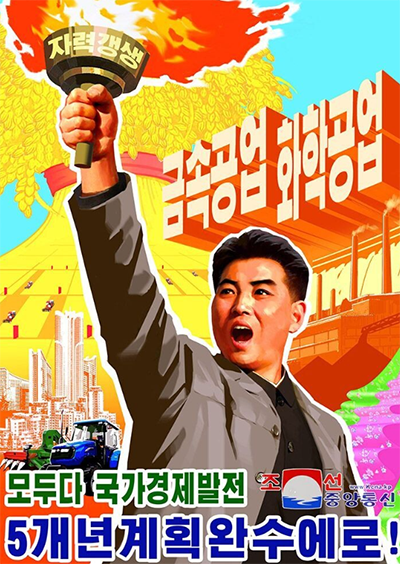
The poster for North Korea's ‘Five-Year Economic Development Plan’ announced in 2023. (Photo by Korean Central News Agency)
How can we assess the North Korean economy in 2023? A primary factor contributing to economic challenges since the late 2010s has been the reduction in trade due to sanctions and border closures. However, in the past year, as border restrictions gradually eased, trade expanded. From January to November, North Korea's trade with China surged by 132.7%, reaching $266.5 million in exports and 146.6%, totaling $1.78 billion in imports, compared to 2022. Both exports and imports experienced significant growth compared to the previous year, approaching pre-pandemic levels. This increase in trade likely contributed to a moderate recovery in the North Korean economy in 2023, although the extent of this recovery was not substantial, and citizens likely continued to face ongoing hardships in their daily lives.
No Major Changes Expected in Economic Policy Direction
What does the economic outlook for North Korea in 2024 look like? To gauge this, it's crucial to first delve into the economic policy direction for the year, as outlined in the plenary meeting report. However, the report suggests that 2024 will largely maintain continuity by adhering to the "12 important goals for people's economic development" without introducing significant new elements. This year marks the fourth year of the five-year economic development plans (2021-2025), which should ideally yield tangible results. However, there is no strong emphasis on achieving this, indicating that despite showcasing economic achievements, North Korean authorities are facing challenges in implementing proactive economic policies amidst tough economic conditions. Consequently, the report suggests that significant changes in North Korea's economic policy direction are unlikely for 2024.
Uncertainty About the Continuation of Recovery
With North Korea maintaining its unchanged economic policy direction, it's anticipated that the country's economy in 2024 will stay relatively consistent with its current state. The rebound observed in North Korea's economy in 2023 was primarily attributed to the rapid return of trade to pre-COVID levels. However, considering the ongoing strict sanctions and limited foreign currency reserves, it appears unlikely that North Korea's trade volume will experience significant growth in 2024, potentially hindering the continuation of the economic recovery. Nevertheless, North Korea may explore alternative means to secure foreign currency, such as expanding Chinese tourism, deploying overseas workers illicitly, and engaging in cryptocurrency theft and monetization through hacking, which could introduce variability in trade volume.
Another critical factor in projecting North Korea's economy is the expected persistence of market control reinforcement policies. Since the 2000s, North Korea's economy had exhibited signs of recovery, driven by increased foreign trade and market development. However, from the late 2010s onward, North Korea has intensified its oversight and management of markets. For instance, the authorities have revised laws to ensure that goods are channeled through the state commercial network rather than the open market. This approach appears to be an attempt to leverage market efficiency while simultaneously bolstering state control and addressing financial challenges. However, this strategy may potentially compromise overall economic efficiency and place additional burdens on residents reliant on private economic activities. Consequently, the sustained push for market control reinforcement could also serve as a limiting factor in North Korea's economic recovery in 2024.
Economic Policies for the Residents Are Needed
The path forward for North Korean authorities to revitalize their economy appears clear. It involves resolving the nuclear issue to lift sanctions, fostering trade, and attracting investments. Furthermore, it necessitates reducing the state's economic footprint, expanding the market sector, and ensuring maximum economic autonomy for residents. However, indications suggest that North Korean authorities may lean toward contrary measures for 2024, potentially prioritizing regime stability over enhancing the well-being of their citizens. With this economic policy direction in place, the prospect of an improved quality of life for North Korean citizens remains uncertain. The hope remains that the North Korean regime will reconsider its economic policies in favor of enhancing the lives of its residents, rather than leaving it as an ambitious expectation for 2024.
-
PREV [Analysis]
-
NEXT [Analysis]