

Kim Jong-un's Bellicosity with Hidden Intent of Ambition for Reunification:
Winning Over Communism by Nuclear Force
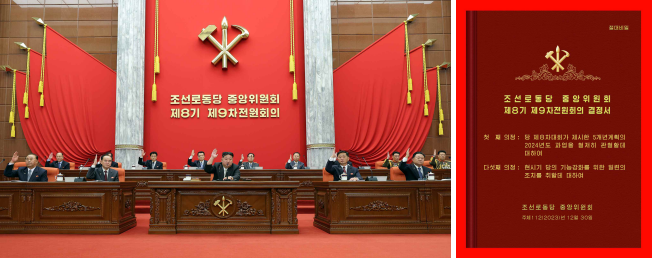
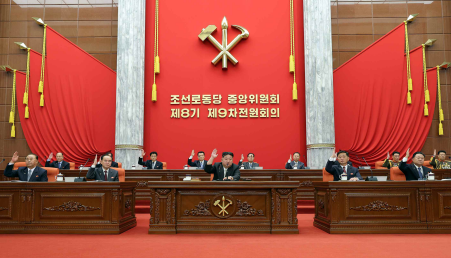
The extended meeting of the 9th Plenary Meeting of the 8th Central Committee of the WPK took place between December 26 and December 30, 2023. (Photo by Rodong Sinmun)
On the early morning of the first day of 2024, Kim Jong-un issued a stark directive, intensifying preparations for a major conflict and signaling the potential use of nuclear power in emergent crises. His forceful proclamation, "We are hostile, no longer a close nation, so conquer the entire territory," made during the 9th Plenary Meeting of the 8th Central Committee of the WPK, highlighted an escalating risk of warfare and the imminent danger of an armed confrontation.
These threats, while not entirely new, mark the first explicit expression of the regime's intention to pursue reunification through the nuclear force. This stance is perceived as the most critical threat of war since Kim Jong-un's ascent to power, heralding a period of increased instability. Furthermore, Kim Yo-jong, the leader’s younger sister, ascribed the advanced development of nuclear missiles to the current administration's policies, thereby shifting blame and setting the stage for future provocations.
Kim Jong-un's denial of the North and South's shared ethnicity and labeling the South as an enemy represents a major departure from past unification policies like ‘the Democratic Confederal Republic of Koryo (DCRK)’ and the 'Among our people' philosophy. This shift indicates a troubling change in Korean Peninsula dynamics. Historically framing its nuclear program as a defense against U.S. aggression, North Korea has recently adopted a more aggressive posture, openly threatening to use nuclear weapons against Koreans amid a tense, Cold War-like atmosphere.
Previously, on the Day of Victory in the Great Fatherland Liberation War – commemorating the 67th anniversary of the Korean Armistice Agreement on July 27, 2020 – Kim Jong-un reflected poignantly, 'I never forget our people who perished in the war due to our lack of guns, nor the emotions of leaving behind our soldiers on the Nakdong River.' He stressed the necessity to enhance nuclear capabilities, unveiling his long-held ambition to subdue South Korea using nuclear force.
Kim's aggressive display of nuclear power, prioritizing missile development over domestic economic issues, peaked last year. He conducted five launches of the Intercontinental Ballistic Missile (ICBM) and succeeded in launching a Reconnaissance satellite on the third attempt after two failures. North Korea also enshrined the 'enhancement of nuclear power' in its constitution and legalized the preemptive nuclear strike against the South.
During a recent training launch of the solid-fuel ICBM 'Hwasong-18' on the 18th of the previous month, Kim issued a stern warning about North Korea's readiness to rapidly counter any hostile actions from Washington, even hinting at nuclear strikes on the U.S. mainland. With escalated provocations expected this year, North Korea might undertake its seventh nuclear test and deploy more reconnaissance satellites, especially during the South Korean legislative elections in April and the U.S. presidential election in November.
North Korea's nuclear threats appear to be imitating Russia's use of nuclear force as a deterrent card to prevent direct military intervention by the United States and other Western countries in the Ukraine-Russia war. Observing how the international community recoils from Russia's mere mention of nuclear weapons, avoiding direct involvement and opting for indirect support, North Korea seems intent on using nuclear threats to gain dominance over South Korea on the Korean Peninsula and block direct U.S. intervention, thereby shattering the South Korea-U.S.-Japan alliance.
Kim Jong-un's aggressive nuclear threats are likely to fail, reflecting his regime's panic over the Yoon administration's efforts to normalize relations and enhance security. The Yoon administration is countering these threats with the U.S.-ROK Washington Declaration, the Nuclear Cooperation Group (NCG), U.S. strategic asset deployment in Korea, and joint military exercises with the U.S. and Japan, and the strategies have nearly turned North Korea's nuclear capabilities into a point of weakness.
Additionally, South Korea's increasing global influence and the widespread popularity of its culture (the Korean Wave, or 'hallyu') are shifting public opinion in North Korea, posing a threat to the regime's internal stability. Kim Jong-un's escalating rhetoric is a clear indicator of his anxiety; typically, the more intense the fear, the more dramatic the response.
With an economy only 1/60th the size of South Korea's, North Korea has plunged into a vortex of arms race by continuing its reckless development of nuclear missiles, leading its economy and civilian life into an inescapable quagmire. Despite Kim Jong-un's claims at the recent Plenary Meeting that last year's economic goals were achieved by over 100%, experts on the North Korean economy generally view these statistics without specific numbers as mere fabrications. Nevertheless, Kim continues to laud his regime with these questionable figures, showing little regard for the suffering of his people under oppressive governance and economic distress.
The idea of achieving a strong and wealthy nation under sanctions and a closed economy is nothing but a delusion. The Soviet Union, the leading socialist state, did not collapse because it lacked nuclear weapons. It collapsed due to severe economic stagnation and excessive defense spending despite possessing thousands of nuclear weapons. The fall of the former Soviet Union mirrors the future of Kim Jong-un, who is solely focused on nuclear development for regime survival rather than improving the civilian economy. To foster stability and progress, the Kim regime needs to abandon its hazardous nuclear threats and aggressive unification tactics against South Korea, and instead embrace a path of denuclearization, peace, and cooperation.
-
PREV [Feature Article]
-
NEXT [NK Focus]