

North Korea Dismantling South-Related Agencies, Removing Directives to Southern Spies from PBS
North Korea is accelerating the dismantling of inter-Korean exchange organizations, and PBS, which previously sent directives to spies in the South, has gone silent since around the 12th. This appears to follow North Korean leader Kim Jong-un's declaration last year, labeling inter-Korean relations as 'hostile,' with a pledge to conquer South Korean territory through force.
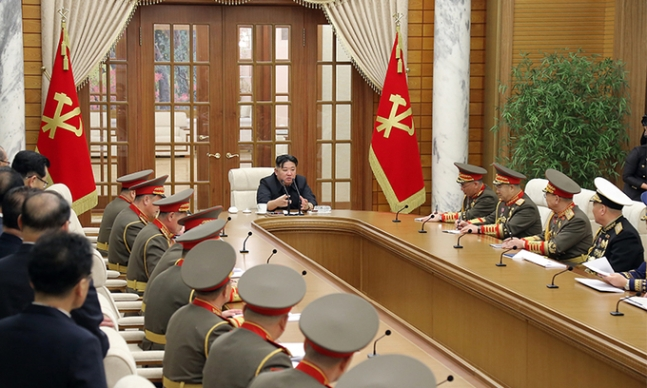
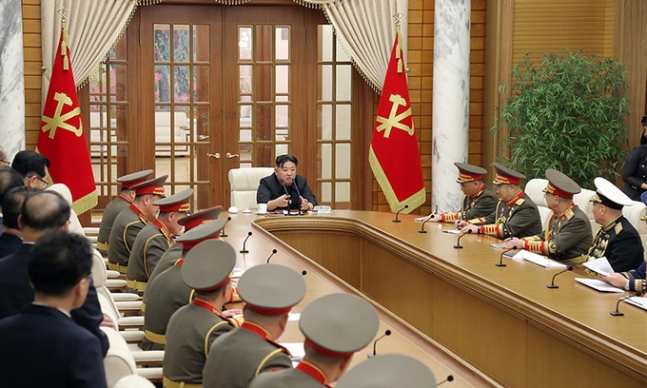
North Korea's leader Kim Jong-un met top military officials and key commanders at the Central Committee of the WPK’s Office Building on December 31 last year. / Photo by Korean Central News Agency
The PBS, a radio broadcast operated by North Korea's agency for the South, has been inaccessible since the afternoon of the 12th. Its website, ‘National Unification’, is also currently unreachable. PBS has a history of being run by North Korea's South-related agency. Starting from the 1960s, PBS aired content that aimed to incite the 'people's democratic revolution.' Notably, it used to broadcast praises of Kim Il-sung and Kim Jong-il at midnight, followed by the recitation of random numbers used for sending directives to spies in the South. This number broadcast was suspended after the inter-Korean summit on June 15, 2000, but it resumed in 2016.
North Korea has officially begun dismantling various organizations involved in civilian exchanges with South Korea. The Korean Central News Agency reported that officials from the opposing sector gathered on the 12th to implement Kim's South-oriented policy shift, proposed during the 9th Plenary Meeting of the 8th Central Committee of the WPK. All related organizations, including the North Committee for the June 15th South–North Joint Declaration, the Pan-Korean Alliance for Reunification Northern Headquarters, the Korean Council for Reconciliation and Cooperation, and the Dangun National Unification Advisory Council, will be dismantled.
The North Committee for June 15th South–North Joint Declaration and the Pan-Korean Alliance for Reunification Northern Headquarters have their headquarters in South Korea. The Korean Council for Reconciliation and Cooperation is an external body of the WPK that has collaborated with South Korea's National Council for Reconciliation and Cooperation. The Dangun National Unification Advisory Council has focused on Korean nation legitimacy and unification.
After Kim Jong-un declared South Korea as a hostile enemy country at last year's Plenary Meeting, South-related agencies were directed to be dismantled. Under Foreign Minister Choe Son-hui's leadership, North Korea is reorganizing these agencies, which might be closed or moved to the Ministry of Foreign Affairs. There is speculation about the integration of the United Front Department of WPK, responsible for psychological warfare and unification operations against the South, into the Ministry of Foreign Affairs.
On North Korea's external propaganda website 'Naenara' with the national domain (.kp), the 'We Are One' section emphasizing unification has been removed. Other North Korean propaganda websites targeting the South, such as Uriminzokkiri, Echo of Unification, Ryugyong, Today's Korea, and Ryomyong, with '.com' domains, have been inaccessible since the 11th.
The reorganization of North Korea's South-related agencies and its shift in South policy are significant. These agencies, which North Korea plans to dismantle, are external organizations of the WPK engaged in inter-Korean exchanges since the 1990s, seeking to overcome diplomatic isolation and secure economic support after the collapse of the Soviet Union and Eastern Bloc.
This indicates a shift from a strategy of disguised peace and fundraising based on the concept of 'Our Nation First' to a policy of overpowering the South based on nuclear force superiority.
Unlike Kim Il-sung's 'One Nation, One System' strategy for liberating South Korea, Kim Jong-un has adopted a 'Two Nations, Two Systems' military unification policy with the aim of forcefully conquering the entire territory of South Korea. During the 9th Plenary Meeting of the 8th Central Committee of the WPK from December 26 to 30 last year, Kim announced plans to actively prepare for a major event in coordination with powerful military actions to take control of the entire southern half.
He also stressed that engaging in discussions about unification with a country he considers a colonial puppet of the United States, solely based on ethnicity, is incompatible with their national dignity and status. Furthermore, he defined South Korea as an enemy nation and emphasized the imperative need for a fundamental policy shift towards the South.
This may be seen as an effort to dispel the South Korean influence among North Koreans, which has been fueled by the influx of South Korean culture. It aims to foster hostility toward the South through antagonistic actions. Simultaneously, as preparations are made to appoint his daughter, Kim Ju-ae, as a successor, cutting off inter-Korean exchanges and designating the South as an enemy seeks to instill a sense of hostility toward the South in the younger generation.
It entails creating a more hostile atmosphere to unite people internally, shift the blame away from economic problems, and give reasons for strengthening nuclear and defense capabilities.
North Korea's emphasis on creating crises to consolidate its regime under the guise of public control is noteworthy, especially as they are worried about their 2024 goals. Kim's labeling of inter-Korean relations as 'adversarial' last year and his mention of preparing for a 'major event' to gain control of South Korean territory suggests the potential for increased tensions on the Korean Peninsula ahead.
-
PREV [SAND Column]
-
NEXT [Current Affairs Analysis]