


Unveiling Kim Ju-ae's Red Guards: The True Motive Behind North Korea's Mangyongdae Revolution Academy Students in Propaganda Activities
Recent revelations highlight students from Mangyongdae Revolution Academy, dubbed North Korea's aristocratic institution, engaging in propaganda at production sites. Renowned as a 'vassal training academy' linked to the Kim Il-sung family's fate, it's central in the fourth-generation succession, especially with Kim Jong-un's daughter, Kim Ju-ae, gaining prominence. Speculation surrounds its role as modern-day Red Guards, backing Kim Ju-ae's ascent.
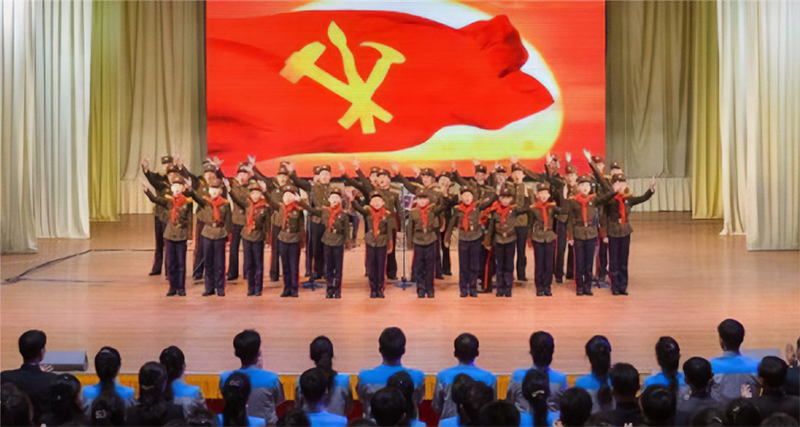
Students of North Korea's Mangyongdae Revolution Academy engaging in economic propaganda in front of workers at the Sangwon Cement Complex on January 20 (Rodong Sinmun)
North Korean state media, including the Rodong Sinmun, recently showcased the active involvement of Mangyongdae Revolution Academy students in economic propaganda activities, notably at the Sangwon Cement Complex. Dressed in military attire, these students lauded Kim Jong-un and the regime while performing at the production site. Described as "successors steadfastly continuing the lineage of the Juche Revolution within the embrace of the Party," they extended their propaganda efforts to sites like the Taean Heavy Machine Complex and the Taean Friendship Glass Factory.
State media extensively covered the Mangyongdae Revolution Academy students' participation in economic propaganda since last October, notably at construction sites in Pyongyang's Hwasong area, a significant project of Kim Jong-un. This departure from the norm is noteworthy, considering the prestigious stature of North Korea's aristocratic school, the Mangyongdae Revolution Academy.
In October 2022, North Korean media intensified its focus on the Mangyongdae Revolution Academy with Kim Ju-ae's emergence. Kim Jong-un attended the academy's 75th-anniversary celebration on October 12 and revisited just four days later with his wife, Ri Sol-ju, affectionately calling the students "our sons." Media coverage of Kim Jong-un's visits to the academy spanned over a week, fostering a celebratory atmosphere.
One month after Kim Jong-un's visit to the Mangyongdae Revolution Academy, Kim Ju-ae appeared at the launch site of North Korea's ICBM, Hwasong-17' on November 18.
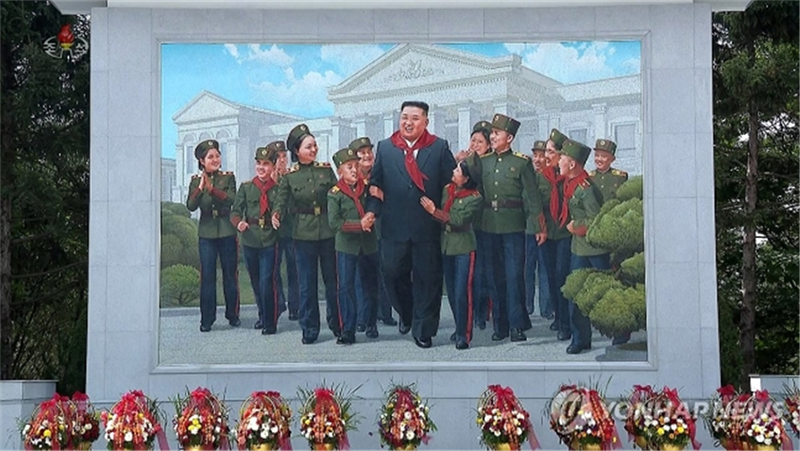
A mosaic mural depicting Kim Jong-un installed at the Mangyongdae Revolution Academy in September last year / Korean Central Television, (Yonhap News Agency)
Furthermore, in September of the previous year, a striking mosaic mural venerating Kim Jong-un was unveiled at the Mangyongdae Revolution Academy. This portrayal of Kim Jong-un, adorned in a red scarf akin to the students, exudes warmth and camaraderie, reinforcing the academy's significance as torchbearers of the Juche Revolution. North Korean media hailed them as the "sons of Mangyongdae," embodying an unwavering commitment to the Paektu bloodline.
Established in 1947, the academy originally catered to the offspring of those who sacrificed during the anti-Japanese partisan activities and the Korean War. Over time, it expanded its intake to include children of South Korean infiltrators and fallen military personnel. Offering a rigorous 8-year curriculum blending military training with political indoctrination, the academy serves as a conduit for its graduates into high-ranking roles within the party, state, and military.
Dubbed as North Korea's aristocratic military academy, the academy ensures its graduates a trajectory towards influential positions within the party, state, and military, post-graduation from institutions like Kim Il Sung University or various military colleges. Its symbolic connection to Mangyongdae, Kim Il-sung's birthplace, endows students with the responsibility of safeguarding the Paektu bloodline, epitomizing their integral role in the hereditary succession system.
Acting as a linchpin in perpetuating the Kim family's hereditary rule, the Mangyongdae Revolution Academy assumes paramount importance, especially amid the emergence of figures like Kim Ju-ae.
Kim Jong-il initiated the 'Three Revolutions Red Flag Movement' for power consolidation, while Kim Jong-un spread the song 'Footsteps' through elementary school students. In the fourth-generation succession, the Mangyongdae Revolution Academy served as a key influencer in shaping societal attitudes.
The Mangyongdae Revolution Academy has been consistently emphasized and utilized in the power successions of Kim family. Kim Il-sung's frequent visits, totaling over 100 during his lifetime, and Kim Jong-il's regular attendance underscore its importance. Notably, Kim Jong-un's early prioritization of the academy upon assuming power emphasizes its pivotal role in shaping the governance strategy of the Kim dynasty across generations. This special attention from the Kim family instills a sense of loyalty among the students, further solidifying their allegiance.
Unlike typical educational institutions, the Mangyongdae Revolution Academy fosters Kim family loyalists, nurturing a shared destiny rooted in lineage and allegiance. Consequently, their engagement in propaganda is seen as calculated to support the fourth-generation succession, with Kim Ju-ae. This solidifies their role as guardians of regime continuity. Monuments at the academy symbolizing the 'Paektu bloodline' and 'suicidal-attack spirit' signify the succession and are part of the curriculum.
It's assumed that amid changing sentiments influenced by 20 years of marketization and external information, the Mangyongdae Revolution Academy is central in reshaping the fourth-generation succession.
-
PREV [SAND Feature Article]
-
NEXT [SAND Feature Article]