

North Korean Athletes' Arrival in Japan
and Prospects for Improved Relations:
Impact on North Korea-Japan Relations Through Sports Exchange

Kim Areum
Visiting Professor at Yonsei University's Graduate School of International Studies
The North Korean delegation landed in Japan on February 25, 2024, to participate in the final qualifiers for the 2024 Summer Olympics. Their participation, the first in an international event on Japanese soil since the International Skating Union (ISU) World Figure Skating Championships in March 2019, broke a five-year hiatus. This visit came as a notable exception to Japan's stringent policy prohibiting North Korean nationals' entry, rooted in sanctions over North Korea's nuclear and missile programs. This time, Japan allowed the delegation's entry, sidelining usual sanctions for the sports diplomacy. Could this display of sportsmanship signal the beginning of a new chapter in addressing the longstanding abduction issues and normalizing diplomatic ties between North Korea and Japan, which have been at a standstill since the era of Koizumi Junichiro?
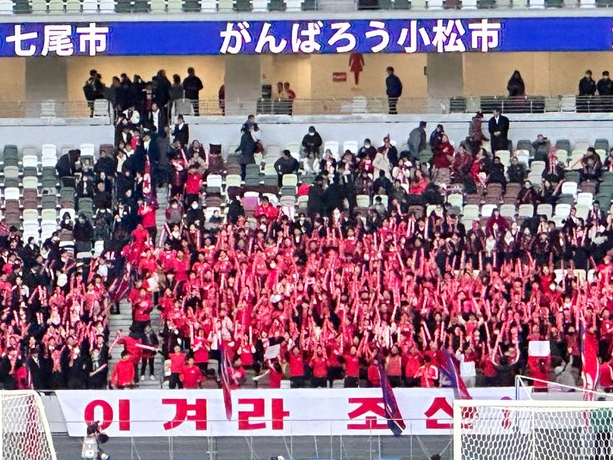
<North Korean supporters seen at the final qualifying match between North Korea and Japan for the Tokyo Olympics women's football, held at Japan National Stadium on February 28 / Photo by RFA>
From Japan's perspective, on an international political level, Japan seeks to ease tensions and foster integration by supporting North Korea's involvement in international sports, moving beyond its focus on abduction issues to rekindle dialogue. This strategy gains importance with the potential geopolitical shifts in East Asia, especially if Donald Trump returns to the U.S. presidency. Reflecting on 2018, when the U.S. and North Korea, and subsequently the Koreas, engaged in summits, Japan shifted its stance under Abe Shinzo, offering to engage with North Korea unconditionally. This reflects Japan's historical approach to diplomacy, reminiscent of the Ping-pong diplomacy era with China and the US, demonstrating its distinctive strategy of using sports and dialogue to foster better international relations.
Since Koizumi Junichiro's time, resolving the abduction issue has been a key focus in Japan's domestic policy. Former Prime Minister Abe Shinzo notably took a firm stance against North Korea over this issue, enhancing his political stature. During his almost nine-year leadership, Abe highlighted the abduction issue as vital to Japan's sovereignty, national security, and the safety of its citizens. Failure to address this issue may lead to public dissatisfaction. Delays could result in victims passing away without closure, inviting criticism of the government for not adequately protecting its citizens from North Korean abductions. Consequently, achieving the comprehensive resolution desired by the Japanese government becomes increasingly difficult. To prevent such a scenario, both internationally and domestically, Japan will maintain its commitment to engaging in unconditional dialogue with North Korea. Negotiations are already underway under the current administration, reflecting Japan's determination.
So, what is North Korea's stance on the current situation and the improvement of relations with Japan? North Korea's recent actions, including labeling inter-Korean relations as "hostile" and dismantling the Arch of Reunification, reflect its complex stance. Yet, its engagement in international sports and attempts to better relations with Japan hint at a broader strategy to blend into the global community.
To prepare for the potential scenario of Trump winning the next U.S. presidential election, North Korea should enhance its relations with Japan for effective communication with the United States. Reflecting on the failed discussion by former President Trump on ending the Korean War prior to the 2018 North Korea-U.S. summit, due to former Prime Minister Abe Shinzo's opposition, North Korea must ensure Japan doesn't hinder progress in North Korea-U.S. relations.
Considering the viewpoints of Japan and North Korea, there's considerable potential for their relations to improve, depending on the U.S. election outcome and Japan's political stance. However, experts emphasize the ongoing 'Megumi Yokota story,' highlighting the abduction issue, which remains intertwined with North Korea's terrorism concerns. Hence, North Korea's political actions are crucial. Nevertheless, historical instances such as Ping-pong diplomacy, the 1988 Summer Olympics, and the 2002 FIFA World Cup Korea-Japan illustrate how sports exchanges fostered reconciliation in international politics. Therefore, closely monitoring the upcoming North Korea-Japan match on March 26th is essential for potential transformative effects.