

The Fate of the Korean Peninsula and Two Singularities:
Unification and the Fourth Industrial Revolution
- Autonomous Vehicles, 3D Printers, Cryptocurrency

Written by Lee In-bae
Secretary to the President for Unification
Former President of the National Institute for Unification Education
The fate of the Korean Peninsula is intertwined with two unpredictable futures: unification and the Fourth Industrial Revolution. It's believed that bridging unification with the Fourth Industrial Revolution is crucial for navigating these singularities.

<The Fate of the Korean Peninsula and Two Singularities / Author: Lee In-bae>
During his time as President of the National Institute for Unification Education, Lee In-bae, in his book "The Fate of the Korean Peninsula and Two Singularities," linked unification with the Fourth Industrial Revolution, areas previously considered distinct.
Lee suggests using Fourth Industrial Revolution technologies in unification strategies, including autonomous vehicles for land development, 3D printing for housing in North Korea, and cryptocurrencies to address monetary issues in a unified Korea.
He highlighted the importance of considering the diverse forms of mobility that will arise from advancements in Fourth Industrial Revolution technologies, such as autonomous vehicles, in the planning of land development for a unified Korea. He proposed that as these technologies progress, especially autonomous vehicles, a considerable share of transportation could become autonomous. This shift would require the creation of compatible autonomous road systems to support the new mode of transport effectively.
He noted that introducing autonomous vehicle systems on the Korean Peninsula could drastically reduce household vehicle ownership to a third and lower the demand for private cars. People could schedule autonomous vehicles as easily as calling a taxi, ensuring a car awaits them the next day. This shift towards shared vehicles and away from personal car dependence would also decrease the need for parking spaces.
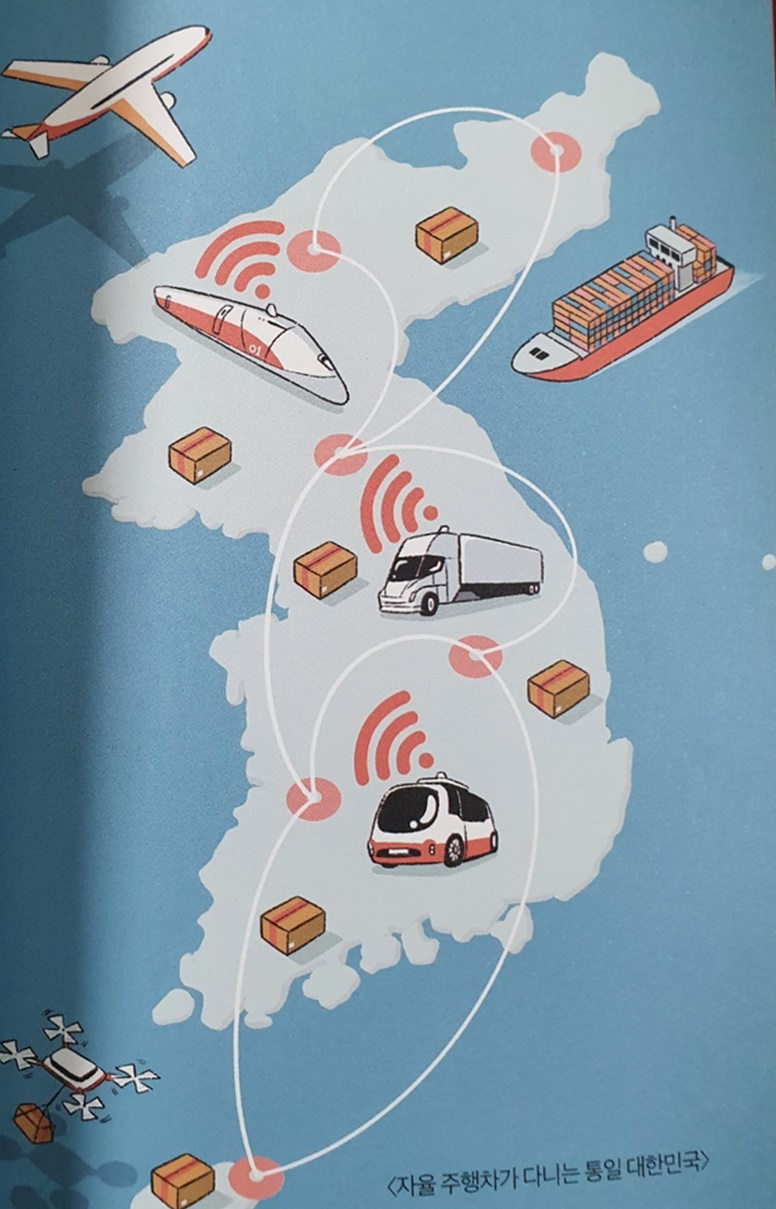
<Projected View of a Unified Korea Embracing Autonomous Vehicles / Source: From the Author's Book>
It was also noted that the adoption of autonomous vehicles would lead to fewer car accidents and a 20% reduction in road space usage. Elon Musk predicted that autonomous vehicle systems would enhance road efficiency by more than 90%.
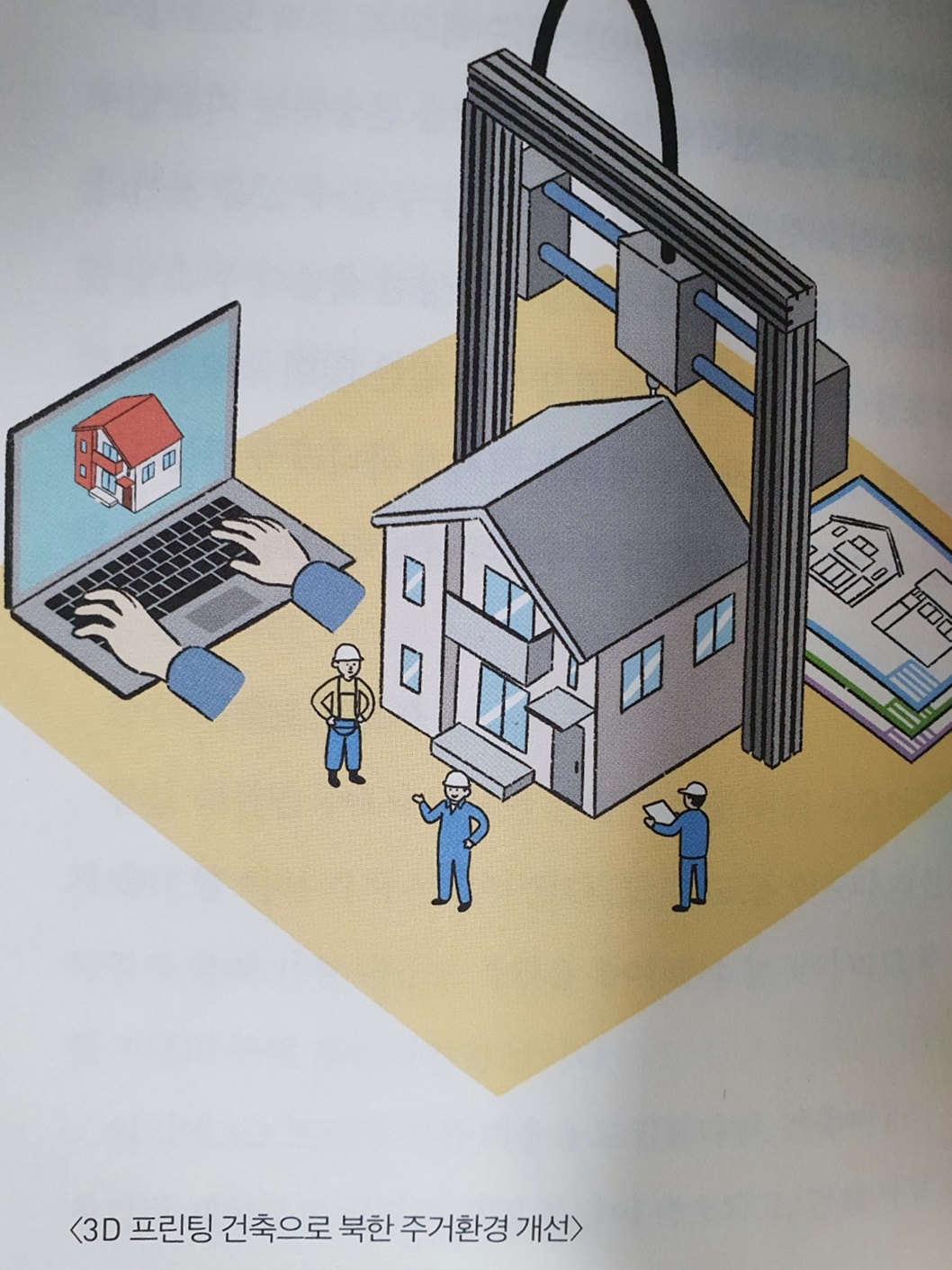
<Projected Enhancement of North Korean Living Conditions via 3D Printing / Source: From the Author's Book>
He also claimed that in a future unified Korea with widespread autonomous vehicle use, the existing 2,900 km of roadways could be reduced by half, emphasizing that incorporating autonomous vehicles into the transportation framework would lead to a major transformation in railway and roadway planning strategies.
3D printing for housing construction is proposed as a swift, cost-effective, and eco-friendly solution to address the urgent housing needs in North Korea, fostering gratitude and quickly stabilizing the nation.
He proposed that using 3D printing to build homes could drastically reduce both time and cost, taking roughly a week and approximately 4.5 million won (about $3,375) per house, without generating any construction waste, thereby being eco-friendly. Furthermore, he recommended that, although constructing 100 different houses in 100 cities may not be practical, offering North Korean residents a selection of sample models to choose from could foster a sense of appreciation. This approach could strategically aid in swiftly stabilizing governance within a unified Korea, enhancing solidarity and community engagement.
The author pointed out digital currency as one of the key technologies for a unified Korea, noting the challenges similar to those faced during Germany's unification. With the creation of a unified physical currency costing approximately 110 billion won ($82.52 million) according to the Bank of Korea, he suggested that digital currency offers a more cost-effective and time-efficient alternative. This approach could notably reduce expenses and accelerate the circulation process, boosting financial efficiency across the Korean Peninsula.
He suggested that using Central Bank Digital Currencies (CBDC), unlike cryptocurrencies like Bitcoin which lack physical backing, could address economic security concerns. CBDCs, being digital yet pegged to tangible central bank assets, provide stability and security. He highlighted blockchain technology's role in safeguarding these currencies from theft and disruption, and noted that digital currencies could also improve the tracking of hidden financial activities, boosting transparency and regulation.
He highlighted the Metaverse as a key Fourth Industrial Revolution technology for unification, bridging the North-South divide with a virtual world. During his tenure at the National Institute for Unification Education, he created a Metaverse version of North Korean places for refugees, fostering a virtual connection to their homeland. Additionally, he saw evolving hologram technology as a way to preserve and celebrate the peninsula's cultural heritage, offering a contemporary method for maintaining its rich legacy.
Lee envisions that advanced technologies of the Fourth Industrial Revolution can provide solutions across political, economic, and cultural sectors, essential for the reconstruction needed in unification.
He envisioned a unified Korean Peninsula where its 75 million people collectively enjoy civilization's freedoms and benefits. He emphasized that the prosperity, safety, and convenience from the Fourth Industrial Revolution should extend beyond South Korea, reaching everyone, including North Koreans, to ensure widespread access to technological advancements.
He also stressed that freedom is essential to these strategies, with a democratic system that embraces diverse ambitions being key to the Fourth Industrial Revolution's sustainable development. He underscored the importance of unifying Korea under a democratic system, enabling all 75 million people to enjoy the freedoms and benefits that come with technological progress.
Referencing Professor Lee Geun from Seoul National University, the current struggle for digital platform supremacy between the U.S. and China is highlighted as a battle between totalitarian and liberal platforms, with a preference for the latter to ensure freedom from surveillance for future generations.
He said, "I prefer to leave behind a world where liberal platforms triumph, rather than a regime of comprehensive platform surveillance that would subject my son's every move to scrutiny."