

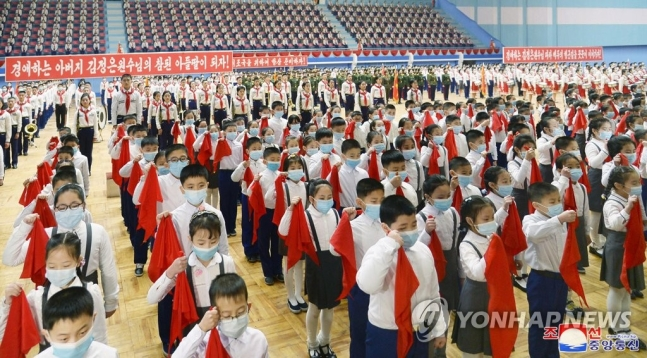
North Korea's Korean Children's Union Foundation Day vershadowed
by National Violations of Children's Rights
Won Jae-chun
U.S. Attorney, Professor at Handong Global University's School of Law; Director of the Center for International Law Studies; Chair of the Human Rights and Humanitarian Affairs Subcommittee of the Ministry of Unification's Future Planning Committee and Advisory Member of the International Humanitarian Law Institute of the Korean Red Cross
North Korea celebrates June 6 as the foundation day of the Korean Children's Union with elaborate ceremonies, similar to a "Children's Day." This state-controlled children's organization is for kids aged 7 to 16. Boys wear red neckties and girls wear red scarves as members, performing unique salutes and chanting "Always Ready." This organization is modeled directly after the Soviet Union's "pioneer movement." Members receive ideological education, participate in self-criticism sessions, and undergo marching, camping, and quasi-military training after school or on Saturdays. Since the 2000s, with the collapse of North Korea's welfare and distribution systems, these children are often exploited for labor, raising rabbits and pigs at schools or homes.
Sadly, the nutritional status of North Korean children is extremely poor. The UNICEF report estimates that 16.8% of children under five, about 285,000, suffer from stunted growth, which is ten times higher than South Korea's rate of 1.7% (26,800 children). Malnutrition causes stunted growth, impacting brain development, height, physical health, and immune system strength. The health of North Korean children is comparable to those in the Democratic Republic of Congo. Experts highlight that strict COVID-19 border closures and the exit of international aid workers have worsened nutrition shortages, further endangering children's health and survival.
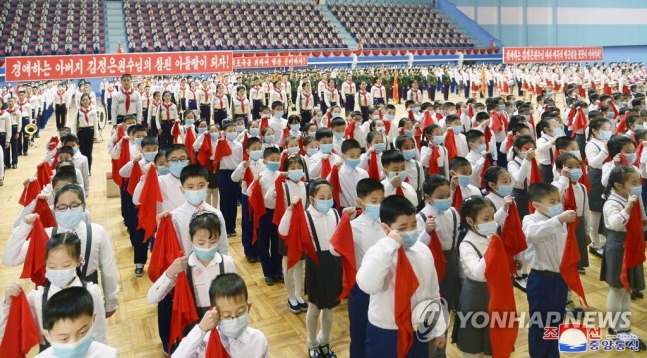
North Korean Students Joining the Korean Boys' Union/2022.02 / Chosun Central News Agency = Yonhap News
North Korea also enacted three harsh laws to control youth ideology: the "Reactionary Ideology and Culture Rejection Law," the "Youth Education Guarantee Law," and the "Pyongyang Cultural Language Protection Law." These laws severely restrict basic rights like access to information and freedom of religion and thought. For example, the "Reactionary Ideology and Culture Rejection Law" bans and punishes access to foreign information and media, labeling them as threats that paralyze revolutionary and class consciousness.
North Korea imposes severe penalties, including the death penalty, for those who import, watch, or distribute "Reactionary Ideology and Culture." Recently, in a public trial, two 16-year-olds were sentenced to 12 years of labor reform for possessing and distributing South Korean dramas. In some areas, teenagers have been executed for similar offenses. These measures seriously violate the youth's right to information and freedom to see, hear, and know.
North Korea joined several significant UN human rights treaties, including the International Covenants on Civil and Political Rights and Economic, Social, and Cultural Rights, the Convention on the Elimination of All Forms of Discrimination Against Women, the Convention on the Rights of the Child (CRC), and the Convention on the Rights of Persons with Disabilities. North Korea must comply with these treaties and protect its citizens' rights. The CRC, which North Korea joined in 1990, requires policies for children to be based on non-discrimination, respect for life, prioritizing children's best interests, and child participation. North Korea's discriminatory policies based on political and social status violate these principles, despite its propaganda of being a "paradise for children."
North Korea needs to transform its discriminatory social system into an equal society. It currently maintains a rigid class society with a feudal-like status system, making social mobility nearly impossible. The entire population is divided into three classes and 51 categories, with treatment based on this classification.
For example, Pyongyang is home to those most loyal to the Kim family, while those with lower social status live in impoverished rural areas. A child's future, including their place of residence, schools, career, military service, and marriage, is determined by their parents' status. While Pyongyang has modern children's cultural facilities and hospitals, rural and remote areas lack such amenities. In North Korea, children born in rural areas become farm workers, and those born in mining areas become mine workers, much like serfs bound to the land in medieval Europe.
Women and children continue to suffer in political prison camps and other detention facilities in North Korea. Children who are imprisoned due to the "crime" of being related to political prisoners, along with those born in these facilities, should be immediately released. The archaic practice of "collective punishment" must be abolished. It is imperative that North Korea ends its state-led discriminatory policies and reforms its human rights and social welfare policies to align with global standards.
At the very least, North Korean authorities should inform children of their rights under the CRC. They should also engage in exchanges and cooperation with international organizations like the World Health Organization (WHO), the International Committee of the Red Cross (ICRC), the United Nations Children's Fund (UNICEF), and various UN countries, as well as South Korea, to enhance the welfare of children and persons with disabilities. Collaboration with non-profit organizations like World Vision and Save the Children is also crucial to improve North Korean children's well-being in line with global standards.
Recently, North Korean Central Television (KCTV) reported that the most popular toy among Pyongyang children is a firework designed to resemble the Hwasong-17 intercontinental ballistic missile (ICBM), capable of striking the U.S. Exposing children to such weapons of mass destruction as toys is a form of violent ideological indoctrination that blatantly violates children's rights. The North Korean regime's anxiety and trauma over its survival trace back to the atrocities it committed during the Korean War. North Korea's aim of reunification through armed communism is inhumane and would be catastrophic for its people. Denuclearization of the Korean Peninsula and sustainable peace are fundamental human rights essential for both North and South Korean children.
A unified Korea will be built on the principles of liberal democracy, the rule of law, human rights, and an open market economy. It will lead Asia in promoting "human rights and respect," and will stand as a beacon of "freedom, democracy, and justice.“
When that day arrives, children from North and South Korea will hold hands, laugh, and play together. The youth will pursue their dreams and ambitions, embracing opportunities worldwide. A nation without dreams and visions for the future cannot flourish.
We envision a unified Korea as the "top country in the world for children to grow and prosper."