


Marketing In North Korea (2)
- Their way of treating the flower of capitalism

Jeon Byung-kil
Senior Consultant of YESInnovation
former of Secretary General of UniKorea Foundation
Brand Marketing in North Korea
North Korea is officially a socialist planned economy. Therefore, the concept of marketing did not exist. If you look at other socialist countries that have transitioned, the concept of marketing was introduced after reform and opening up.
With the implementation of various economic reform measures, North Korea has begun to introduce the concept of marketing, albeit on a limited scale. Today, the concept of marketing in North Korea is at the basic level of production and sales. In Western societies, marketing in the 1960s meant marketing to the masses, and from the 1970s onward, segmentation, the categorization of consumers, and targeting of specific consumer groups, became active. The marketing that is slowly taking place in North Korea today is typical marketing to the masses.
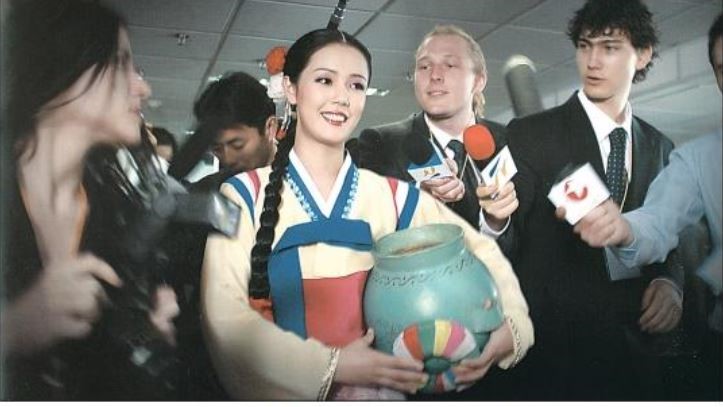
North Korean dancer Cho Myung-ae, selected as the model for South Korea's Samsung Electronics' 'Anycall' mobile phone
in May 2005, being interviewed by the press after a dance performance / The Hankook Ilbo
Since the partial introduction of capitalism, North Korean society has become increasingly interested in marketing, brands, and trademarks which called the capitalist flower. Until now, North Korean brands have largely reflected the North Korean way of thinking and history. The Kim Il Sung University Academic Bulletin Economics (No. 3, 2000) distinguishes between capitalist and socialist brands. It evaluates capitalist brands as a means to "exploit workers, wrap goods in luxury, lure buyers, and make maximum profits. North Korea, on the other hand, describes socialist brands as a way to show the people the legitimacy of economic policies and to make workers feel proud of their products.
North Korea's lone echo
In 2002, South Korea's Samsung Electronics cast North Korean dancer Cho Myong Ae, a part of the Mansudae Arts Troupe, as the face of a commercial for its cell phone AnyCall, alongside South Korean singer Lee Hyori. Since the division, Cho garnered attention by becoming the first North Korean to appear in a South Korean broadcast commercial. The ad's copy reads, "Digital Exciting - One Sound. It was also featured in The Spy Gone North, released in August 2018, once again bringing North Korea's Cho Myong Ae and South Korea's Lee Hyori to consumers. The late 1990s and early 2000s were also a time for North and South Korea to explore each other through advertising.
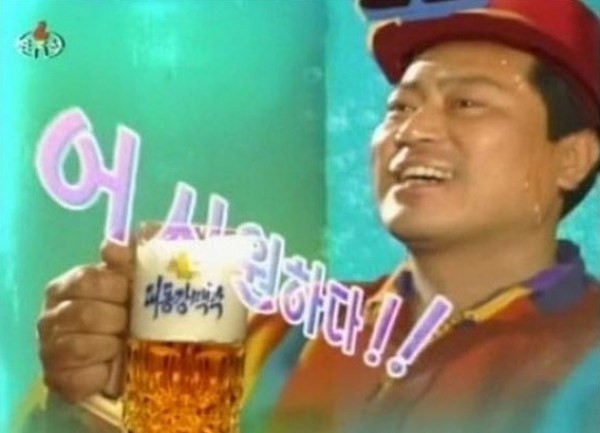
A North Korean man advertising Taedong River beer in May 2017 / Korean Central Television
It's easy to think of "advertising" as forbidden territory in a socialist regime. But North Korea has been partially practicing advertising for more than 30 years. The Pyongyang Sinmun, published by the Pyongyang City Committee of the Workers' Party of North Korea, is one of the country's most prominent daily newspapers, along with the Rodong Sinmun, the organ of the Workers' Party, and the Minju Choson, the organ of the cabinet. Rodong Sinmun and Minju Choson are mainly devoted to sympathizing with Supreme Leader Kim Jong Un, propagating political ideas, and reporting on the country's activities and accomplishments in fulfilling economic tasks. On the other hand, the Pyongyang Sinmun is a smaller newspaper, but it contains serialized novels, cartoons, product advertisements, and other news.
In the 1990s, advertisements began to appear in the Pyongyang Sinmun. At a time when the socialist camps in Eastern Europe were collapsing and the Chinese economy was accelerating its reform and opening up, North Korea was forced to start advertising, at least partially, as a spearhead of its capitalist economy and a lubricant for the distribution of goods. Commercial advertisements were also published in the Foreign Trade of DPRK, the country's foreign trade publication. And in the Rajin-Seonbong Special Economic Zone, established in 1993, advertising regulations were created. The purpose of advertising, in the eyes of the North Korean authorities, was to attract foreign exports and investment capital. Of course, the advertisements did not lead to the promotion of North Korean goods or foreign capital investment as the North Korean authorities had hoped.
North Korea Ads On Air
From the 2000s onwards, the country became more open to the acceptance of 'advertising' than before. Pyeonghwa Motors, a joint venture between North and South Korea established in 1999, imported FIAT's Siena in 2002 to produce and sell the Hwiparam. At this time, the company first utilized outdoor billboards for publicity, attracting great attention.
In 2005, South Korean Samsung and Hyundai advertisements debuted at the Kim Il Sung Stadium in Pyongyang, and in 2006, North Korea's first advertising company, the Korean Advertising Corporation, was established. Established to handle product and trade advertising, the Korean Advertising Corporation receives orders from North Korean institutions, businesses, and organizations to produce and install advertisements.
The company also accepts advertising orders from foreign companies and organizations operating in North Korea. The advertisements produced by the Korean Advertising Corporation are displayed on the streets, in sports stadiums, exhibition centers, and rallies, as well as in publications and on the Internet. A case in point is the North Korea-Uzbekistan 2018 World Cup qualifying match at the Kim Il Sung Stadium in Pyongyang in June 2015. The match featured a number of never-before-seen billboards for ginseng, building materials, and other products. North Korean companies were able to capitalize on the international attention generated by the sporting event in their own way.
For two months in July-August 2009, TV commercials appeared on KC TV in North Korea, albeit temporarily. The commercials advertised beer, ginseng, hairpins, and quail dishes, but had to be canceled at the behest of North Korean leader Kim Jong Il. According to a November 9, 2009 report in the Chosun Ilbo, then North Korean leader Kim Jong-il was watching TV and saw the ads and angrily said, "Such ads were the first thing China did when it started reforming and opening up," and fired the person in charge of North Korea's broadcasting.
Ah! Cool - Taedonggang Beer
The most talked-about North Korean TV commercial that ran for two months in 2009 was for Taedonggang Beer. Taedonggang Beer' is a beer brand that has been produced in North Korea since 2002 after the North Korean authorities brought beer equipment from the closed Ushers brewery in the United Kingdom and drying equipment from Rauschmann in Germany to North Korea in response to Kim Jong Il's order to make the world's finest beer.
Taedonggang Beer has been the subject of much international gossip since its inception, which began with the attention of North Korea's supreme leader and the importation of production equipment from abroad. In the beginning, the beer was only available to party cadres and foreigners in Pyongyang, but now it is supplied to more than 200 beer bars in Pyongyang every day. A typical Taedonggang Brewery is said to sell around 2,000 500-milliliter glasses a day. 'A 500-milliliter glass costs 60 North Korean won ($1 = around 100 North Korean won), but on the black market, it costs dozens of times more.
The alcohol content is 5-5.7%. It uses local ingredients such as purified groundwater from the upper reaches of the Taedong River, barley from Jeryong in Hwanghae Province, and hops from Yanggang Province. Taedonggang Beer is relatively low in carbonation and rich in bubbles, giving it a unique flavor.Taedonggang Beer has been reported by foreign media such as the Economist as "more delicious than South Korean beer," putting South Korean beer to shame.
The ad for Taedonggang Beer from 2009 is also notable because North Korea is advertising beer, regardless of its message. The fact that beer is a familiar product and comes from a country of seclusion and isolation added to the curiosity.
The "Taedonggang Beer" ad at the time was vague about its target audience and the appeal point of its message. In short, it lists all the benefits that Taedonggang Beer can bring. It begins by stating that Taedonggang Beer is "the pride of Pyongyang," and then mentions its largest, most advanced, hygienic, and internationally certified production facility, as well as its ingredients: white rice and Taedong River water. It also included a part about the taste - refreshing, cool, and flavorful - and a friendly explanation that it would be more familiar to people's lives in the capital city of Pyongyang, where it was distributed.
It feels like watching a short promotional documentary video of 2 minutes and 40 seconds rather than an advertisement familiar in capitalist society. Of course, various media reported 'Ah! Cool' as the appealing point of the ad, but it was just one of the many mentions in the ad video.
But North Koreans had a different reaction. North Korea's Reunification News reported that sales of Taedonggang Beer spiked after the TV ad. Although Taedonggang Beer disappeared from North Korean TV ads within two months, in 2013, North Korea's propaganda website Uriminzokkiri TV began running a promotional video for the rumored soft drink, Taedonggang Beer.
And while not an advertisement, North Korean media outlets have continued to promote Taedonggang Beer in the form of news and in-depth reports, as well as through indirect advertising, such as the Taedonggang Beer Festival. In 2019, there was even a North Korean beer tourism program for foreigners. Taedonggang Beer was even featured in the 2020 South Korean drama "Love Crash Landing," which featured several scenes of Taedonggang Beer being consumed.
'Ads' Not 'Ads', Evolving 'Ads'
In North Korea, the marketization trend has led to the distribution of goods, especially consumer goods, and indirect product TV commercials in the form of news and documentaries have emerged. News-style TV commercials are one still image with no voiceover. At the end of North Korean news programs, two to three products are advertised in the 'introduction of good products' section, which is a 30-second still image and music. The products range from everyday consumer goods such as herbal medicine, cosmetics, and food to home appliances such as computers and TVs.
Documentary-style TV commercials are 5-10 minute promotional programs that focus on the products of distribution or service-related companies or consumer goods factories. The content is mainly quality-oriented, introducing product characteristics or product experiences. Food factories, leisure facilities, horse riding stables, aviation and transportation services, and shops in various streets and markets have been featured in these programs. This form of indirect advertising in the form of in-depth reporting is also an aspect of the North Korean media that is not allowed to air TV commercials separately, despite the high demand for and need for advertising.
As the 2010s progressed, advertising activities in North Korea increased and a culture that emphasizes advertising was established in the society as a whole. In late 2008, North Korea launched Koryo Link, a mobile phone service in partnership with Egypt's Orascom, and the number of subscribers has grown rapidly every year since then, which has naturally led to an increase in advertising.
In April 2016, new video panel ads appeared in the Pyongyang subway in North Korea. The video panel advertisements regularly feature heart medication and children's products. But why heart medication and children's products among many others? The subway is an important form of transportation in Pyongyang. The area around Pyongyang subway stations is densely populated with government offices, schools, and shops, with a lot of foot traffic. People who use the subway enjoy a higher standard of living than the average North Korean. As a result, they naturally care about their health and child-rearing and can afford to invest in them. North Korean companies have recognized this need and started advertising to Pyongyang.
In Pyongyang and other major North Korean cities, there is an increasing number of advertisements for all kinds of products and services. These include cosmetics, herbal medicine, electronics, groceries, healthcare, and shoes. North Korean advertising is becoming increasingly centered on mass consumer goods. Of course, not many people are able to enjoy this consumer culture.
Where are North Korean ads going?
The Socialist Enterprise Responsibility Management System (SERMS), which has been in place since August 2013, has served as a catalyst for aggressive advertising and marketing by North Korean businesses and merchants. SERMS is a decentralization of management authority to the local level, with the goal of expanding the authority of enterprises from planning to production and the disposition of products and profits.
The significance of this system is that it gives autonomy and incentives to factories and enterprises, while legalizing to a large extent the informal coexistence of planning and the market. Under such a system, producers are forced to think more about sales and consider the consumer's perspective. Commercial advertising is motivated to expand.
However, North Korea has a long way to go to develop its advertising. Under sanctions, North Korea's advertising is rudimentary, and it will take time and effort to improve both the quality of the products it promotes and its consumer culture.
-
PREV [Feature article]
-
NEXT [NK Focus]