

'Dangerous Deal': Kim Jong-un and Vladimir Putin's Pact
for Immediate Military Assistance
North Korea and Russia have agreed to provide "immediate military assistance" if either faces a military invasion. This is viewed as a revival of the "automatic military intervention" clause, transforming their relationship into a "military alliance." Concerns arise that Kim Jong-un and Vladimir Putin, pressured by international sanctions over Ukraine and illegal nuclear activities, have made a "dangerous deal" to counteract Western pressure.
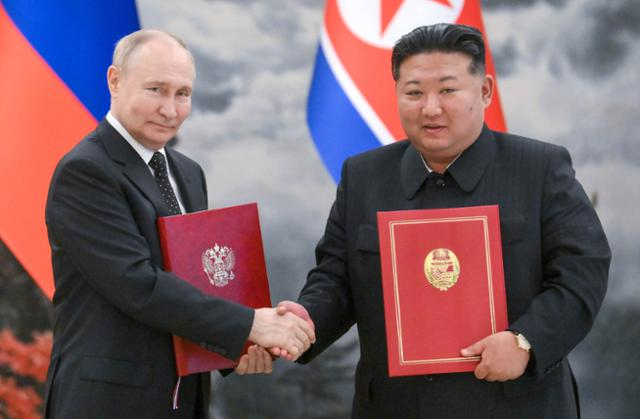
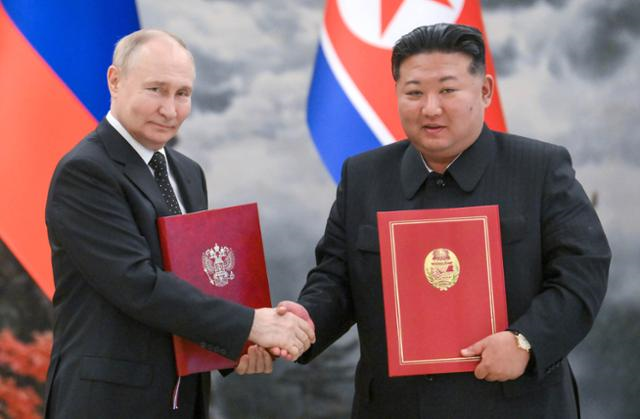
Russian President Vladimir Putin (left) and North Korean leader Kim Jong-un pose after signing a musual defense pact
in Pyongyang, North Korea, on the 19th. /Reuters·Yonhap News Agency
North Korea's Korean Central News Agency reported on the 20th that Kim Jong-un and Vladimir Putin signed a "comprehensive strategic partnership agreement" in Pyongyang the previous day, marking a major advancement in their relationship.
Article 4 of the treaty states that "if either party is in a state of war due to military aggression by another country, the other party will provide military and other assistance using all means at its disposal without delay, in accordance with Article 51 of the UN Charter and the laws of North Korea and Russia."
Article 51 allows UN member states the right to individual or collective self-defense if attacked.
The automatic military intervention clause was first included in the 1961 "North Korea-Soviet Union Treaty of Friendship, Cooperation, and Mutual Assistance," ensuring immediate support if either side was attacked. This treaty ended after the Soviet Union dissolved in 1991, and Russia announced in 1996 that it would not extend it. The 2000 "North Korea-Russia Treaty of Friendship, Good-Neighborliness, and Cooperation" excluded this clause but added an "immediate contact" clause.
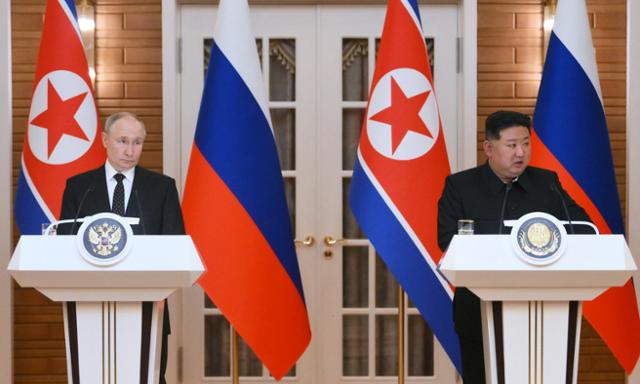
Russian President Vladimir Putin (left) and Kim Jong-un hold a press conference after their meeting
in Pyongyang, North Korea, on the 19th. /Reuters·Yonhap News Agency
The upgrade of North Korea-Russia relations to a "comprehensive strategic partnership" from a "friendly and good-neighborly" relationship, along with "immediate military support," indicates their relationship is now at a "military alliance" level. Kim Jong-un emphasized this during a press conference after the summit, using "alliance" three times.
This agreement is seen as stronger than the US-South Korea Mutual Defense Treaty, forming a military alliance while recognizing North Korea's nuclear capabilities. Article 5 prevents either party from making agreements with third countries that infringe on their core interests, blocking improved South Korea-Russia relations, which North Korea considers hostile.
Article 16 states that "both parties oppose extraterritorial measures, including unilateral coercive actions, and consider them illegal and contrary to the UN Charter and international legal norms." This rejects the legitimacy of UNSC resolutions on sanctions against North Korea, similar to the 1961 North Korea-Soviet Union alliance treaty.
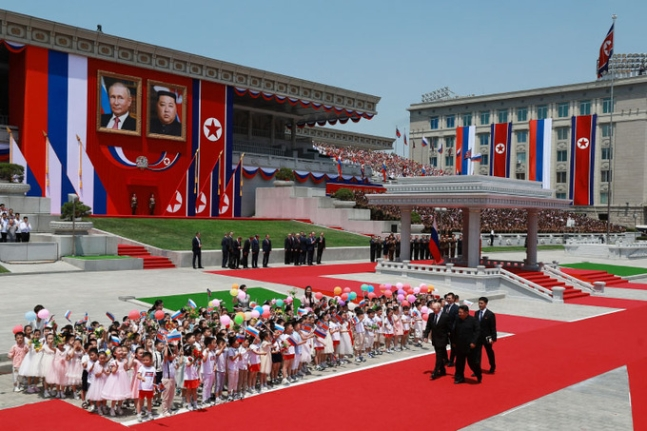
A welcoming ceremony at Kim Il-sung Square in Pyongyang on the 19th, attended by Russian President Vladimir Putin
during his visit to North Korea. /Tass·Yonhap News Agency
There are concerns that the new treaty will accelerate military cooperation between North Korea and Russia, including arms trade, defying international sanctions against North Korea's nuclear provocations. Vladimir Putin suggested revising "US-led UNSC sanctions against North Korea," signaling an intent to challenge these sanctions.
Vladimir Putin announced that Russia and North Korea would enhance military cooperation under the new agreement, potentially including military technical collaboration. While details were not disclosed, Ukrainian authorities reported that North Korea supplied Russia with 1.8 million rounds of 122mm rocket artillery shells and 152mm self-propelled artillery shells. Additionally, North Korea is said to be providing short-range ballistic missiles and parts for repairing Russian vehicles and tanks. There is also speculation that North Korea might supply Russia with 240mm rocket artillery shells with a range of 40km, suggesting related discussions.
During their private meeting, Vladimir Putin likely reassured high-level cooperation in developing North Korea's reconnaissance satellites. On the 27th of last month, North Korea's attempt to launch its second reconnaissance satellite with a new rocket failed due to an explosion.
Economic cooperation between North Korea and Russia is expected to expand. They announced an agreement to build a bridge over the Tuman River. Kim Jong-un appears to prefer expanding economic exchanges with Russia rather than relying on China, which has been cautious due to UN sanctions.
A new financial system not controlled by the international community is anticipated. In a Rodong Sinmun article on the 18th, Vladimir Putin stated, "We will develop a trade and mutual settlement system not controlled by the West and jointly oppose unilateral, illegal restrictive measures." This suggests that Russia and North Korea aim to establish their own trade and settlement system to bypass the US-dominated international financial system and the dollar.
-
PREV [Opinion]
-
NEXT [Feature Article Series]