

Marketing In North Korea (4)
- Cosmetics Rivalry, 'Pomhyanggi' Vs 'Unhasu'

Jeon Byung-kil
Senior Consultant of YESInnovation
former of Secretary General of UniKorea Foundation
Sinuiju Cosmetics Factory
In the early 1900s, during the Russo-Japanese War, Japan built the Honor Line between Seoul and Sinuiju in North Pyongan Province. A station was built at the point connecting Dandong, China, to the Korean Peninsula across the Yalu River and named Sinuiju Station. With the opening of the railroad station, the Sinuihi area experienced rapid growth. Trade developed, government offices and businesses moved in, and schools were established. Sinuiju Station served as a stopover point between the peninsula and mainland China.
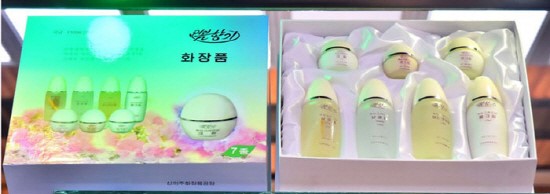
"Pomhyanggi"Cosmetics Set Produced at Shinuiju Cosmetics Factory in North Korea/Today of Joseon
In the late 1930s, a hydroelectric power plant was built on the banks of the Yalu River in Sakju, North Pyongan Province, near Sinuiju. An industrial zone was established around Sinuiju using electricity from the plant. At the time, the main reason for building the plant was to provide reliable industrial electricity to Northeast China and the Korean peninsula. Before the liberation from Japan, Sinuiju had factories producing cloth, pulp, paper, hosiery, underwear, matches, shoes, alcohol, etc.
After liberation in 1945, the Japanese-built factories in the Sinuiju area were forcibly interned by the North Korean communist regime. In September 1949, the Sinuiju Cosmetics Factory opened, making soap and other beauty products. In the early years of Kim Il-sung's regime, North Korea prioritized heavy industry while simultaneously promoting a complementary policy of light industry focused on consumer goods. One of the complements was to create a cosmetics factory in a city with a strong industrial base in light manufacturing.
The Sinuiju Cosmetics Factory produces facial soap, toothpaste, makeup cream, hair oil, perfume, and other products used by North Korean women. However, North Korean cosmetics are not of the highest quality, as is typical of products produced in socialist countries. Most of the products are basic cosmetics, and color cosmetics and other products are much lower quality than those in developed countries. Cosmetics experts rate North Korean cosmetics at the level of South Korea's 1980s and 1990s.
North Korea's top cosmetics brand 'Pomhyanggi'

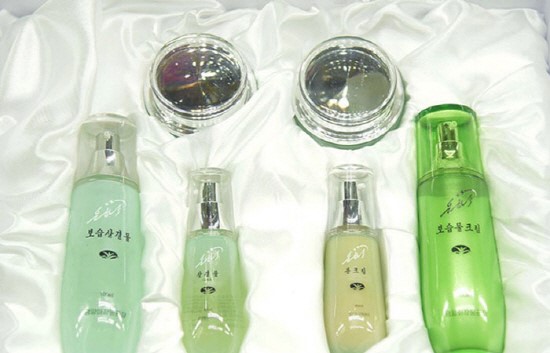
'Unhasu'Cosmetics Set Produced at Pyongyang Cosmetics Factory in North Korea/Joseon's Today
North Korea began to pay attention to cosmetics in the 2000s. Sinuiju Cosmetics Factory uses sterile spring water instead of synthetic emulsifiers to make natural cosmetics with various medicinal ingredients that have great anti-aging and whitening effects.
In 2003, the factory launched its own brand, Pomhyanggi. The name "Pomhyanggi" is the Korean word for "Chunhyang," the protagonist of the novel Chunhyangjeon, meaning that youth is like the scent of spring. Chunhyangjeon is a classic story popular not only in South Korea but also in North Korea.
The launch of Pomhyanggi was an initiative to rebrand North Korea's cosmetics industry, which is characterized by low-quality products. In 2005, North Korea even made a promotional film, "Pomhyanggi," about the product development process at Sinuiju Cosmetic Factory.
The promotional film "Pomhyanggi" is based on Kim Jong Il's visit to the Sinuiju Cosmetics Factory and tells the story of Young Jun, a discharged soldier who is hired as a new process engineer at the factory, and his search for "sterile water," an ingredient needed to make good cosmetics. The film reveals the North Korean leader's interest in the modernization of the cosmetics production process and the 'Pomhyanggi' product. The fact that North Korea has even made a movie to promote its cosmetics shows the urgent need for quality improvement.
Pomhyanggi cosmetics come in a variety of formulations, including skin, lotions, and scalp nourishers, and are categorized into two types: for domestic use in North Korea and for export. Domestic products are labeled as Sinuiju Cosmetics Factory, a reference to the company's pride in being the largest and oldest cosmetics factory in North Korea. For export, the product descriptions are in English.
Challenger ‘Pyongyang Cosmetics Factory’
The Sinuiju Cosmetics Factory, which produces Pomhyanggi cosmetics, is the oldest and most recognizable in North Korea. However, there are several other cosmetics factories in North Korea that compete with it. Pyongyang Cosmetics Factory is one of them. It can't compete alone, it need an opponent. In sports, in dramas, and in real life, there are rivals. Rivalry is usually represented in a 1:1 structure. There can be multiple competitors, but usually the representative of the competition is the second runner-up, competing against the first runner-up at the top. Competition strategies for second and third place are often quite different. Rivals are both competitors and collaborators. In North Korea's cosmetics industry, Sinuiju Cosmetics Factory and Pyongyang Cosmetics Factory have such a relationship.
Founded in 1957, the Pyongyang Cosmetics Factory produces a variety of cosmetics under the Unhasu brand using natural ingredients such as ginseng, wormwood, and aloe. Kim Jong-il and Kim Jong-un have visited the factory several times, emphasizing the need to improve people's lives and enter the global market. In particular, in 2003, Kim Jong Il is said to have said that 'Pomhyanggi' and 'Unhasu' should compete to improve the quality of their products. This was the first time the North Korean leader mentioned quality and brand competition between cosmetics rivals.
The rivalry between 'Pomhyanggi' and 'Unhasu' has created several episodes before. According to an October 23, 2010 report in the Chosun Sinbo, "When it was announced that Sinuiju Cosmetic Factory's newly developed products would be exhibited, Pyongyang Cosmetic Factory decided to exhibit better functional cosmetics than planned, so Sinuiju Cosmetic Factory transported the cosmetics with better packaging and quality by train and placed them on display the night before the exhibition began."
Where does the future of 'Pomhyanggi' and 'Unhasu' lie?
In North Korea, new cosmetics are being launched as women are recognized as the main consumers. In nature, everyone seeks beauty. The desire for beauty is almost instinctual. Women, in particular, worry about how to look more beautiful or younger. The desire for beauty is endless. Recognizing this desire, cosmetics companies introduce products that provide solutions to these desires. And they express their values through trademarks.
However, North Korea emphasizes that trademarks should contain ideological and cultural values. Unlike the capitalist system, where consumer desires are emphasized, trademarks in North Korea must reflect the ideas the state wants to instill. 'Pomhyanggi' and 'Unhasu' are two trademarks that exemplify this ideology.
The influx of South Korean videos into North Korea since the revitalization of Jangmadang has indirectly led to a growing preference for South Korean cosmetics. As a result, South Korean cosmetics, which are smuggled in unofficially through the Chinese border, are popular in North Korea. Although North Korea talks about "Pomhyanggi" and "Unhasu" through official media, North Korean consumers have already seen South Korean dramas and used South Korean actors' cosmetics in their minds.
The future of 'Pomhyanggi' and 'Unhasu' is here. It needs to make people more beautiful than the characters in South Korean dramas. And it continue to read the minds of consumers and reflect the trend of the times. That's the way forward for 'Pomhyanggi' and 'Unhasu,' both competitors and collaborators.
Furthermore, 'Pomhyanggi' should dream of shooting a CF in Namwon, Jeollabuk-do, South Korea, the hometown of 'Chunhyang', the brand's etymology. And 'Unhasu' can imagine a 'cosmetics x cell phone' promotion with Samsung cell phones, which have the 'Galaxy' brand, which means 'Unhasu' in English. That is the future path to the world beyond North Korea.
-
PREV [North Korea in History]
-
NEXT [Defectors' Podium]