


The Limits of North Korea’s Policy to Encourage
Youth Residency in Rural Areas Amid Exodus

Kim Hyuk
Senior Researcher at the Korea Rural Community Corporation's Research Institute
Despite Kim Jong-un's efforts through various agricultural reform policies, North Korea's food production has not seen substantial improvement. For over a decade, the country's annual food output has lingered in the mid-4 million tons range without significant growth.
To address these challenges, North Korea launched the ‘New Era Socialist Rural Revolution Principles’ in December 2021. This initiative aims to boost food production and improve rural living conditions by increasing agricultural productivity and building housing. Additionally, the ‘City and County Development Law,’ enacted in September 2021, aims to bridge the urban-rural gap.
Controlling Rural Areas and Their Poor Agricultural Conditions
Why is rural revitalization such a priority for North Korea? The push to create more livable rural areas underscores the severe challenges these regions face. Since the 1970s, they have struggled with a rigid class structure, poor living conditions, harsh work environments, restricted mobility, and stagnant incomes. The emphasis on heavy and chemical industries has further hindered agricultural and rural development, making rural revitalization essential.
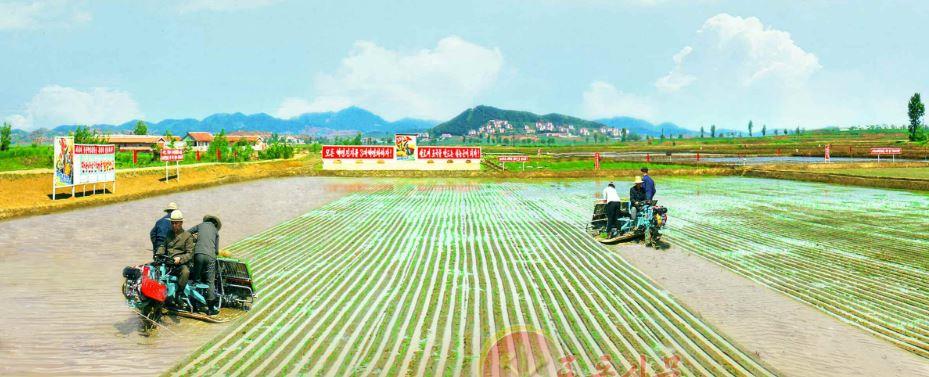
Farmers planting rice at Wonhua Farm in Pyeongwon-gun, Pyongannam-do, North Korea in May/Rodong Sinmun
Recent efforts to improve rural living conditions include housing construction under the Five-year Economic Development Plan (2021-2025). North Korean authorities are also promoting youth involvement in challenging sectors through extensive campaigns in the Central Daily Rodong Sinmun and the Korean Central Broadcasting Committee, encouraging young people to work in mines, coal mines, construction sites, and agricultural cooperatives.
Why are rural areas considered harsh environments, and why is there a strong push for youth to work there? The answer lies in structural challenges related to population and industry. As of 2022, North Korea's urban population was 62.9%, while the rural population was 37.1%. Excessive population movement and difficult agricultural conditions have led the government to encourage young people to move to rural areas.
To prevent rural population decline, North Korea restricts farmers from moving to cities. Typically, children born to farmers must remain in rural areas, preventing upward class mobility from peasant to worker. Conversely, moving from worker to peasant is encouraged, reflecting a discriminatory class system.
The control over class mobility began to address labor shortages in agriculture. With machinery operation rates significantly lower than the mechanization rate (60%) due to fuel shortages, young labor in rural areas is critically needed. Despite these needs, the rural population continues to shrink due to youth exodus. In response, North Korea permits workers to move to rural areas and change their class to peasant, actively encouraging youth relocation to the countryside.
The Reality of Rural Areas and the Exodus of Youth
Why are young people fleeing rural areas? Poor working conditions due to low mechanization, enforced lifetime farm work, and stark urban-rural living standards differences are key reasons. North Korean agriculture demands year-round labor without any off-season. Children born to farm workers must live their entire lives in harsh agricultural environments as permanent members of the peasant class. Urbanization and market-driven changes in cities create a sense of relative deprivation and a longing for urban life.
If agricultural work isn't done on time, it can ruin the entire year's harvest and lead to food shortages. In North Korea, farming activities are relentless: spring planting and rice planting from April to June, more rice planting from July to August, autumn harvesting and wheat and barley planting from September to October, and river maintenance and manure collection from late October to March. With a constant labor shortage, the government mobilizes everyone, from children to adults, during key farming seasons. These harsh working conditions, reliant on manual labor, drive young people to avoid rural assignments, leading to a continued exodus from rural areas.
The strict control over class mobility to prevent rural population decline is a major factor in the exodus. Once someone becomes a farmer, they are forced to remain in that role for life, and their children are also bound to the same fate. This class control perpetuates through the rural landscape, causing farmers, especially those in large agricultural areas, to aspire to urban worker lives.
Another driver of rural exodus is the lack of ownership rights over production, preventing improvement in living conditions. Since the early 2010s, North Korean farmers have operated under a 6:4 system (6 for the state, 4 for the farmers), shifting to a 7:3 system with the 2016-2020 economic strategy due to pre-purchase and post-distribution practices. In the 2020s, excess production regulation through the field responsibility system further stagnated farmers' lives as excess production reverts to the state.
Income disparity between rural and urban areas and the appeal of urban lifestyles are also significant factors in youth leaving rural areas. Unlike stagnant rural regions, cities with higher urbanization and population density have developed markets and expanded economic opportunities, resulting in rising wages for urban workers. The proliferation of market capital in cities has influenced urban development, leading to a longing for city life among farmers and driving rural exodus.
The Outlook of Policies Encouraging Youth Entry into Rural Areas
Despite North Korean authorities' efforts, the rural population continues to decline, particularly among young people, highlighting the limitations of long-term control policies. Data from Statistics Korea's North Korean population statistics show that despite efforts to control the rural population since the 1970s, outflows have continued: 0.9% from 1975 to 1984, 1.4% from 1985 to 1994, 0.8% from 1995 to 2004, 1.5% from 2005 to 2014, and 1.6% from 2015 to 2022. Except for the period from the mid-1990s to the mid-2000s, when economic crises drove people to rural areas for survival, the rural population outflow has increased to around 1.5%, indicating clear policy limitations.
The prospects for North Korea's rural revitalization policy remain bleak despite ongoing agricultural development strategies and rural housing construction. Problems such as forced peasant class succession, the state's focus on production quotas, poor rural living conditions compared to urban areas, and the individualism of the Jangmadang, Millennial, and Gen Z generations make it difficult for these policies to succeed. In summary, the top-down approach of encouraging youth to move to rural areas, without addressing the underlying issues, is unlikely to be effective due to the structural limitations of collectivism.
-
PREV [Feature Article Series]
-
NEXT [Issue Brief]