


North Korea 30 Years After Kim Il-sung's Death: Past, Present, and Future (3)
Kim Il-sung's Stalinist Purges and Party Power Struggles

Kang In-deok
Former Minister of Unification of the Republic of Korea
After the armistice in July 1953, tensions within the North Korean party regarding war responsibilities turned into power struggles. Kim Il-sung and his supporters blamed the failure of the Korean War on anti-party activities and espionage by Pak Hon-yong and his group. They argued that the claim that 200,000 South Koreans would rise up to welcome the People's Army was a lie, thus shifting the blame for the defeat to the South Korean Workers' Party (SKWP).
In December 1955, a special court trial for Pak Hon-yong and over ten other cadres from the SKWP including Yi Kang-guk, Yi Sung-yop, and Yim Hwa, led to death sentences and immediate executions. The 3rd Congress of the Workers' Party of Korea in April 1956 reaffirmed the legitimacy of these purges and discussed economic plans for post-war reconstruction.
During this meeting, the "heavy industry first" resolution (April Theses) was adopted amid debates. Kim Il-sung's faction pushed for the reconstruction of heavy industry to rebuild revolutionary bases, while the moderates (mainly the Yan’an and Soviet factions) prioritized addressing people's hardships through agriculture and light industry. Alongside these economic debates, a power struggle over party leadership emerged, fueled by disagreements on whether to adopt the "de-Stalinization and peaceful coexistence" policy introduced by the 20th Congress of the Soviet Communist Party in February 1956.
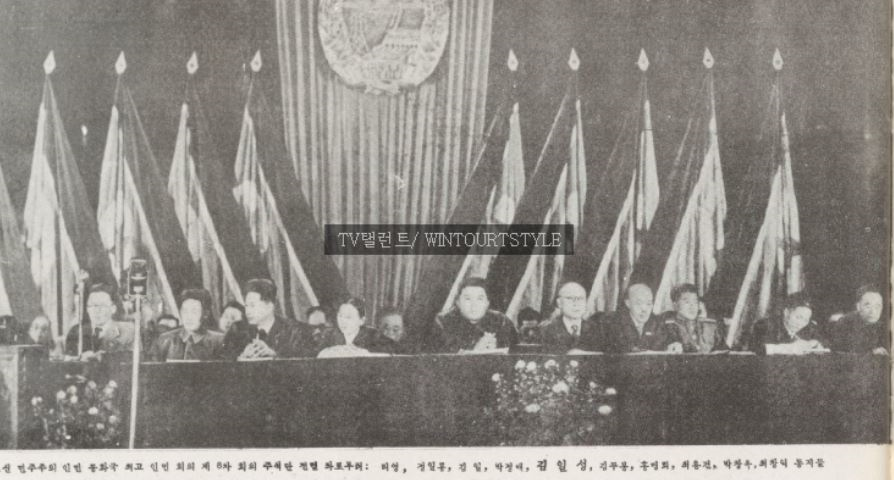
Kim Il-sung's faction, the Yan’an faction, and the Soviet faction seated together at the 8th session
of the Supreme People's Assembly of North Korea, 1954. / WINTOURTSTYLE
The key issue was that Kim Il-sung, like Stalin, should not act as a dictator by ignoring party democracy, similar to the Soviet Union's move to de-Stalinize. The anti-Kim faction's call for "de-Kim Il-sungization" was unacceptable to Kim Il-sung's supporters. They labeled members of the Central Committee of the Workers' Party of Korea, including Choe Chang-ik, Pak Chang-ok, and Yun Gong-heum, who made such claims, as factionalists and decided to arrest and purge them.
Aware of this, some opponents, including Yun Gong-heum (Minister of Commerce), Seo Hui (Chairman of the General Federation of Trade Unions of Korea), and Lee Pil-gyu (Central Committee member), used a temporary recess to escape across the Yalu River to China, where they reported Kim Il-sung's tyranny to Chinese Communist Party leaders. Realizing the severity of the internal power struggle, the Chinese Communist Party, with Soviet leader Anastas Ivanovich Mikoyan, sent Peng Dehuai and Mikoyan to Pyongyang to ask Kim Il-sung to stop the purges. Kim Il-sung, unable to resist, revoked the expulsion orders for Choe Chang-ik, Pak Chang-ok, and others, marking the "August Faction Incident.“
A year later, in August 1957, those involved in the "August Faction Incident," including Choe Chang-ik and Pak Chang-ok, were arrested and purged on charges of plotting a "state coup." Those who escaped fled to China or the Soviet Union. The purge activities expanded into a nationwide ideological scrutiny campaign under the "May 30th Resolution," adopted at the Central Committee plenary session chaired by Kim Il-sung on May 30, 1957.
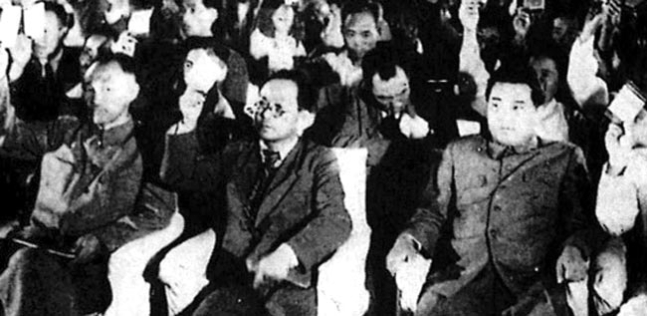
Kim Il-sung (front row, right) and Pak Hon-yong (center), representing the SKWP, voting at the 1st session
of North Korea's Supreme People's Assembly, September 2, 1948. / Media Korean Studies
After the "May 30th Resolution," factionalists and impure elements in local parties were purged over the course of a year. By December 1958, with these purges complete, Kim Yong-ju, Kim Il-sung's brother and head of the Central Committee Organization and Guidance Department, launched the "Intensive Guidance Project," a comprehensive investigation of the entire North Korean population.
Kim Yong-ju mobilized 7,000 people, including senior students from Kim Il Sung University and other universities, along with the heads of the Central Committee's administrative and organizational departments, the Ministry of Social Security, the Supreme Prosecutor's Office, provincial party vice-chairmen, and cabinet ministry chairmen, to conduct a nationwide identity inspection campaign.
The "Intensive Guidance Project," a year-long purge campaign, rivaled the infamous purges of the Soviet Communist Party under Joseph Stalin in the late 1920s. During Stalin's agricultural collectivization, 20 million people, including landlords, wealthy farmers, innocent peasants, and resisters, were purged.
In the 1930s, the purges continued, targeting party officials and military leaders, including Soviet Chief of Staff Marshal Mikhail Tukhachevsky, until 1940. During this period, 200,000 of our compatriots living in Primorsky Krai were forcibly relocated to the wastelands of Central Asia. Ethnic minorities, including Jews, Ukrainians, and residents of the Baltic states, were accused of being anti-Soviet and exiled to Siberia or remote areas of Central Asia. This project was comparable to Stalin's notorious purges.
Note: Despite the devastating famine from 1927 to 1932 that killed 20 million people due to agricultural collectivization, Joseph Stalin still hailed the 17th Party Congress of 1934 as the "Congress of Victory." After the assassination of Sergei Kirov, Stalin's chosen successor, Stalin ordered the NKVD, led by Nikolai Yezhov, to purge and execute key party leaders who had participated in the October Revolution with Vladimir Lenin, including Lev Trotsky, Nikolai Bukharin, Grigori Zinoviev, and Lev Kamenev, as well as Central Committee members like Pyatakov and Karl Radek. Ironically, Yezhov himself was later purged for alleged leftist extremism. In June 1937, Stalin purged top military leaders, including Soviet Chief of Staff Mikhail Tukhachevsky, accusing them of being Nazi spies. Consequently, 98 out of 139 Central Committee members elected at the 17th Party Congress were executed as anti-party elements and imperialist spies.
The "Intensive Guidance Project" in North Korea divided the population into three classes: loyal core, wavering middle, and hostile impure, further subdivided into 51 categories. The impure class included families of defectors to the South, wartime security force members and their families, anti-communist organization members and their families, Christians and their families, landlords, wealthy farmers, businessmen and their families, and sympathizers of the August faction and their families.
Measures against these people were based on Cabinet Decision No. 149, aimed at eliminating impure elements and implementing the “Red Urbanization Plan”, which involved expelling impure elements 20 kilometers from the coast and the Demilitarized Zone, 50 kilometers from Pyongyang and Kaesong, and 20 kilometers from each city. These distances indicated expulsion to remote areas in northern North Pyongan, Jagang, and South Hamgyong provinces, and northeastern North Hamgyong province. Expulsion essentially meant confinement in political prison camps.
According to "Cabinet Decision No. 149," 5,000 households from Pyongyang, 600 from the Kaesong Industrial Region, 1,500 from Hwanghae Province, and 1,000 from Gangwon Province, totaling about 8,000 households, were expelled. As a result, party members who were expelled, dismissed, or demoted accounted for 40% in the Pyongyang Party, 70% in the Kaesong Industrial Region Party, 60% in the Hwanghae Province Party, and 80% in the Gangwon Province Party, leading to an estimated punishment of over 60%. While conducting this nationwide identity investigation, they also emulated Stalin's agricultural collectivization by abolishing private farms and incorporating all farmers into collective farms, thus completing a socialist and totalitarian control system.
-
PREV [Issue Brief]
-
NEXT [Issue Brief]