

Marketing In North Korea (7)
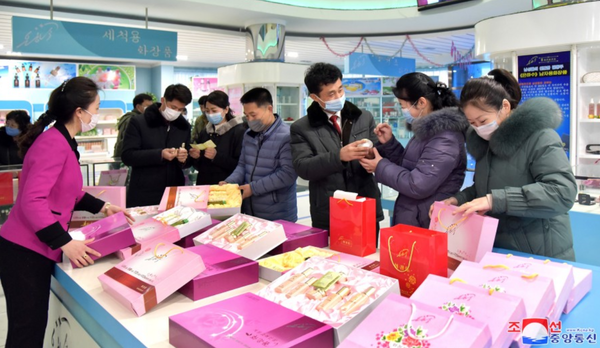
- Sanitary napkins for women, its name is 'Bongseonwha' (means garden balsam)

Jeon Byung-kil
Senior Consultant of YESInnovation
former of Secretary General of UniKorea Foundation
Products close to women's lives
From their early teens to their early 50s, women experience more than 400 periods. Women are usually more concerned about quality than price of sanitary napkins. In other words, when women buy sanitary napkins, they pay close attention to what ingredients they're made of and how comfortable they are when they wear them. That's why sanitary napkin manufacturers customize their products for consumers.
So what kind of sanitary pads are North Korean women using? Prior to the 2000s, North Korean women used lightweight, soft cheesecloth or artificial cloth sanitary napkins. Then, in the mid-2000s, disposable sanitary napkins started arriving from China. But North Koreans who couldn't afford it weren't interested in buying sanitary napkins. At the time, most North Korean women didn't think it was necessary to pay a lot of money for sanitary pads that would be used once and thrown away. Unsurprisingly, disposable sanitary napkins didn't sell well.
After Kim Jong Un took power in 2012, sanitary napkin products of varying prices and quality began to appear on the market. Panty liners and winged sanitary napkins, customizable sanitary napkins in different thicknesses to fit menstrual cycle, and cheesecloth sanitary napkins and cheesecloth panty liners, which are said to be economically beneficial. In the North Korean market, cheesecloth sanitary napkins used to be sold individually with no packaging, but now some are sold in packs of 10. It also sell them individually packaged for travelers.
North Korea's sanitary napkins 'Comsumer Report'
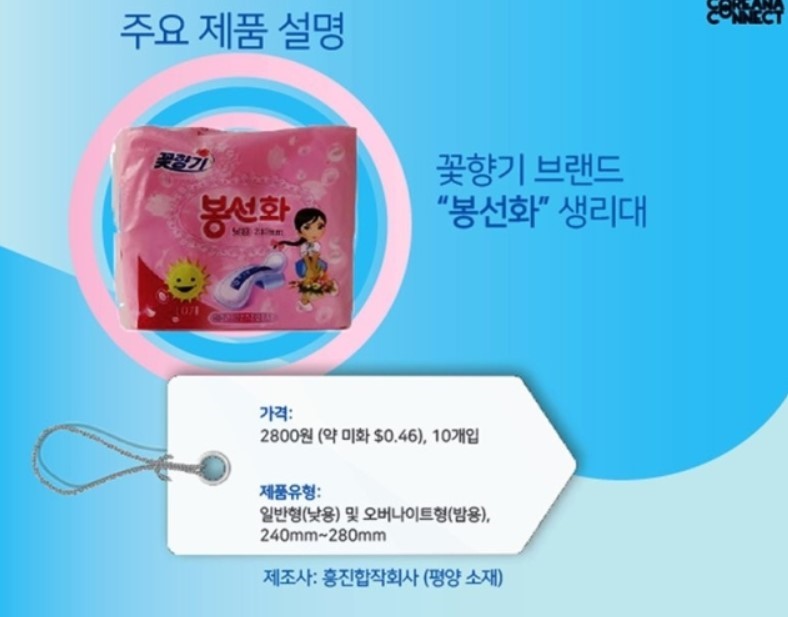
North Korea's disposable sanitary pads 'Bongseonhwa' /Yonhap News Agency
Coreana Connect released a Consumer Report-style report, "Women's Hygiene Products in North Korea," comparing eight different types of sanitary pads distributed in North Korea in 2018. The group collected eight brands of sanitary napkins (six North Korean and two Chinese) sold mainly in department stores, supermarkets, and markets in Pyongyang and the Rason Special Economic Zone.
Coreana Connect commissioned a laboratory specializing in the quality of paper and textile products to conduct functional tests on the collected products in terms of Absorption Before Leakage (ABL) and Multiple Acquisition Time (MAT). In other words, we evaluated absorbency and adhesion, which are the core functions of sanitary napkins.
'Bongseonwha' was the highest rated brand in terms of absorption speed and amount. It was followed by 'Rakrang', 'Seolwha', 'Kkothyanggi', and 'Seonghyang'.
The 'Rakrangbonghwa store', the parent company of the 'Bongseonhwa' brand, which topped the quality ranking, appears to be an affiliate of the 'Rakrangbonghwa cloth factory', which opened in 2010. The clothing products produced by this factory are branded as "Bongseonwha" and the trademark logo is almost identical to the logo on sanitary napkins.
Ryukyung Household Goods Factory, the parent company of Rakrang, was originally the December 7th Factory, which produced military goods. After Kim Jong-un's era, the factory was reorganized into a modernized sanitary products production plant, which Kim visited in July 2015. There's a simple reason why North Korea's leading sanitary napkin company has "Rakrang" in its name. The factories are located in the Rakrang district of Pyongyang.
Coreana connect tested women ages 18 to 24, but did not disclose the number of respondents, their nationalities, or the name of the organization that conducted the quality testing. Here's what people who have used North Korean sanitary napkins have to say about them
21-year-old respondent - It's comfortable to use. However, the adhesive doesn't seem to work well, my menstrual blood was spread all over and not absorbed and there was leakage. I think it would be better if they improved it a bit more.
18-year-old respondent - Wearing it while sleeping caused my underwear to stain with menstrual blood, but I didn't have a problem with it during the day.
Respondent, 20 years old - Not enough adhesive on the back to keep it in place, but the absorbency was fine.
Respondent, 18 years old - I like that the sanitary napkins are lightweight and not particularly fragranced, but the adhesive on the wings and the back of the pad is not very good, making it difficult to keep them in place in my underwear, and the constant movement makes it uncomfortable because it stains my underwear. The plastic side of the sanitary napkin is too thin and tears easily.
According to the report, North Korean sanitary napkins are similar to thin pads or regular sanitary napkins commonly sold in the West and are comfortable to wear. However, it was pointed out that they are inconvenient because they have poor adhesion and need to be replaced frequently.
Best Sanitary Napkin - 'Bongseeonwha'
The use of “Bongseonhwa” as a trademark targeting women in North Korea began in 2011. The trademark was first applied to women's clothing produced at the Rakrang Bonghwa cloth factory, and the word “Bongseonhwa” signifies women's coldness, anguish, and suffering.
The packaging of Bongseonhwa, a sanitary napkin that received high marks in the report, states that it contains 10 pads and is 265mm long. Based on the Korean standard for sanitary napkins, medium is 240mm and large is 280mm, so it seems to be somewhere between medium and large. There is no separate size labeling.
North Korean sanitary napkins are categorized into daytime and nighttime. When it open the outer packaging of a Bongseonhwa sanitary napkin, it can smell a strong wormwood odor. While South Korean sanitary napkins are usually made up of layers of absorbent sheets, the absorbent layer of North Korean sanitary napkins is more like a pulp. In terms of absorbency, North Korean "Bongseonhwa" sanitary napkins are not as absorbent as their South Korean counterparts, and liquids are not absorbed immediately, but instead remain on the surface for some time.
North Korean women's sanitary napkins are advertised as being effective in preventing women's diseases, treating gynecological diseases, and stopping the pain of women with menstrual cramps, and having a strong adsorption and absorption capacity by adding polymer absorbents. These are not only the ingredients, but also the advertising phrases used to promote the product. North Korea has few restrictions on exaggerated advertisements, so the claims are often overstated compared to South Korea.
Disposable sanitary napkins are an everyday item?
According to NKDB's 2018 survey of 100 North Korean women, "North Korean Women's Perceptions of Menstruation and Menstrual Products," 56% of them used cheesecloth sanitary napkins, 38% used disposable sanitary napkins, and 5% used paper. Of the women who used cloth sanitary napkins, 77% used lobster cloth, while the rest used old clothes or blankets for economic reasons. The 38% of women who use disposable sanitary napkins may seem surprising given the economic situation in North Korea, but they are expensive and only used occasionally when needed.
Most disposable sanitary napkins sold in North Korea are targeted at the upper class and foreign tourists, not the average North Korean. In fact, 'Kkothyanggi' sells for US$0.46 (KPW 2,800) for a pack of 10. 'Seolwha' costs between KPW 2,500 and 'Seonhyang' costs KPW 3,500. The average price of sanitary napkins is around KPW 3,000, which is about the same price as 500 grams of rice.
Disposable sanitary napkins are not yet common in North Korean society. Alternative menstrual products, such as tampons, are also hard to come by. Tampons are only used by elite athletes and high-ranking women. Menstrual cups and reusable sanitary napkins can be effective alternatives for women in developing countries, but they are not available in North Korea.
North Korea currently has a feminine hygiene culture that coexists between the use of disposable sanitary napkins and the use of cheesecloth, tissues, and paper as sanitary napkins. Developing quality products is important, but more important is universal access to feminine hygiene products.
-
PREV [Feature Article Series]
-
NEXT [Defectors' Podium]