

North Korea 30 Years After Kim Il-sung's Death: Past, Present, and Future (4)
"Strengthening the Revolutionary Base," the Four Military Guidelines,
and Provocations Against South Korea

Kang In-deok
Former Minister of Unification of the Republic of Korea
Kim Il-sung believed that purging dissenters had secured his regime's stability. Confident in this, he held the 4th Congress of WPK in September 1961, where he promoted the Juche ideology (self-reliance) to address the Sino-Soviet split and introduced a seven-year plan for national defense and economic growth. By December 1962, at the 5th Plenary Session of the Party Central Committee, he laid out the Four Military Guidelines: arming the population, fortifying the nation, creating an officer corps, and modernizing the military.
During a period when economic support from China and the Soviet Union was dwindling due to their distrust of North Korea's neutral stance, this focus on military led to severe economic decline. Allocating over 25% of the GDP to military expenditure left little for economic development. The solution was to mobilize the masses' labor force. Initiatives like the "Chollima Movement" and the "Daean Work System" aimed to drive economic growth through ideology and mass labor, reflecting an anti-economic logic.
North Korea's economy began to falter. Despite this, Kim Il-sung held the 8th Central Committee Plenary Session in February 1964, proposing the "Three Revolutions" strategy to strengthen North Korea's revolutionary base, boost revolutionary forces in South Korea, and enhance international support. He pushed for violent revolution and underground parties in South Korea. The 2nd Party Delegates' Conference in October 1966 attempted Mao Zedong's strategy of encircling cities from the countryside, aligning with anti-American movements, and using North Vietnam's support for armed struggle against South Vietnam. However, this plan failed completely.
Kim Jong-il's Succession and North Korea's "Red Guards": The Three Revolutions
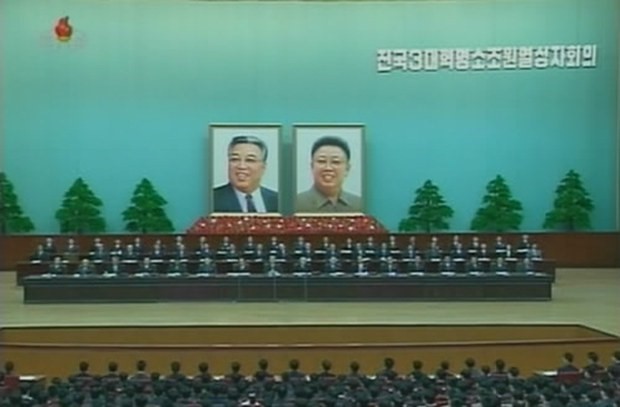
The "National Conference of Enthusiasts for the Three Revolutions Teams" held in Pyongyang in February 2013
/ Korean Central Television
At the 5th Party Congress in November 1970, Kim Il-sung reviewed the past decade's accomplishments. He praised the success of the Four Military Guidelines, the strengthening of the Three Revolutionary Forces, and the simultaneous development of the economy and defense. He also highlighted the establishment of his Juche ideology as the party's sole ideology.
However, new challenges arose with the end of the Vietnam War, improved U.S.-China relations, South Korea's economic superiority, and criticism from other communist parties. To address these issues, Kim engaged in inter-Korean dialogue and began selecting his successor.
Reflecting on Nikita Khrushchev's efforts to de-Stalinize and China's Lin Biao's failed coup against Mao Zedong, Kim Il-sung decided that his eldest son, Kim Jong-il, was the only person he could fully trust. After discussing with loyal partisans Choi Hyun, Choe Yong-gon, and Kim Il, he named Kim Jong-il as his successor at the 8th Plenary Session of the 5th Central Committee in December 1972. However, the decision for the Workers' Party of Korea—supposedly committed to Marxist-Leninist revolutionary theory—to adopt hereditary succession, a trait of pre-capitalist feudal societies, was unusual and drew criticism from communist parties worldwide and North Korean intellectuals. How could this discontent and criticism be managed?
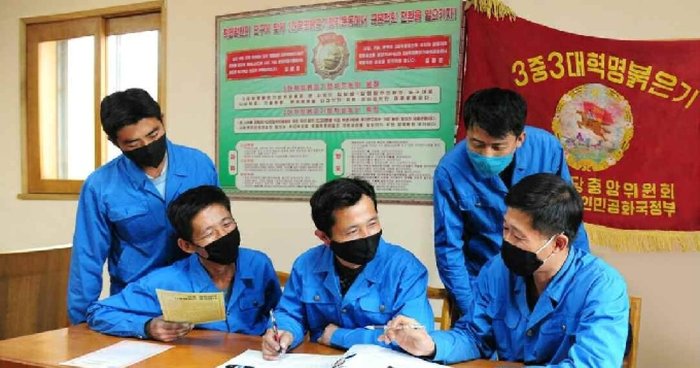
In February the following year, Kim Il-sung directed the formation of the "Three Revolutions (ideological, technical, and cultural)" led by young university students under Kim Jong-il's leadership. These teams were sent to local regions to persuade party cadres, senior officials, and intellectuals to abandon outdated ideas. He instructed, "Your mission is to help and awaken the cadres. Your struggle is against their outdated ideas, not the cadres themselves. Fight uncompromisingly against old ideas" (Collected Works of Kim Il-sung, Vol. 7, p. 209).
But was this directive genuine? Young members of the Three Revolutions Teams boldly confronted senior officials and their university professors, demanding they abandon old ideologies. These officials, aware of the implications, had no choice but to comply. The knowledge of past purges, like the August Faction Incident, and the Central Party's intense guidance projects meant they understood the consequences of non-compliance. Over a year, around one million young activists were dispatched across the country, joining the party with Kim Jong-il's endorsement. Finally, on February 13, 1974, Kim Jong-il was promoted to the political committee. From that point forward, he was known as the "Central Party" and focused on solidifying his power base.
-
PREV [Defectors' Podium]
-
NEXT [Analysis of issues]