


The 80-Year Legacy of North Korea’s Workers’ Party:
Will a Fourth Generation of Hereditary Rule Follow?

Kang Dongwan
Dong-A University prof. / kangdongwan TV
To cut to the chase, North Korea’s fourth-generation succession must not happen, nor should it be allowed to. Ever since Kim Jong-un started bringing his daughter, Kim Ju-ae, to public events, speculation about a possible fourth-generation succession has intensified. Some scholars have attempted to analyze this issue through the lens of social science, debating whether Kim Ju-ae is the next heir. However, this issue is not one of academic debate but of fundamental values. Should we just sit back and watch as dynastic successions, reminiscent of feudal times, occur in the 21st century under the guise of dictatorship? Why did Kim Jong-un choose to publicly introduce his daughter? Kim Ju-ae was seen beside Kim Jong-un during a commemorative photo session with those responsible for launching the Intercontinental Ballistic Missile (ICBM) ‘Hwasong-17’ on November 18, 2022. Insights into North Korea’s intentions can be gleaned from the November 27 edition of Rodong Sinmun.
In particular, words like “esteemed child,” “future generations,” and “Paektu bloodline” stand out in the article. The original text includes phrases such as, “We must first become stronger for the sake of our country and future generations…” and “We will continue to follow only the Paektu bloodline and remain loyal to the end.” This article, titled A Pledge of Loyalty and Conviction to the Party Center, takes the form of a loyalty letter from the scientists, technicians, workers, and officials involved in the missile launch, addressed to Kim Jong-un. In this pledge, they vow to “follow only the Paektu bloodline and remain loyal to the end.” Unlike previous documents, which typically pledged loyalty solely to Kim Jong-un, this one specifically mentions the Paektu bloodline—clearly encompassing Kim Ju-ae.
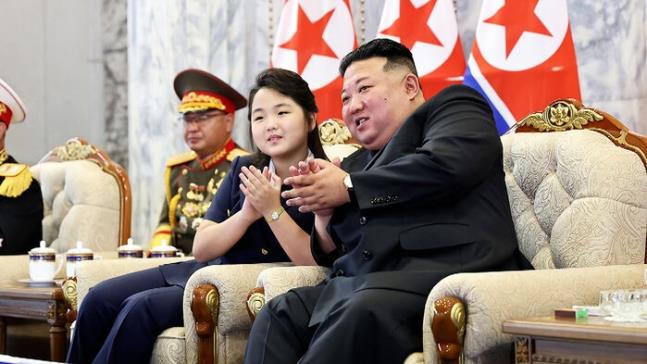
North Korean leader Kim Jong-un and his daughter Joo-ae sit side by side at a military parade marking
the 75th anniversary of the founding of the North Korean regime/North Korea Central TV
Additionally, one of the 15 photos released that day, staged in front of the statues of Kim Il-sung and Kim Jong-il, was clearly deliberate. Previously, most commemorative photos with Kim Jong-un were taken in front of buildings or large squares. This time, however, the photo was staged with the statues of Kim Il-sung and Kim Jong-il at the center, subtly emphasizing the continuation of the Kim family’s rule across four generations. The intention here wasn’t to directly highlight Kim Ju-ae as the next leader but rather to reinforce that the Paektu bloodline will continue the hereditary leadership.
The use of the honorific “esteemed child” in reference to Kim Jong-un’s daughter is also noteworthy. The word “esteemed” implies a person of noble and precious status. Yet, Rodong Sinmun described Kim Ju-ae, a teenage girl, in such lofty terms. In the photos, she can be seen shaking hands with military commanders significantly older than her, standing tall, exuding authority as though she is in a superior position. In contrast, the military commanders bow slightly, using “both hands” to shake hers respectfully. This scene starkly illustrates the prominence—and hypocrisy—of the Paektu bloodline.
Kim Jong-un’s directives are absolute. Since coming to power, he has emphasized the ideology of “loving future generations and prioritizing youth.” North Korean propaganda even praises Kim for personally distributing school supplies to children and prioritizing dairy production for childcare. However, this so-called love for future generations is merely a pretext for strengthening ideological indoctrination from a young age, cultivating loyalty to the regime. The regime’s survival relies heavily on instilling strong ideological commitment, starting with the indoctrination of children to foster loyalty and belief in North Korea’s supremacy.
North Korean propaganda often emphasizes Kim Jong-un’s supposed care for children, from providing school supplies to prioritizing dairy products. Now, they claim his completion of nuclear missiles guarantees a strong homeland for future generations. A key element of this narrative is Kim’s public appearances with his daughter, showcasing her as a symbol of pride and love. Instead of focusing on Kim Ju-ae as the heir, attention should be on why Kim is highlighting her now. The regime even produced a music video, Beloved Father, portraying him as a caring parent. In a system that depends on the leader’s absolute power, the crafted image of a loving father with his daughter serves to reinforce his authority.
The current situation, where missile launch contributors—self-described as "members of the inner circle close to Kim Jong-un"—pledge loyalty exclusively to the Paektu bloodline, exposes the core of the North Korean regime. Despite struggling to provide basic necessities like dairy for its children, the regime continues to invest heavily in missile and nuclear development. They claim that nuclear weapons are the only defense against foreign threats, urging citizens to endure present hardships for the sake of future generations, using this narrative to suppress internal discontent.
But do North Koreans really believe this narrative? As they watch their children suffer from hunger and malnutrition, how must they feel seeing the stark contrast with Kim Jong-un’s well-nourished daughter? What goes through their minds as they witness a regime so corrupt that it uses even a child to justify its rule? The idea of a fourth-generation succession is terrifying. The solution is clear: we must raise awareness among the North Korean people through external information, helping them become the agents of change in their own country. One thing is certain: we cannot let this dictatorship persist unchecked while talking about peace.