

Kim Jong-un Shifts Focus to South Korea After Hanoi Summit:
Remarks on Nuclear Threats and Potential Provocations

Choi Jin-wook
Former President of the Korea Institute for National Unification
What drives North Korea’s nuclear development? Initially, North Korea claimed its nuclear program was to address power shortages, later justifying it as a defense against U.S. hostility. The regime argued that its nuclear weapons were meant to deter U.S. aggression and protect South Korea. However, North Korea now openly identifies South Korea as the primary target of its nuclear arsenal.
When the North Korean nuclear crisis began in the early 1990s, Kim Il-sung claimed North Korea neither needed nor had the capability to develop nuclear weapons, asserting its nuclear reactors were only for electricity generation. The crisis, which nearly led to war, was averted in 1994 with the U.S.-North Korea Agreed Framework. North Korea agreed to dismantle its 5 MWe plutonium-producing reactor in exchange for two 1,000 MWe light-water reactors and 500,000 tons of heavy fuel oil annually. However, the deal did not address the plutonium North Korea had already accumulated.
In hindsight, North Korea’s nuclear ambitions were clearly aimed at weapon development. However, many initially believed the program was focused on energy shortages, economic aid, securing U.S. guarantees and stabilize the regime. Fears of regime collapse shaped U.S. policy toward non-proliferation and stability, but repeated diplomatic efforts by the U.S. and South Korea failed to recognize North Korea’s true intentions, and attempts at denuclearization consistently fell short.
Even after the Agreed Framework, North Korea continued to develop nuclear weapons. When the U.S. confronted them in 2002, North Korea claimed it had no choice but to pursue nuclear arms due to U.S. hostility. It argued that a peace agreement was necessary to transition from a state of war to peace. North Korea’s interpretation of U.S. hostility wasn’t direct aggression but rather Washington’s support for South Korea in the inter-Korean conflict.
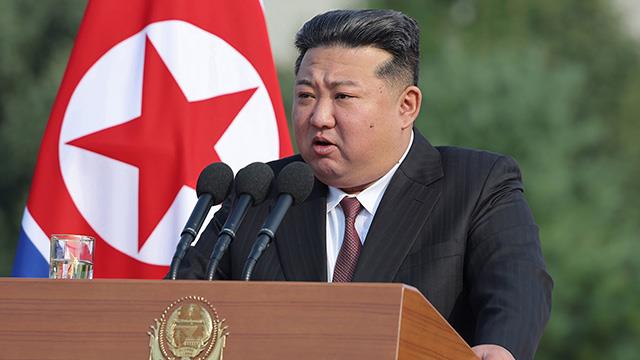
North Korean leader Kim Jong-un delivers a speech on the 60th anniversary of Kim Jong Un National Defense
University / Korean Central News Agency
Essentially, North Korea warned that if the U.S. continued aiding South Korea, it would face the threat of North Korean nuclear retaliation. To back these threats, North Korea developed medium and long-range missiles capable of targeting not only South Korean ports like Busan, where U.S. forces might land, but also regional U.S. bases, such as Guam, and even the U.S. mainland.
The claim of a U.S. "hostile policy" is unfounded. After the Cold War, the U.S. showed little direct interest in North Korea but sought stability in inter-Korean relations, helping sustain the regime with food aid, fuel, and verbal security assurances. After 9/11, U.S. policy shifted to the war on terror, relegating North Korea behind Iraq, Iran, and Syria. As China’s influence grew, North Korea became even less of a priority in U.S.-China relations.
North Korea’s ambitions became clear in 2006 with its first successful nuclear test. After Kim Jong-un took power in 2012, the regime further solidified its stance by embedding nuclear weapons in its constitution, declaring them non-negotiable. Since then, North Korea has aggressively expanded its nuclear capabilities.
With President Donald Trump's inauguration in 2017, U.S. policy toward North Korea shifted significantly. His "America First" policy and top-down diplomatic approach brought a new era of dialogue between the two nations. The third U.S.-North Korea summit in Hanoi in February 2019 was met with high expectations for a final agreement with Kim Jong-un, but the talks ultimately ended in failure.
Trump believed that the U.S.-led liberal world order only benefited China while harming U.S. interests. Instead of bolstering U.S. leadership, Trump pursued a more isolationist policy. He argued that weakening China by distancing North Korea from it would reduce the economic burden of maintaining alliances. This led to an intriguing proposal: North Korea would dismantle its nuclear weapons in exchange for the reduction or withdrawal of U.S. troops from South Korea and a peace agreement between the U.S. and North Korea.
North Korea, in turn, offered to permanently shut down all nuclear material production facilities at Yongbyon if the U.S. lifted its economic sanctions. At a midnight press conference following the breakdown of the talks, North Korean Foreign Minister Ri Yong-ho called this the largest step toward denuclearization that North Korea could take at that stage. However, North Korea rejected additional U.S. demands regarding the Kangson uranium enrichment facility, which was believed to have a higher production capacity than Yongbyon. This rejection cast further doubt on North Korea’s sincerity in its offer to denuclearize.
The Hanoi summit clarified North Korea’s true intentions. Up until then, North Korea had justified its nuclear weapons as a response to U.S. hostility, insisting a peace agreement was necessary. However, no mention of such an agreement was made at Hanoi. Ri Yong-ho expressed disappointment over the failed talks, suggesting that a better deal might not be possible and that such an opportunity may never return.
Following the collapse of the Hanoi summit, North Korea shifted its focus to South Korea, issuing threats and insults. Kim Jong-un stated, “Don’t expect anything from South Korea” and “Even if we starve, we won’t beg,” marking a hardline stance. Officials began making derogatory remarks and resumed missile provocations. In June 2020, North Korea expressed its frustration by demolishing the Kaesong Inter-Korean Joint Liaison Office.
After South Korea's conservative government took office in May 2022, North Korea's hostility escalated. Kim Jong-un threatened preemptive nuclear strikes, while Kim Yo-jong stated they would no longer engage with the South. In December 2022, Kim Jong-un ordered a significant expansion of North Korea’s nuclear warhead stockpile at the 6th Plenary Meeting of the 8th Central Committee of WPK.
Kim Jong-un officially redefined inter-Korean relations as those between two hostile states. In late 2023, at the 9th Plenary Meeting of the 8th Central Committee, he introduced the "Two States policy" and ordered the restructuring of agencies handling South Korean affairs, including the United Front Department. In January 2024, during the Supreme People's Assembly, Kim called for the removal of concepts like unification, reconciliation, and shared ethnicity from North Korea’s history. He then disbanded the National Committee for the Peaceful Reunification of the Fatherland, the National Economic Cooperation Committee, and the Mount Kumgang Tourist Bureau—agencies responsible for inter-Korean dialogue and cooperation. Additionally, the Monument to the Three-Point Charter for National Reunification, symbolizing Kim Il-sung's unification legacy, was dismantled.
In July 2023, Kim Yo-jong's statement marked a shift in North Korea’s rhetoric, referring to South Korea as “the Republic of Korea” for the first time, signaling heightened hostilities. Traditionally, North Korea’s inter-Korean policy centered on shared ethnicity, reconciliation, and unification, aligning with U.S.-supported stability. However, its claim of having nuclear capabilities sufficient to strike the U.S. remains highly doubtful.
The most significant shift in North Korea’s strategy after the Hanoi summit was its focus on South Korea over the U.S. By rejecting any notion of shared ethnicity, North Korea justifies its threats of preemptive nuclear strikes and tactical drills. Its recent disclosure of uranium enrichment facilities suggests imminent military provocations, likely aimed at pressuring future U.S.-North Korea negotiations.
North Korea’s hostility toward South Korea is mirrored in public sentiment. Over 90% of South Koreans believe North Korea will never give up its nuclear weapons, and more than 80% fear potential provocations. The main motivation for unification is now less about shared ethnicity or becoming a great power, and more about preventing war. As North Korea’s aggression drives shifts in South Korea’s approach, tensions on the Korean Peninsula keep escalating.