

Israel-Hamas and Israel-Hezbollah Conflicts,
with Alleged North Korean Support for Tunnel Networks

Kim Kang-suk
Assistant Professor, Department of Arabic, Hankuk University of Foreign Studies
1. Escalating Instability in the Middle East amid Israel-Hamas and Israel-Hezbollah Conflicts
The Israel-Hamas war, triggered by a surprise Hamas assault on October 7, 2023, has continued despite global diplomatic efforts. Israel has weakened Hamas’s military presence in southern Gaza, targeting figures like Yahya Sinwar, and has expanded its operations northward against Hezbollah. On September 17, 2024, Prime Minister Netanyahu broadened Israel’s objectives to include the return of residents from its northern border with Lebanon, alongside neutralizing Hamas, securing hostages, and reducing Gaza-based threats. These escalated actions intensified clashes with Hezbollah, resulting in the deaths of leader Hassan Nasrallah and his successor, Hashem Safieddine.
While the war persists, military conflict between Israel and Iran has also erupted. Israel views its battles with Hamas and Hezbollah as extensions of its ongoing conflict with Iran, leading to escalating tensions. In April 2024, Israel bombed the Iranian consulate in Syria, sparking a series of retaliatory attacks. Iran responded with drone and missile strikes targeting Israel, while Israel countered by striking Isfahan. On October 1, Iran launched about 200 ballistic missiles at Israel, claiming it was retaliation for the deaths of Hamas leader Ismail Haniyeh, Hezbollah leader Hassan Nasrallah, and IRGC deputy commander Abbas Nilforoushan. In response, Israel struck back on October 26, further destabilizing the political situation and intensifying unrest across the Middle East.
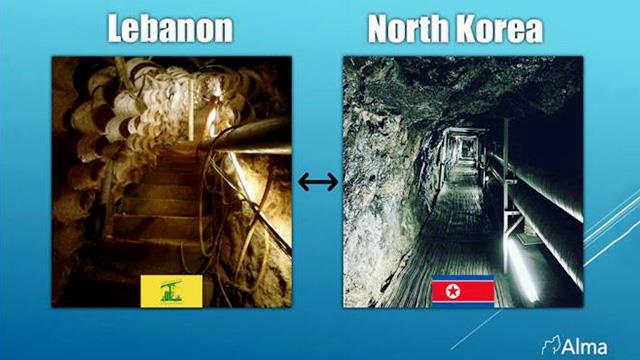
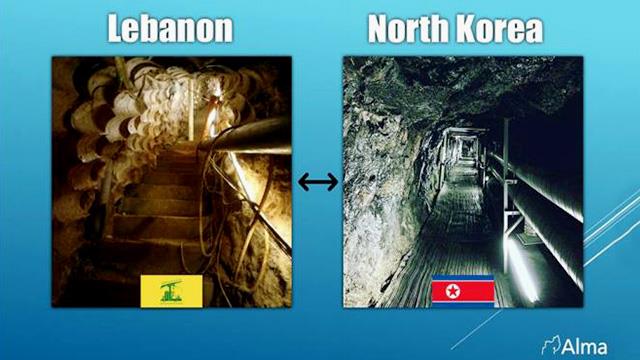
A recent report by Israel's Alma Research and Education Center, titled "Hezbollah's Land of Tunnels," indicates that
Hezbollah has received materials and technical support for tunnel construction from North Korea's arms export company,
the Korea Mining and Development Trading Corporation (KOMID). / Alma Research and Education Center
2. Israel’s Growing Security Concerns over Hezbollah’s Tunnel Networks
As tensions across the Middle East escalate, Israel has increased its ground operations against Hezbollah. Israeli forces have reported finding Hezbollah tunnels near a United Nations Interim Force in Lebanon (UNIFIL) base, located along the Blue Line boundary. Israel alleges that Hezbollah uses these tunnels as weapon depots and hideouts and has expressed frustration with UNIFIL's inability to restrain Hezbollah's activities in southern Lebanon. The ongoing skirmishes between Israel and Hezbollah have reportedly led to an attack on a UNIFIL base, injuring peacekeepers and prompting UNIFIL’s leadership to protest to the Israeli government.
Israel has deployed ground forces in Lebanon to dismantle Hezbollah's extensive tunnel networks, recognizing that airstrikes alone are insufficient. Concerns over Hezbollah’s tunneling capabilities have grown since Israel's 2000 withdrawal from southern Lebanon, which enabled Hezbollah to bolster its military strength. These concerns intensified during the 2006 conflict, as Hezbollah effectively used its tunnels to resist Israeli airstrikes on its main bases.
Following the 2006 conflict, UN Security Council Resolution 1701 was adopted, leading to Israel's military withdrawal, Hezbollah's disarmament, and an expanded UNIFIL deployment. However, tensions between Israel and Hezbollah persisted. At that time, a 120-kilometer Blue Line was established along Israel's northern border with southern Lebanon, marking an official boundary under Resolution 1701. Despite these efforts, conflicts continued, and Israel’s concerns over Hezbollah's tunnels grew. The 2014 Hamas tunnel attacks in the southern Gaza conflict heightened Israeli fears that Hezbollah might use similar tactics in northern regions.
3. Allegations of North Korean Support for Hezbollah’s Tunnels
In response to the growing security threat, Israel launched “Operation Northern Shield” in December 2018, aiming to uncover and dismantle Hezbollah’s tunnel networks. Israel claims that Hezbollah, with North Korean assistance, has developed two types of tunnels in southern Lebanon: one for offensive purposes and another for infrastructure support. During Operation Northern Shield in 2018, Israel discovered tunnels large enough to accommodate vehicles and equipped with command centers, storage facilities, and missile launch sites.
Israel argues that Hezbollah’s advanced tunnels could not have been constructed without North Korean support, given Lebanon’s rugged terrain and dense bedrock, which demand sophisticated tunneling technology—unlike the more pliable soil in Gaza. Citing North Korea’s longstanding ties with Iran and Syria, Israel is confident that North Korea has aided Hezbollah’s tunneling efforts. Reports from the Alma Research and Education Center indicate that North Korea’s state-owned KOMID has supported Hezbollah in building a 45-kilometer tunnel linking southern Lebanon to the Beqaa Valley.
In August 2024, Hezbollah released footage of its large underground complex, “Imad 4,” emphasizing its readiness against Israel. This release intensified suspicions of North Korean involvement in its construction. North Korea has denied these allegations, though claims of its support persist, bolstered by its longstanding alliances with Iran and Syria. With four known infiltration tunnels from North Korea discovered in South Korea—the first in 1974, followed by others in 1975, 1978, and 1990—Israel remains vigilant in monitoring Hezbollah’s underground capabilities and any potential North Korean involvement.