


The 80th Anniversary of the WPK, North Korea's 7th Nuclear Test,
and Reconnaissance Satellite Launch
- Political and Military Policy Directions for 2025
Through North Korea's Party Plenary Meeting and South Korea's Response Tasks -

Kim Ho-hong
Professor at Dongguk University
1. Assessment of the WPK Plenary Meeting
Key Directions: Strengthening Regime Cohesion, Hardline Stance Toward the U.S. and South Korea, Continued Military Reinforcement
North Korean leader Kim Jong-un outlined major policy directions for 2025 at the 11th Plenary Meeting of the 8th Central Committee of the WPK, held from December 23 to 27, 2024. Since 2020, he has replaced traditional New Year’s addresses with plenary speeches, making this the sixth consecutive year. These meetings encapsulate his governance strategy, providing insight into North Korea's domestic and foreign policies.
During the session, North Korea lauded 2024 as a “year of great leaps forward marked by achievements despite severe trials.” The regime highlighted the successful progress of key projects outlined at the WPK’s 8th Congress. For 2025, Kim proposed “national prosperity and the improvement of people’s welfare” as policy goals, urging advancement in independence, self-reliance, and self-defense. This emphasis on “self-reliance,” despite UN sanctions, highlights the regime’s steadfast commitment to it.
The plenary session outlined three key priorities: strengthening internal unity, maintaining a hardline foreign policy while monitoring global developments—such as the Russia-Ukraine war, a potential second Trump administration, and South Korea's political instability—and advancing military capabilities, particularly nuclear armament.
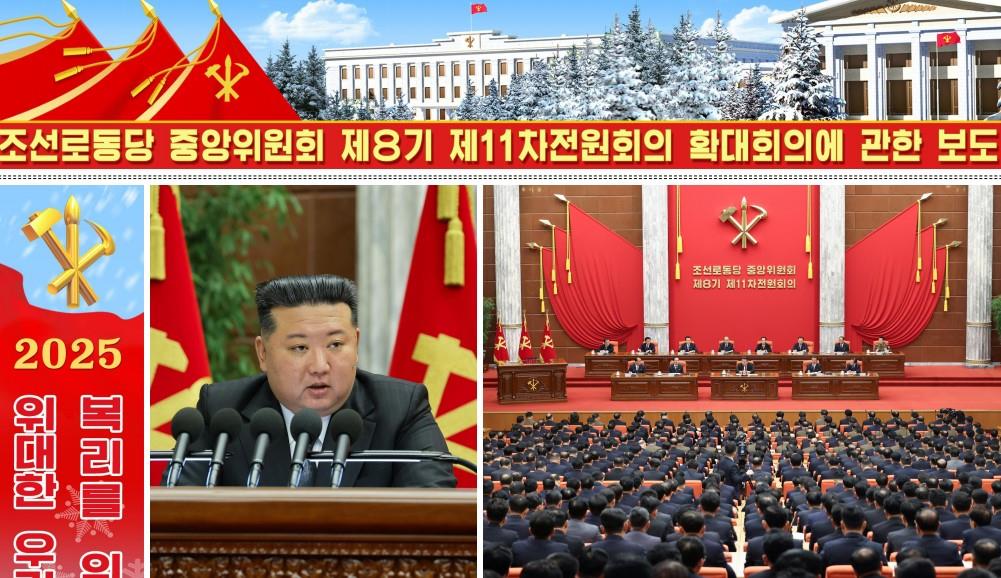
11th Plenary Session of the 8th North Korean Workers' Party held in Pyongyang on the 29th of last month
Controlling Public Dissatisfaction to Maintain Regime Unity and Leveraging Major Political Events
The WPK reaffirmed its “people-first politics,” prioritizing public welfare improvement alongside ideological education. This is likely a calculated move to suppress growing public discontent amid prolonged economic difficulties and to prevent societal unrest. Additionally, North Korea emphasized meticulous preparations for significant political events, including the WPK's 80th anniversary.
Of particular note is the upcoming election for the 15th Supreme People's Assembly. The term of the 14th Assembly ended in 2024 without elections being held, suggesting that votes and potential constitutional amendments could take place in early 2025. The 80th-anniversary celebrations of the WPK, designated as a critical milestone year, are expected to feature high-profile events, including invitations to international delegations and a grand military parade, to underscore the stability of Kim Jong-un’s regime.
Simultaneously, North Korea aims to finalize the achievements of the 8th Party Congress while ramping up preparations for the 9th Congress in 2026. Efforts will focus on presenting the successful execution of the “Five-Year Economic Development Plan” and the “Five-Year Plan for National Defense Science Development and Weapons Systems” as key accomplishments of Kim Jong-un's leadership.
Encouraging Ideological Armament and Emphasizing Modern Warfare Capabilities
Unlike in 2022, this plenary meeting did not detail specific defense development plans. Instead, it focused on broad directions for strengthening the ideological and technical readiness of the military. The emphasis on ideological armament may stem from concerns about potential backlash over North Korea's involvement in the Ukraine war.
Significant emphasis was placed on enhancing warfare capabilities to meet modern conflict demands. Kim Jong-un called for "deepening research on military tactics, modernizing operational command, and refining scientific training methods to counter evolving enemy strategies." He also urged comprehensive civil defense preparations to ensure readiness for unexpected conflicts. This approach appears aimed at preventing accidental clashes or war scenarios between the two Koreas while emphasizing emerging warfare methods, such as drone, cyber, and electronic warfare, as observed in recent conflicts in the Middle East and the Russia-Ukraine war.
2. Key Points to Observe in 2025
2025 could see rising military tensions on the Korean Peninsula, fueled by a new U.S. administration, North Korea's advancements in nuclear capabilities, and the fallout from its troop deployments to Russia.
Kim Jong-un’s unwavering commitment to enhancing nuclear capabilities has been evident since he came to power. Over the past 12 years, North Korea's nuclear sophistication has grown significantly. In a speech at the Hwasong-19 missile launch site on November 31 last year, Kim reiterated that the pursuit of nuclear force enhancement would continue under any circumstances. His regime’s nuclear provocations are expected to persist.
The first major development to monitor is North Korea’s 7th nuclear test. Following Kim’s September 13 visit to a highly enriched uranium (HEU) production facility, intelligence agencies in South Korea and the U.S. believe that the test is fully prepared, awaiting only Kim’s approval.
The second focus is the launch of a military reconnaissance satellite. Although North Korea successfully launched such a satellite in November 2023 and announced plans to launch three more in 2024, a failed attempt in May delayed further progress. North Korea is likely to attempt another launch in the first half of 2025, potentially aided by technical cooperation with Russia.
If the Russia-Ukraine war continues, North Korea’s troop deployments could lead to domestic challenges. The disclosure of these deployments may result in dissatisfaction among soldiers’ families, increased draft evasion, desertions, and a rise in defections. These factors could pose significant threats to the regime's stability.