

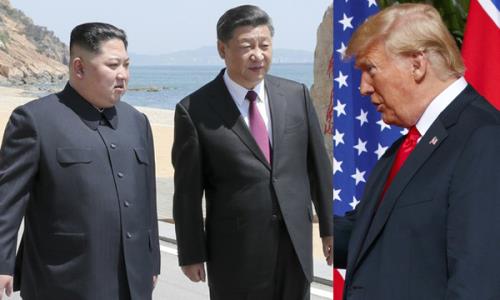
Why Trump's push for a U.S.-North Korea nuclear deal could accelerate deterioration in North Korea-China relations?

Kim Dongchan
Assistant Professor, Graduate School of International Studies, Yonsei University
China Revamped Its North Korea Policy due to the 2018 U.S.-North Korea Talks
North Korea-China relations have fluctuated with changing international dynamics. Although many view their ties as a “blood alliance”, the two nations had notable differences in their war objectives during the Korean War.
Notably, the normalization of ties between South Korea and China in 1992 dealt a severe diplomatic blow to North Korea, which it perceived as a betrayal. After the Cold War, China’s strategic interest in North Korea waned, with some even suggesting their relationship had become more like that of regular states.
North Korea’s nuclear development was not something China advocated. And Beijing sought a stable regional environment for economic growth and modernization. Therefore, North Korea’s continued military provocations put a strain on China.
Consequently, following the normalization of ties between South Korea and China, North Korea-China relations remained tense. Specifically, from Xi Jinping’s rise to power in 2012 until the May 2018 summit, the relationship was severely strained.
In 2018, when President Trump sought to address the North Korean nuclear issue through direct talks with Kim Jong-un, China was prompted to revise its policy toward North Korea. One of China’s key goals toward the Korean Peninsula is to maintain its influence on North Korea. And historically China sees the northern part of Korean Peninsula as a crucial area for its national security.
When the Trump-Kim summit was confirmed for June 2018 in Singapore, China focused on the potential for a breakthrough in U.S.-North Korea talks. It recognized that a successful negotiation on the nuclear issue could lead to improved U.S.-North Korea relations.
In the context of the ongoing U.S.-China strategic competition, improving relations between the U.S. and North Korea would not only negatively impact China’s influence over North Korea but also pose a significant strategic challenge to China.
In response, China swiftly invited Kim Jong-un, with President Xi Jinping personally offering the 'Three Unchanging Guarantees,' assuring that China’s strategic support for North Korea would remain firm despite international or regional changes. China also fully revised its North Korea policy to strengthen bilateral relations.
The Root Cause of Recent North Korea-China Tensions: Diverging Strategic Goals
Just five years after China significantly shifted its policy to improve relations with North Korea in 2018, tensions have resurfaced. Recent reports in both domestic and international media have highlighted signs of a growing rift between the two countries.
China recently removed the commemorative plaque from the 2018 Xi-Kim summit in Dalian. Reports also revealed that Chinese authorities seized North Korean contraband, and despite North Korea’s request to return the items for Kim Jong-un, China ignored it and auctioned them off.
Additionally, there was a news that China demanded the repatriation of all North Korean workers. Despite 2024 being the "Year of China-North Korea Friendship," exchanges between the two countries remained limited. Meanwhile, North Korea’s deepening ties with Russia, highlighted by stronger military cooperation and the signing of a strategic partnership treaty, fueled speculation about a rift between Beijing and Pyeongyang. Then, what are the root causes of the recent deterioration in North Korea-China relations?
Experts, both domestic and international, cite several possible reasons for the worsening ties between North Korea and China, including China’s dissatisfaction with the 2024 North Korea-Russia treaty and increased military cooperation, as well as China's limited economic support for North Korea.
These factors are certainly key contributors to the recent deterioration in North Korea-China relations. However, the root cause seems to lie in the significant mismatch between the strategic goals pursued by both countries.
China aims to prevent intensifying U.S.-China strategic competition from escalating into military confrontation, where it is at a disadvantage, or causing severe economic consequences, particularly by avoiding decoupling from the U.S.-led global economic system. Avoiding competition in areas where it perceives a disadvantage is a logical strategy for China to strengthen its position in the broader strategic rivalry.
In contrast, North Korea views a new Cold War structure in Northeast Asia—aligning with China and Russia against the U.S., South Korea, and Japan—as favorable. This is why it asserts that 'the world has entered a new Cold War' while pursuing a regional security dynamic that China seeks to avoid.
Moreover, North Korea is actively working to promote the formation of a new Cold War structure in Northeast Asia through military cooperation with Russia.
Trump's Second Term Nuclear Talks Likely to Worsen North Korea-China Relations
On his first day in office, President Trump called North Korea a "nuclear power" and highlighted his good relationship with Kim Jong-un. This has raised the possibility that, in his second term, he may push for another summit to address the nuclear issue.
On January 28, 2025, White House National Security Council spokesperson Brian Hugues stated, "President Trump will pursue the complete denuclearization of North Korea, just as he did during his first term.“
However, skepticism grew in the U.S. over the feasibility of complete denuclearization of North Korea. Meanwhile, in South Korea, concerns have emerged that the second Trump administration might pursue a 'small deal'—one that tacitly acknowledges North Korea’s nuclear arsenal while focusing on arms control or freezing its ICBM program.
President Trump's attempt to restart nuclear talks with North Korea could pose a dilemma for China’s North Korea policy and aggravate North Korea-China relations. If the talks succeed, China may once again worry about the negative consequences of closer U.S.-North Korea ties, as it did in 2018.
Conversely, if U.S.-North Korea nuclear talks fail, North Korea will likely double down its push for a fixed new Cold War structure and try to provoke military tensions between the U.S. and China, which China seeks to avoid. In either case, the significant gap between China’s and North Korea’s strategic goals will remain a key factor in exacerbating existing bilateral tensions.
-
PREV [Analysis of issues]
-
NEXT [Feature Article Series]