

Acknowledge but Not Authorize North Korea's Nuclear Weapon

Taewoo Kim
Head of Nuclear Security Study, Korea Inst. for Military Affairs (KIMA)
President Trump's comments on North Korea have been a hot topic in Seoul. “North Korea is a nuclear power,” he said right after his return to the White House, indicating his willingness to resume nuclear negotiations with Pyongyang. It was not surprising that some South Koreans reacted by asking, “Does he accept and authorize North Korea's possession of nuclear weapons?” However, if one looks at it calmly, it's not something to be upset about, but rather an opportunity for South Korea to realize the correct nuclear policy that it has been ignoring until now.
In general, a country must cross two thresholds, technical and political, to become an authorized nuclear-weapon state. The first threshold is crossed when a country develops and shows nuclear weapons, and the second one is crossed when it is treated as a normal state not subject to diplomatic or economic sanctions for having nuclear weapons. Five nuclear powers - the United States, Russia, the United Kingdom, France, and China - are authorized nuclear-weapon states under the Nuclear Non-Proliferation Treaty (NPT), while Israel, India, and Pakistan developed nukes outside the NPT but later gained de facto authorization by gaining U.S. acquiescence.
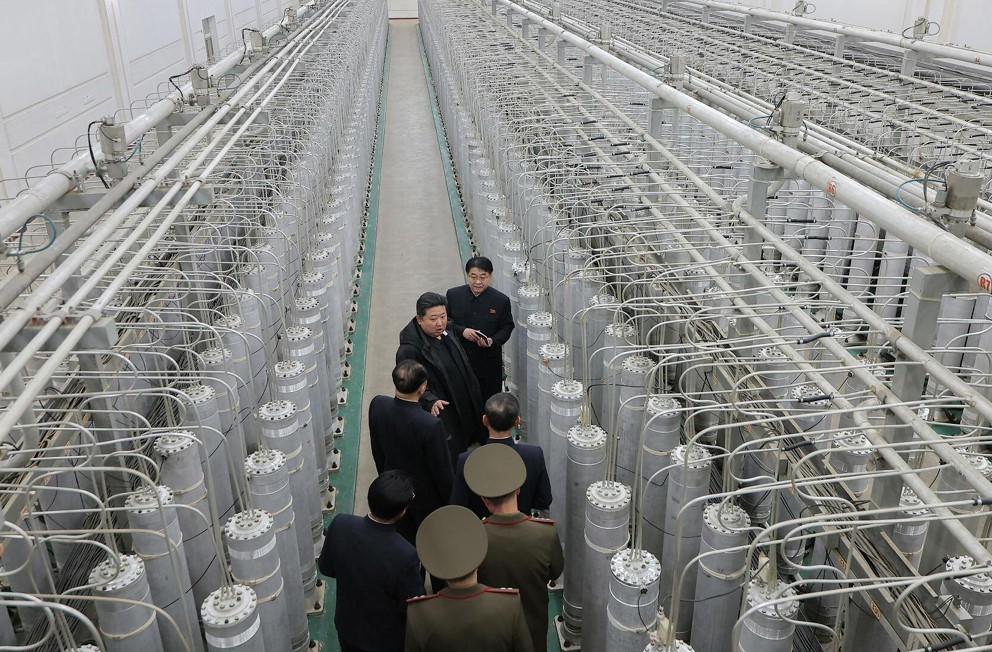
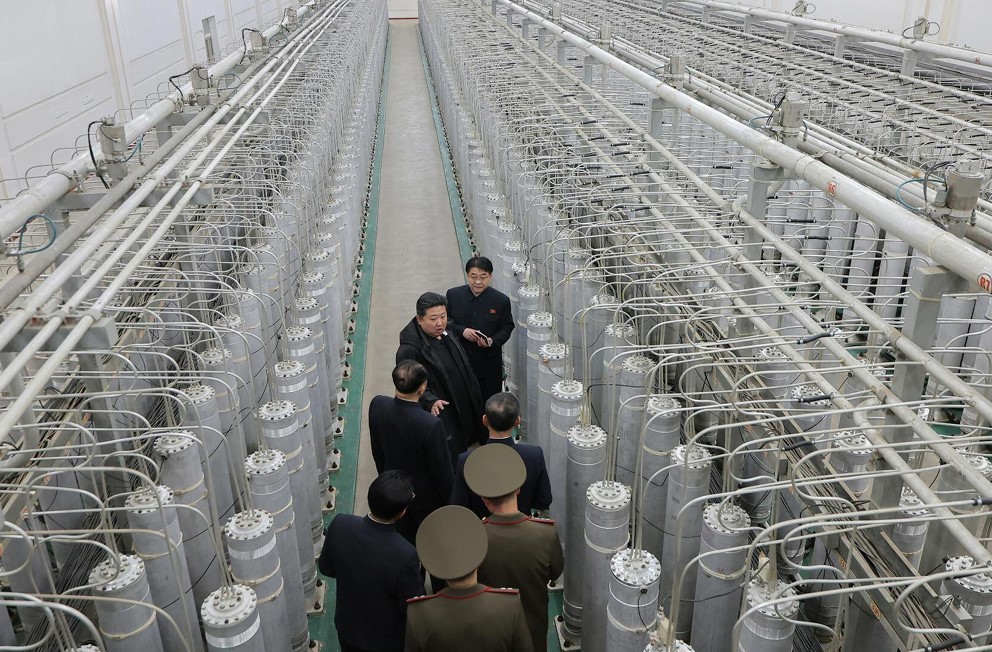
North Korea has not crossed the second threshold as it is subject to U.S. and international sanctions. As long as it remains a “rogue state” threatening the stability of the Korean Peninsula and the region, it will not be let cross the political threshold. President Trump's comments only acknowledged the existence of North Korea and signaled his intention to negotiate to reduce the nuclear threat, not authorize it, and as reaffirmed at the February 7 U.S.-Japan summit, the “complete denuclearization of North Korea” remains the ultimate goal for both the U.S. and South Korea.
Then, there is no reason for South Korea to view resumption of the U.S.-North Korea nuclear talks negatively. If the negotiations result in a reduction, freeze, or slowdown in North Korea's nuclear weapon program, it would be good for South Korean security. Even if the United States concentrates on reducing North Korea's long-range nuclear missiles like ICBMs, South Koreans need not complain that “the U.S. only cares about its own security.”
South Korea should consider that when the U.S. mainland is vulnerable to North Korean nuclear attack, it can shake up the ROK-U.S. alliance and undermine the credibility of extended deterrence. In other words, the more North Korea's ability to use nuclear weapons against the United States is constrained, the stronger the alliance is and the safer South Korea is. Given that North Korea is unlikely to dismantle all of its nuclear weapons anytime soon, South Korea's opposition to U.S.-North Korea nuclear dialogue on the grounds that “the complete denuclearization of North Korea in our only goal” would be not only pointless, but could be construed as complacency, meaning that South Korea is willing to live with the North Korean bombs on its doorstep.
South Korea's such complacency and lip service to “complete denuclearization of North Korea” is not the right way to achieve a nuclear weapon-free Korean Peninsula. Nuclear arms control negotiations can only be initiated in a log-rolling situation, where if one side falls into the water, the other side is bound to fall with it. Numerous nuclear arms control treaties, including the 1963 Test Ban Treaty (PTBT), the 1970 Nuclear Non-Proliferation Treaty (NPT), the 1972 Sea-Bed Treaty (SBACT), the 1991 U.S.-Soviet Strategic Nuclear Reduction Treaty (START) etc.
were concluded because both sides shared the burden of nuclear competition. It was for the same reason that Brazil and Argentina abandoned mutual nuclear weapon development competition through the establishment of the Agency for the Monitoring and Control of Nuclear Material (ABACC) in 1991. On the Korean Peninsula, however, South Korea has undressed itself and asked North Koreans to take off their clothes. This way did not and will not bring North Korea to a real nuclear negotiating table.
Therefore, if the U.S. and North Korea enter into nuclear negotiations, South Korea should use separate channels of dialogue with the U.S. to ensure that the U.S.-DPRK negotiations do not proceed in a way that undermines South Korean security, rather than jumping up and down and saying, “Are you bypassing us to authorize the North’s nukes?” In doing so, it should convince Washington States that pursuing an “inter-Korean nuclear parity” is a starting point for true denuclearization of the Korean Peninsula.
With this in mind, Washington should make it clear that Pyongyang be offered a carrot in return if it shows progress in reducing its nuclear threat while it will be punished accordingly if it insists on nuclear buildup. This means that to increase the likelihood of a successful negotiation the U.S. needs to offer both the carrot and the stick and that the stick includes possibility of redeployment of U.S. tactical nukes, ROK-U.S. nuclear sharing or nuclear alliance.