

North Korea’s Reckless Nuclear Tests Could Unleash a Catastrophic Chain Reaction
Hwang Si-wan,
a researcher at the Unification Vision Institute
On May 1, an earthquake struck Kilju County in North Hamgyong Province, North Korea—marking the second tremor in the area this year. Experts suspect that the region’s geological stability has been compromised by North Korea’s six underground nuclear tests conducted between 2006 and 2017.
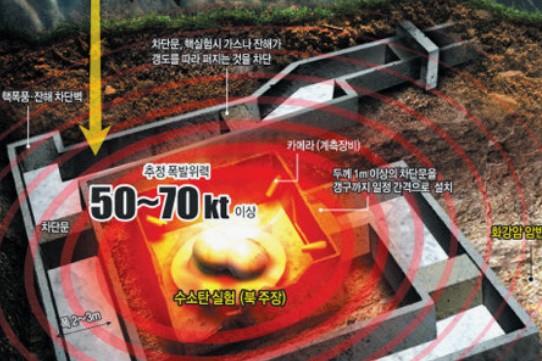
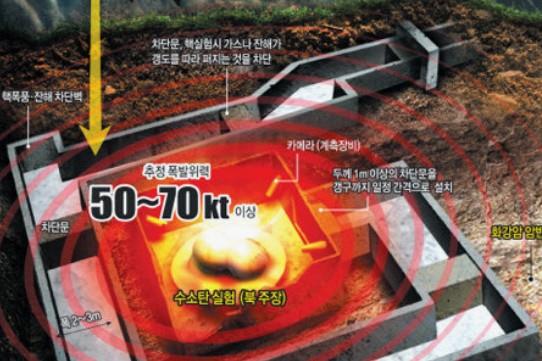
The sixth and most powerful of these tests, carried out on September 3, 2017, at the Punggye-ri Nuclear Test Site, triggered a man-made earthquake with a magnitude of 5.7. Just minutes later, the ground above the testing site collapsed, causing a magnitude 4.1 aftershock—an indication of the explosive force unleashed.
In the months following that test, seismic activity in Kilju spiked dramatically, with seven earthquakes recorded by the end of 2017. In 2023 alone, the number jumped to 33, pushing the cumulative total to 88 quakes. Notably, there had been no recorded earthquakes in the region prior to the sixth nuclear test. This pattern strongly suggests a link between North Korea’s nuclear activities and the area's rising seismic volatility—possibly signaling the early stages of a geological disaster.
Standing at 2,744 meters above sea level, Mount Paektu is the tallest peak on the Korean Peninsula and the site of one of history’s most violent volcanic eruptions—the Millennium Eruption of 946 AD. With a Volcanic Explosivity Index (VEI) of 7, it was a blast estimated to be 160,000 times more powerful than the Hiroshima atomic bomb. For context, the eruptions that destroyed Pompeii and shook Mount St. Helens were both rated at VEI 5, highlighting just how cataclysmic Paektu’s eruption was.
Since that event, Mount Paektu has erupted more than ten times. Despite the century-long dormancy since its last known eruption in 1925 (as claimed by North Korea), it remains classified as an active volcano.
Mount Paektu is back in focus due to seismic monitoring between 2002 and 2005, during which more than 3,000 microearthquakes were recorded in the surrounding area. Chinese geologists interpreted this seismic activity not as natural tremors, but as signs of magma movement and pressure building deep underground.
Further cause for concern came in 2016, when a joint research team from the UK, US, and North Korea published findings in Science under the title “Evidence for partial melt in the crust beneath Mt. Paektu.” Their study confirmed the presence of molten rock at depths of 5 to 20 kilometers beneath the volcano—evidence that Paektu may be quietly reawakening.
Despite these warnings, North Korea built its nuclear test site at Mount Mantap, a 2,200-meter peak in Punggye-ri, just under 100 kilometers from Mount Paektu. The site was chosen for its mountainous terrain, which makes foreign surveillance difficult, and its granite bedrock, assumed to be strong enough to contain nuclear blasts.
But experts now caution that the artificial quakes caused by such testing could disturb underground magma systems—raising the terrifying possibility of a volcanic eruption akin to what once destroyed Pompeii.
The consequences of nuclear testing extend beyond the geological. Before the tests, Kilju County was known for prized local delicacies like pine mushrooms and cherry salmon, once classified as luxury “No. 8 products” reserved for the elite.
But after the tests began, these species vanished, and alarming health issues surfaced. Locals reported mysterious illnesses, birth defects, and spikes in cancer rates. Chang In-soon, former head of the Korea Atomic Energy Research Institute, noted that while melted granite may trap radiation, leaks can still occur due to fractures, ground subsidence, or collapsed cavities—especially given North Korea’s limited technical capabilities.
The North Korean government has not publicly addressed the potential radiation leaks. Even residents in the affected areas are kept in the dark. Many suffer and die from what they call “ghost disease,” unaware that radiation may be the cause.
In an interview, a woman identified as “Kim Young-sook” from Kilju County revealed that locals rely on water from streams flowing down from Punggye-ri, about 30 kilometers away. Despite this distance, residents have fallen ill from what are likely radiation-related diseases. She herself didn’t realize the cause of her illness until reaching South Korea.
To suppress awareness of radiation-related health damage, the regime has imposed tight restrictions on the movement of people in and around Kilju and Punggye-ri. Tragically, Kim Young-sook’s son also succumbed to a radiation-induced illness.
In May 2018, North Korea announced it had closed the Punggye-ri test site by demolishing entrances to Tunnels 2, 3, and 4. But satellite imagery and reports from 2022 and 2023 suggest otherwise. A new access point was created at Tunnel 3, leachate was spotted seeping from within, and electrical and communication cables were seen near the entrance—evidence that preparations for another test may be underway.
North Korea’s defiant nuclear experiments pose not only a grave threat to the region’s geological safety but also endanger its own citizens. With the risk of disaster mounting, the international community must take a more proactive and urgent stance to address this looming crisis.